Archive for the ‘Metal’ Category

Home Made Welding Machine

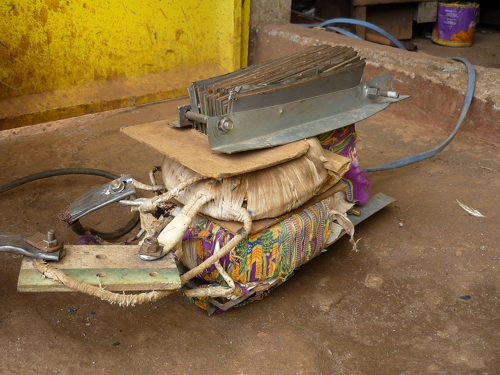
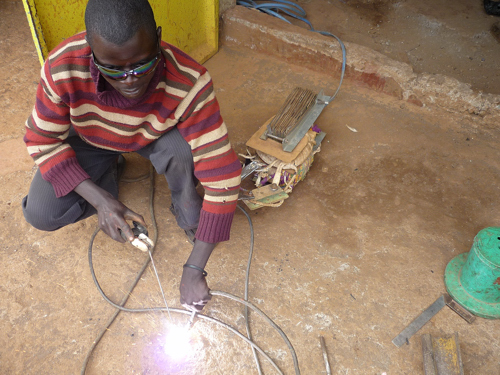
Being on the ground in Nairobi makes it a little easier to find good AfriGadget stories. I took a walk down Ngong road, an area with a lot of shadetree mechanics, wood carvers and metal fabricators. The first place I stopped at had a home made welding machine.

Simon, the shop owner, showed me a couple of the machines and gave a video tour of how it works. He’s a prime example how an entrepreneur in Africa will figure out ingenious solutions to meet local market demands. The welders sell for around 14,000 Kenya Shillings (just over $200), but fabrication costs only a small fraction of that.

Below is the video and some pictures. (Another video will be uploaded later, connection speed issues preclude me uploading another one right now).


DIY Welder

Home Made Welding Machine in Nairobi, Kenya

Home Made Welding Machine - Parts

Send in your stories of African ingenuity here.

Multimachine — truck-parts-based machine shop for Africa

The MultiMachine Group at Yahoo! Groups carries plans for “The Multi-Machine” which is

an accurate all-purpose machine tool that can be built by a semi-skilled mechanic with just common hand tools.

Open Source Multi-Machine

Multi-machines are 3 in 1 machines based on old car engine blocks (a 3-in-1 machine is usually a combination of a metal lathe, mill and drill press). The machines are designed such that they use the tolerances and engineering initially used to create the engine block that is re-purposed as the core of the tool to help guarantee that various components of the machine integrate with a high level of precision.

The machines have a design that not only allows them to be assembled using “elbow grease” but that also allow them to run on alternative power sources where mains electricity is not available. They are also easily adaptable to new purposes by adding on modules.

Plans to build a multi-machine can be found at this link at the The Open Source Machine website.

(via BoingBoing)

The foldaway house.

Rajan Harinarain, a South African entrepreneur and inventor has come up with a temporary foldaway house for use in emergency situations complete with electrical wiring and fittings, doors and windows that can be erected by a small team in 5 minutes.

The patented structure weighs less than a ton, collapses to under a foot in height and can be modified with insulation/ventilation for hotter or cooler environments.

Foldaway House

Links to the complete story at:

- South Africa Info
- IOL
- South African Engineering News

Ghanian mechanics bring cars back from the dead

The BBC Website carries a story about a Ghanaian mechanic called Frank Darko who claims that he can make any car from wrecks and scrap.

From the article:

Mr Darko is a “straighter” - so-called because he can straighten crooked vehicles.

He is one of an estimated 80,000 mechanics, engineers and artisans who work in Suame Magazine, an industrial slum, possibly one of Africa’s biggest.

Frank Darko specialises in straightening wrecked vehicles. On the outskirts of the Ghana’s second city, Kumasi, the Magazine’s origins lie in the city’s long history of working gold and other metals.

Over time, more and more of these artisans turned their hands to vehicle repairs and engineering, eventually moving to Kumasi’s Suame suburb after World War II.

In a continent and a country where buying new can stretch already overburdened pockets, the Magazine’s artisans show how far you can get with ingenuity, skill and a few mechanical tools.

Ethiopian Ingenuity: Turning Mortar Shells Into Coffee Makers

There’s an interesting story on the BBC about an Ethiopian gentleman who is taking war’s leftovers and converting them into coffee machines.

He uses old mortar shells, which stand about one metre high, to make his coffee machines.

He cuts off the pointed ends, seals them and puts holes into the aluminium cylinder. The cylinder channels the water, coffee and milk.

Read the rest of the story

Making Coffee Machines from Old Mortar Shells

(hat tip Elizabeth)

Kenya Ceramic Jiko

The larger part of Africa’s population do not have access to “processed” fuels like natural gas or modern cooking equipment. This means they are primarily dependent on open wood fires, a method of cooking that it extremely inefficient and harzardous to the environment.

The Kenya Ceramic Jiko (”jiko” is the Swahili word for cooker) solves two problems simulataneouly by addressing the issue of high cost of raw material for making the cooking equipment as well as reducing the amount of biomass required to cook by using available energy more efficiently.

Kenya Ceramic Jiko

Kenya Ceramic Jiko

This ingenious application of appropriate technology is composed of a fired ceramic heat containing liner fitted inside a metal housing. This housing is typically made from metal sheeting from discarded packaging - such as the ubiquitous 55 gallon steel drum - that would otherwise have ended up as hazardous waste in the environment. The liner essentially acts as an insulator when burning wood or charcoal containing the heat generated to ensure that it goes to cooking rather than escaping into the environment. This means that the ceramic cooker typically uses between 25 to 40% less fuel than a regular jiko.

Kenya Ceramic Jiko

You can find more information about this ingenious invention at the following links:

- Daniel Kammen’s Cook stoves for the developing world.
- Equator Initiative’s A burning concern.

Hugh Allen has also published a handbook of making Kenya Ceramic Jikos through the Stylus publishing house.

Kenya Ceramic Jiko in use

Making Tools from Scratch

Tools for specific needs can be expensive or hard to come by in some places in Africa. It could be something as simple as a certain sized wrench that is needed to remove a particular bolt.

I decided to take a short walk in Nairobi and just see what caught my eye. Bernard runs a small engine repair shop on the outskirts of Nairobi, Kenya. Mostly, he fixes lawn mower engines for the wealthy people living nearby, however he also fixes about any other small engine that you can think of.

The tools shown below are just what he works with. Many times he has to fabricate pieces that would be impossible to buy, or to expensive for him to make a profit on. It is really amazing to see him work, and to watch the problem-solving take place. As Bernard shows us in this video and pictures, your imagination and ingenuity are the only things holding you back.

Tools Made from Spare Parts

Below, a piece of rebar is bent, and the end hollowed-out to make a specific sized wrench:

rebar wrench Rebar Wrench 2

Below, a bolt from a truck tire is welded to a piece of metal to make a specific sized Allen wrench for small engines:

Truck Bolt = Wrench

A video explaining how Bernard created the tool.

How-to Refurbish a Computer with Basic Tools

Kikuyumoja shows us how he fixed an old Dell Latitude using a simple cookie tin.  True ingenuity, with an African flavor.  (He first tried with a Tusker bottlecap, but it proved to small)

Jua Kali Computer Fixes

Fixing a Laptop like a Jua Kali

Check out KikuyuMoja’s realm for the full story.