Archive for the ‘Recycle & Reuse’ Category

Jua kali dressed in Mitumba

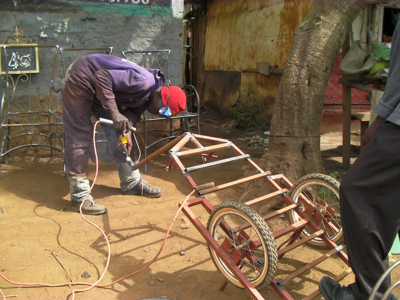
Cat walk ready arc welder

Catwalk ready arc welder

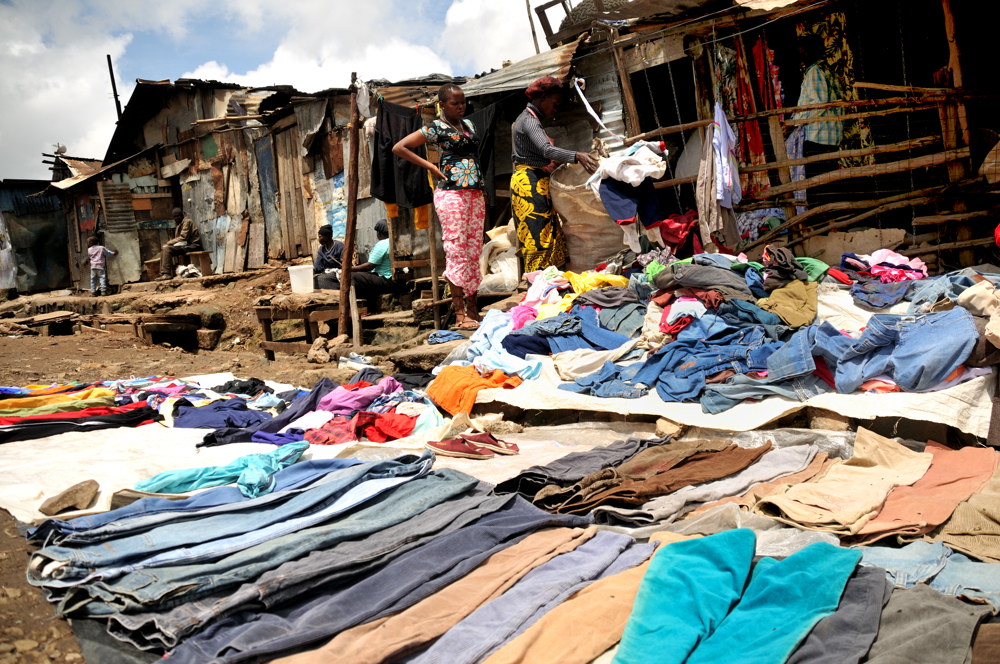
This bizarre fabricated arc welding machine is the unique collaboration between jua kali and mitumba. Jua kali literally means hot sun in Kiswahili, and refers to the informal small traders who work outdoors in the sun fabricating mostly work metal and wood items, fixing cars and other household items. Unable to afford new tools they fabricate their own out of locally available materials. Mitumba refers to the second hand western clothing sold on the streets of many African cities. The arc welder uses stolen scrap and second hand wires that are coated for insulation using strips of cloth torn from unsellable mitumba clothes.  This is then wound into the welding machine coils.

God help James if it rains

God help James if it rains!

I’d gone to Limuru to get a welder for a job on a dairy where I met James Mutahi. He is a typical jua kali wrought iron artisan who operates on the sidewalk outside his street workshop using his own home made tools.  I’ve seen jua kali home made arc welding machines before but usually they are housed in a protective box. To save money James dispensed with the casing revealing the guts of his arc welder.

James was making security grill for a window. There’s a huge demand for arc welding in Limuru especially for gates and window bars which are essential in the high risk security zones of Nairobi and other urban centers.  Nairobi’s security is the result of the collaboration between mitumba and jua kali!

The picture speaks volumes about the Jua-Kali sector in Kenya– cost saving is paramount whilst safety is overlooked hence no housing box – look for welding goggles, fire extinguisher and other safety gear.

(This submission is from Dominic Wanjihia)

Tractor tyres and bush buckets in Masailand

I have just spent a week in the field studying Masailand ecology and community conservation with Princeton University students. The location is not that remote (Kitengela and Olerai within 40 km of Nairobi) and the community are wonderfully resourceful when it comes to day to day tools for pastoralism.

Masai salt lick made from tyres in Kenya

Tractor tyre trough for water for goats and sheep

This old tractor or truck tyre was somehow cut, opened up and sealed at either end to make a perfectly good livestock watering trough. Even Joy Adamson noted that the Masai question using modern appliances if home made ones do the job anyway.

salt lick2small

Tractor tyre cattle salt lick

Another way to make  a salt lick, Evelyn just cut a truck tyre in half and placed it  on the ground supported by stumps.

traditional bucket small

home made bucket works perfectly

Why buy a bucket when you can just make one with an old water container and a piece of metal?

manure spadesmall

Home made shovel

And if you don’t have a shovel for your manure, just straighten out some corrugated iron, cut it and nail to a stick  and Presto – probably more effective than anything you could  buy in Nairobi. Manure is one of the few products sold to passing trucks on these remote ranches.

beads small

Keeping land open for wildlife migrations in and out of Nairobi National Park can be costly to those living with wildlife. Those in The Wildilfe Foundations land lease scheme earn 4$ per  acre per year to keep the properties open (no fences)  and to supplement their income they make beautiful beaded artworks for sale on Olerai Conservancy.

Maasai ladies making beaded works of art Kenya

It might look like a tough life for some of us, but the Masai out here seem perfectly satisfied and at peace

Modified farm implements in Kenya

In Baringo one farmer has come up with two rather interesting innovations.

Murray Roberts is in the business of planting restoring grasslands which involves planting grass seeds in severely degraded landscapes.

The primary purpose of ploughing is to turn over the upper layer of the soil, bringing fresh nutrients to the surface, while burying weeds and the remains of previous crops, allowing them to break down. It also aerates the soil, and allows it to hold moisture better.

A traditional plough comprises a series of blades all facing the same direction.

Murray Roberts Modified Plough

Murray Roberts has modified his plough so that it has two blades facing each other. These create a hill and furrow effect which is perfect for grass seeding to improve the trapping rainwater in this semi arid part of Kenya. Normally the rainwater hits the surface and sheets off the ground carrying away the valuable top soil and seeds!

But that’s not all. Ever tried to make a fence using barbed wire – you know how tangled it can get? Well not if you use one of Murray Roberts fencing gizmo, it’s basically a tool onto which you thread the barbed wire so that when you go out into the field to fence a plot, you can release the wire in an untangled manner and under tension.  Simple and obvious and you don’t need a wire tightening tool.

barbed wire fencing gadget

That’s William Kimosop and Princeton University Undergraduates checking it out – don’t ask  me what that dog is up to!

Rim Stoves: Cooking MamaPut Goodness

I love street food. Everywhere I go, from street markets in Russia, to back alleys of Beijing to side streets in Skopje, to the boulevards of Bamako, I make it a point to eat as many meals from roadside stands as possible. Ghana and Nigeria are no exception. In fact, I love me a MamaPut.

Its only where Mama herself is there to put more of her good eats on your plate, that I really feel I’m getting a good meal. Why? Because I can see ever step of its preparation, talk with the chief personally, and share the transcending bond of food with my fellow man and woman.

Now I wouldn’t call myself a street food expert – I’m not discerning enough for that title, but I am observant in the different styles of edibles vendors. In West Africa, I’m particularly impressed by the stock street food cooking apparatus. Simple, cheap, and recycled, I present to you the “Rim Stove”.

.rim stove in action rim stove charcoal.

Using the steel rim off a car wheel as the basic starting point, three metal legs are wielded to the outside of the rim. Inside, a metal grate is added to the bottom to hold in the coals, and some form of pan or kettle stand is wielded to the top.

I’ve seen several variations on this theme, but the basics are always the same – the Rim Stove burns charcoal that’s been ignited in the middle of the rim, fed by air from the bottom and heating a cooking container sitting either on the pot stand or the coals themselves.

During on extending brainstorming session, I even tried to think of improvements to the Rim Stove – how it might burn hotter with less customization. My only solution? Make sure a Rim Stove is cooking chips for your fresh grilled fish.

Recycling: From diving wetsuit to laptop bag

When Dipesh Pabari of Camps International sent me pictures of these laptop bags and bottle can holders, I just knew it would be something you AfriGadget fans would appreciate.

Recycling wetsuits

The fact that discarded waste is converted to something very useful… Its definitely AfriGadget. I asked Sander Den Haring a few questions about these cool products.

Recycling wetsuits

How did you begin your company?

I was born in a small town called Hellevoetsluis in the Netherlands but only lived there till i was 5. At that point my family moved to Yanbu, Saudi Arabia where i grew up and ended up spending 16 years. Yanbu is an industrial town situated on the Red Sea and i believe that a lot of the what, who, why and where i am is as a result of this. From the very beginning of our time in Yanbu my parents began a weekly outing to the beach which my brother and i eagerly anticipated every Friday (weekend is Thursday and Friday in Saudi Arabia). Once at the beach we would go out and snorkel virgin reefs in the Red Sea and be stunned by the serenity and tranquility each and every time. My love for the aquatic realm and the conservation of said realm has derived from these expeditions. It led me to complete a Masters in Marine Biology from the University of Groningen in the Netherlands in 2000 so that i could work in the field of marine conservation.

In 2004 i moved to Kenya where i have lived ever since. I began work for Buccaneer Diving as a base manager and soon added on the role of resident marine biologist. Under this capacity i was able to instigate a snorkeling program for some of the underprivileged local government schools in Mombasa (Schools to the Sea program) and an artificial reef program in the Mombasa Marine Park. Both these projects had local partners involved as well. I eventually finished full time work with Buccaneer Diving in June 2009 as the Operations Manager of Buccaneer Diving Kenya and currently fulfill only a part-time quality control position within all of Buccaneer Diving (Kenya and Zanzibar).

I really enjoy thinking of ways to create environmental attitudes and the recycled wetsuit product line has been great in achieving this thus far! We are still coming up with new products and refining the existing products. There are no limits barring our creativity.

What was the inspiration for re-using the diving wetsuits?

In the dive industry wetsuits have a finite lifetime after which they become ineffective (have lost their insulating capability), or they become too hole-ridden to use in a professional business. In the past, these wetsuits were discarded. This seemed an obvious waste of material (as for the sake of a few holes, large patches of usable neoprene were being thrown out), so Buccaneer Diving began looking at what could these patches of neoprene be used for. Traditionally we have used smaller bits of neoprene for various “odd jobs” (eg. snorkel holders, buffering/padding material, informal packaging, patch material for other wetsuits), but these “odd jobs” required small amounts that did not need frequent replacement. So we started thinking if there was anything else that could be made and the obvious item was laptop bags. The bottle/can holders soon followed suit as the sleeves and legs of wetsuits already had the obvious shape (they just needed a bottom added). We are currently making the products more of an “item” and also looking into how we can incorporate the production of these products to benefit other charities. these exciting developments will be happening within the next few weeks we hope so definitely watch this space (it’ll be worth it!).

When did you start selling the bags/bottle covers etc?

This is a new venture and its been active for the last seven months, so still very young. We are looking at various other items we can make from the recycled neoprene (placemats and coasters might be possibilities).

How much do the items cost?

Currently the laptop bags sell for Ksh 2500 (about 32 usd) and the bottle/can holders ksh 350 (about 5 usd)

Are they made in Kenya/Mombasa?

They are indeed produced in Mombasa. Again, the story behind the production will unfold in the next few weeks and its worth the wait.

Where can people order? Can they pay by MPESA (Mobile Money)? (Just kidding, but hey!)

These products can be purchased at the Buccaneer Diving base at the Voyager Beach resort, Mombasa. We have not yet explored the use of MPESA in the purchase of these products as they are still young, but who knows what the future will bring. We can also arrange for products to be sent via courier if people are unable to visit the Buccaneer Diving base. Sander can be reached via email sander at green-water [dot] org.

Recycling car batteries in Rural Kenya

Maina, Rhoda and little Winnie are  a typical Kenyan family who live on the outskirts of Nairobi in an area that has no electricity.

But they have solved the problem of getting the daily news

rhoda family2

When I visited their home I was impressed that despite the lack of electricity, Maina has come up with an innovative solution and is able to keep up with whats going on and listen to his favourite Kikuyu music all day long!

taking it down

Here’s a better look at the system – a second hand car battery hooked up directly to his radio

Radio charger

The wiring is simple

maina showing

Fully charged the battery last 2 weeks. To recharge Maina has to take it to a place in town for 24 hours at a cost of Ksh 50 (about 80 cents US. If he were to  use ordinary batteries Maina would be paying several hundreds of shillings per month (15$) and creating toxic waste with their disposal (Kenya has no battery disposal system).  No wonder used batteries are in such huge demand!

bicycle ride2

And no wonder this family is smiling!

I’m wondering how much it would cost to hook up Mainas battery to a solar panel and  some lights. They currently depend on hurricane lamps.  Powered with kerosene these are not only a weak source of light but are dangerous and prone to cause fires.

rhoda lamp

Got any ideas anyone – can we charge a car battery from solar?

Post note:  This story was found while making a video slideshow about this average Kenyan families carbon footprint for WildlifeDirect.

Coconut + Zippers = Handbags

My daughter and I had a lot of fun on Lamu island, off the coast of Kenya, earlier this year. One of the items we came across was this coconut handbag. Some had designs, some were raw, all were incredibly cool.

Coconut + Zippers = Handbags

If I remember correctly, I bargained poorly and bought it for 150/= ($2). The problem was that the merchant new how badly my daughter wanted it so he knew I was stuck. :) This is the one we ended up buying:

Coconut + Zippers = Handbags

Yes, these are mainly for tourists. However, it’s a good showcase of local reuse of what would otherwise be garbage for microentrepreneurial gain.

Solution for Nairobi Blackouts

It’s no secret that Kenya’s rivers are running dry as a result of forest destruction and environmental degradation which has led to a season of blackouts in the capital city Nairobi.

Typical of the ingenious people of Nairobi one street vendor has cashed in on the crisis with this wonderful gadget which he markets as

“Perfect for Nairobi black out”

juakali lamp1

As you can see I could actually read by the light of this lamp which is made from a used tin can, some pieces of wire to make the connections

juakali lamp3

And the battery compartment is ingeniously crafted from a circle cut from a retired flip flop.

juakali lamp2

I love my juakali lamp and everyone that I know  in Nairobi needs one of these lamps. Everything about it is so true to the juakali spirit – hand crafted using colourful recycled tins, and designed for a real purpose with a handle so you can move it around from room to room or hang it up. The vendor tried to sell it to me for Ksh 350 but we settled on Ksh 200 (about $2.50) though I’m sure he would have gone cheaper but the traffic was moving and I had to go.

If you want one visit the Nyayo stadium roundabout.  They stood out amongst the chinese junk that vendors are selling you could practically kit out your house from the junk on sale there. Here’s a short list of what I saw during my 30 minute traffic hold up:

Pens, hats, footballs, blow up spiderman (who needs one of these?), peanuts wrapped in newspaper cones,

smelly car things, driveres licence holding cases, scarves, giant maps, Kenya flags, apples, kits (spiderman kites),

Nike shorts, cowboy hats, socks, oanges, backpacks, cheap watches, key chains knives, olympic medals (yes I wanted one of those!),

knee length shorts for guys who sag, hazard ttriangles, cables to cack your car, name tags for meetings, torches, window wipers (!),

car mats, pears, plumbs, tiny folding chairs for children (or Chinese people?), vehicle number plates, fire extinguishers, stickers,

Enormous framed pictures of furry cats and snow leopards (I can just see one of these this in my house), bananas and bandanas, plastic lunch boxes, pillows and cussions, a huge variety of stuffed toys,

posters with Jesus’ sayings, polo shirts, stearing wheel covers, spanners, screw drivers and of course my favourite – juakali lamps.

Nairobi never fails to impress. I love it. What else have you seen on sale in the Nairobi streets?

RoboCon Kenya 2009 Nairobi Regional

First Peaks

The Ministry of Higher Education and Technology has organized a Robot Contest (RoboCon), between Kenyan Universities and middle level colleges. The regional competition is taking place today at the Kenya Polytechnic. Here are the first looks at the Robots from institutions taking part in the competition.

University of Nairobi Robot

University of Nairobi Robot

Nairobi Technical Training Institute Robot

Kiambu Institute of Science and Technology Robot

Nairobi Technical Training Institute Robot

Nairobi Technical Trainin Institute Robot

Kenya Technical Training Institute, The Winner

Kenya Technical Training Institute Robot, The Winner

Machakos Institute of Technology (MIT) Robot

Machakos Institute of Technology (MIT) Robot

Some video will come soon…

For more information on RoboCon click here.

Re-using plastic containers in Kenya

While hiking in the rift valley recently I came across a cow wearing this plastic gadget on his nose. It’s made from an old plastic container …..the local herdsmen said it was to stop him from suckling his mother – which is especially critical due to the severe drought in the region.

cow gadget

Simple and effective I’d say!

And here’s another one from Dominic Wanjihia – he calls it his vertical shamba

doms hanging veg garden

and it’s water efficient and space conserving… perfect for a tiny yard.

Here’s another clever use of plastic water bottles – bird feeders are impossible to find in Kenya

bird feeder

So Maina Maina fabricated this at Kitengela Glass where virtually nothing is thrown away

maina maina

These feeders have pieces of mirrors attached and attract a huge assortment of birds at all times.  He’s selling them at Ksh 200 (US $2.50 )