
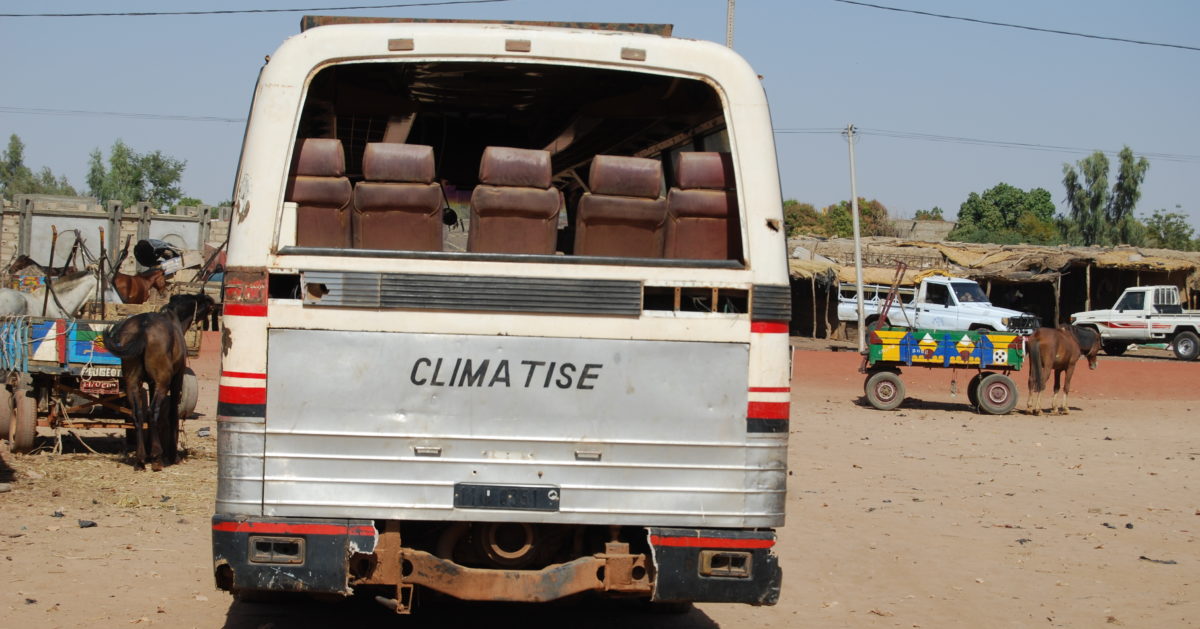
You’d think that given the amount of cow dung available around rural Africa that biogas would be a big hit right? Well, its actually relatively unknown. The main reason is materials, coast and complicated technology. People in these areas use charcoal or wood for their domestic cooking needs – its not only dirty hard work to collect firewood, but it’s unhealthy and damages the environment. But, it’s free …
We believe that biogas from cow dung holds huge promise for rural and urban areas as a cheap source of energy that can be turned into domestic use or even business anywhere in rural Kenya….eg. pasturizing milk, making yoghurt, running fridges, generators, hammer mills for grinding corn, cooking, baking, heating water, running machines… and reducing your carbon footprint.
I have recently become the latest guinea pig for Dominic Wanjihias experiments … and it has been quite a learning experience
Problem No. 1.The system needs to be cheap and mobile for communities who don’t own land or who move regularly (pastoralists)
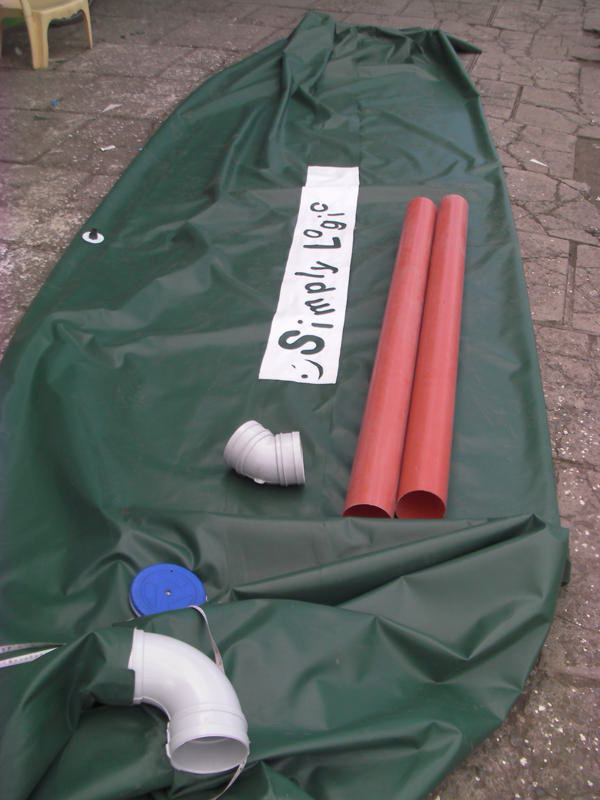
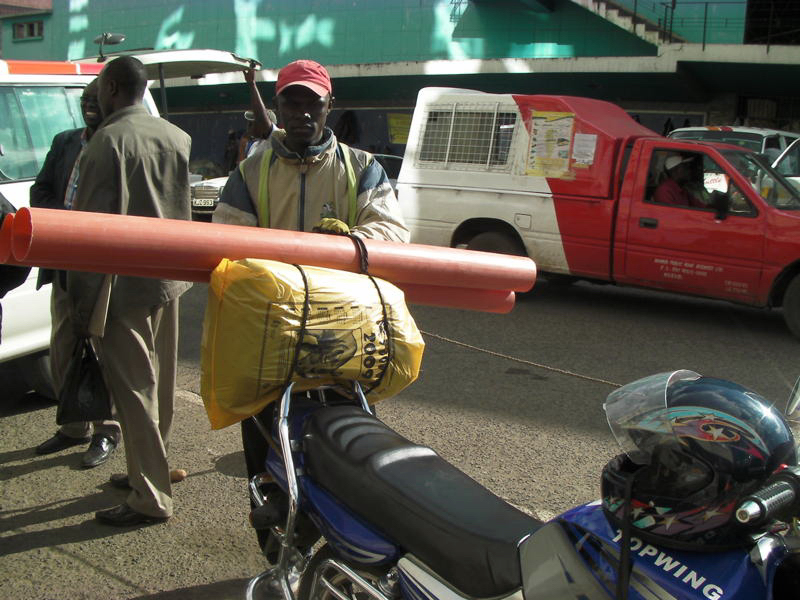


After only 2 weeks it will have ballooned like this

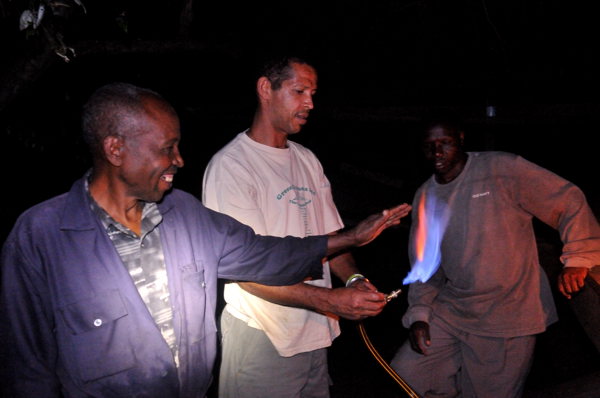
Problem No. 2. The pressure is not enough to light a stove. Nothing ever works as you initially planned that’s why having a fundi like Dominic around to modify, adapt and rethink as you go along helps so much.
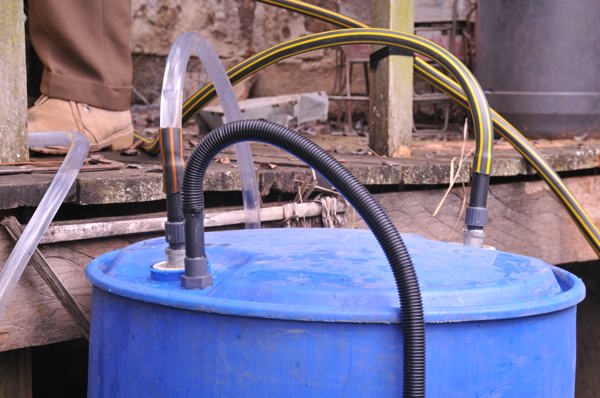
To create pressure Dominic got two tanks, and did some juakali pipe connections. One tank was placed above the other. The lower tank was filled with water. Long pipes and short pipes were put through the lids and specially made holes in the tanks … It’s all about applying simple physics really…
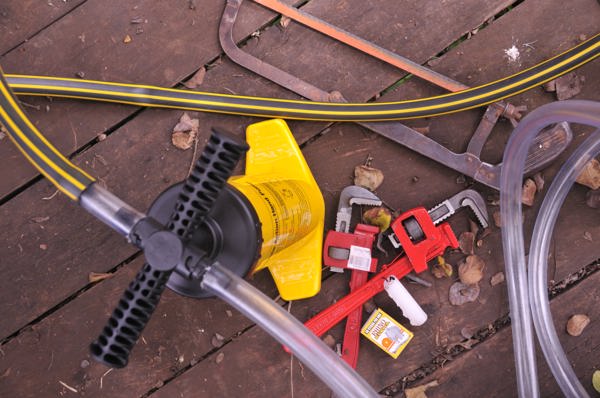
Then using a pump ..(we’ll be using a modified bicycle pump next time) he was able to move the gas from the flexi bag to the lower tank and displace water to the upper tank. This water creates enough back pressure to get the stove to light.. that’s the theory … here is what happened.
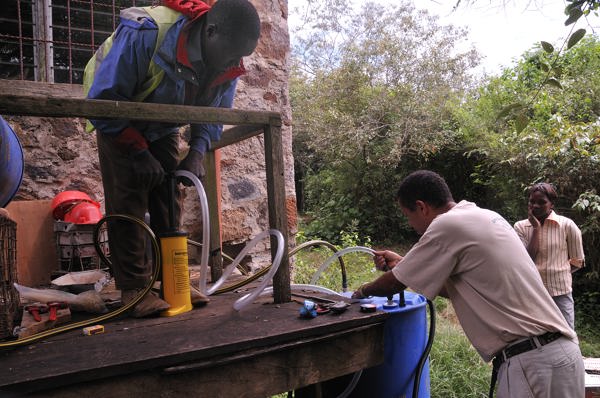
A curious boda boda rider (motorbike taxi) called Victor volunteered to help… Rhoda watched in awe
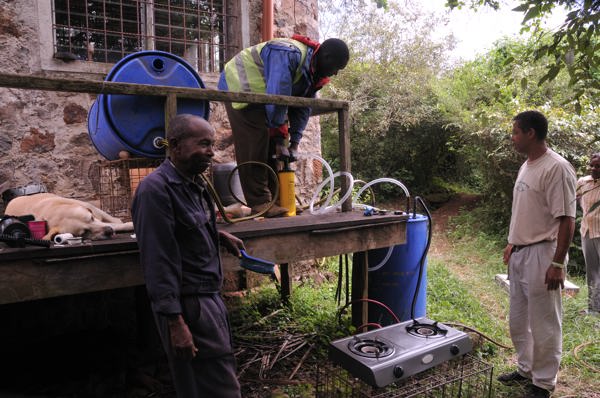
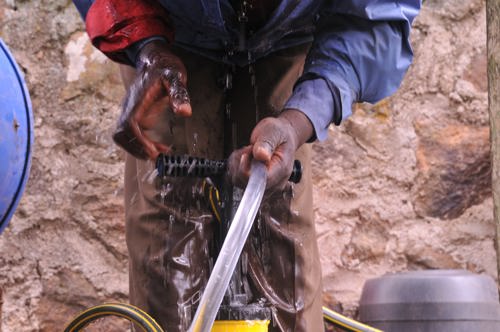
“Houston we have a problem” …Ok, accidents are bound to happen…pressure pushed the pipe off and Victor got soaked..just water though. The top tank fills with water as you pump biogas into the bottom tank, and the water drains back to the bottom tank as the gas is used
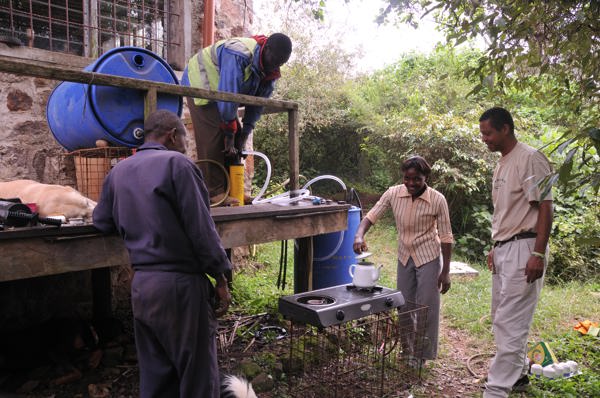
Course all this hard work was not for nothing – we had to make a cup of tea –
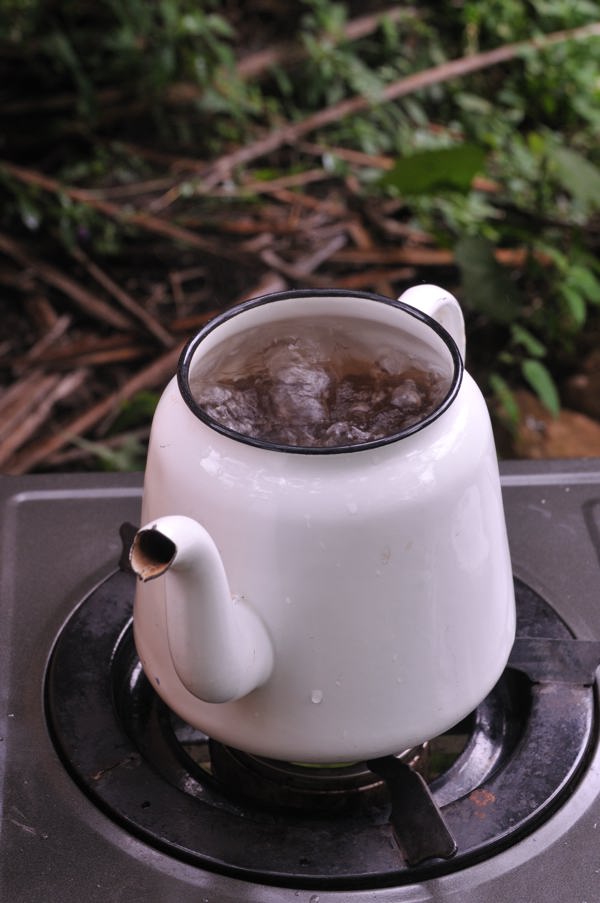
It took 15 minutes for the water to boil!
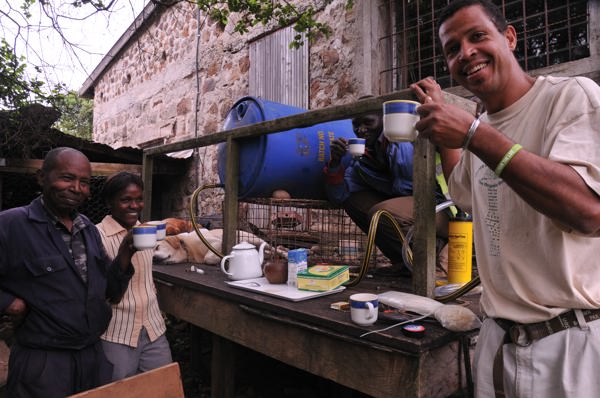
Yes we are very very proud that the system worked so Cheers! a well deserved cup of tea.
We estimate that it took about 1/4 to 1/2 of the gas in one blue tank to boil the kettle – that’s about 1/8th of a cubic meter – and the entire flexi bag contains about 5 cubic meters… which means we have about 10 hours of gas use…..and the stuff is being produced all the time (we had quite some wastage as we fooled around to get the system to work)
Well it all seemed to be going just fine when …pssssssttttt
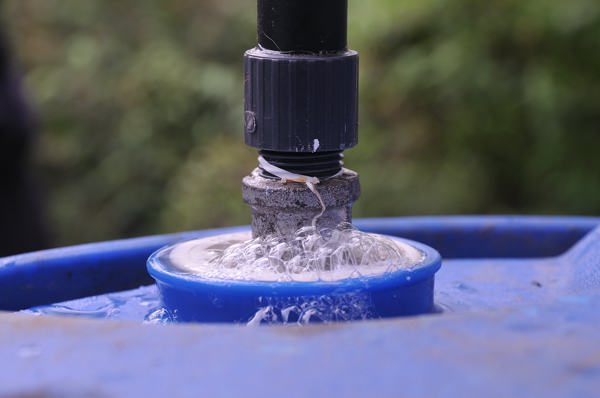
Nothing serious but we were losing a bit of gas through one of the lids (holes had been drilled through the lids to insert pipes) …we need to fix that before we build up any pressure in that tank.
If you are interested in biogas let us know! Leave a comment.
Excellent guys!! Good Work!
Now, just try feeding the thing food waste – particularly stuff that’s sugary (fruit) or starchy (flour) – and watch your gas production go through the roof. This is ARTI style!!
Dr Anand Karve of the ARTI institute, India, asked “what if we feed the digester food, rather than let an animal derive energy from it and then pick up the remaining bacterial activity in it’s dung?” — the result is much faster gas production. In practical terms it can mean a smaller digester and storage system.
See…
http://www.arti-india.org/index2.php?option=com_content&do_pdf=1&id=45
and – what T.H. Culhane is developing…
http://solarcities.blogspot.com/
Keep it up!
There’s an article by Michael Yon on biogas in asia:
http://www.michaelyon-online.com/gobar-gas.htm
One way to increase the gas pressure is to put a weighted plank on the gas bag. Another is an reservoir bag that can be squeezed when gas is needed.
A similar bio-gas reactor is described at
http://www.aidg.net/index.php?option=com_remository&Itemid=34&func=fileinfo&parent=category&filecatid=14
Since it is made from thin polyethylene it is more fragile but the articles describes the important features.
I’m interested. Would love to know cost of setup when all is perfected.
Brilliant article, I’ll pass it on to everyone we know in Kenya.
This is why I like Afrigadget – they’re pioneering things I’d like to see in the developed world in the future. If every house had one of these the environment would be much healthier. Obviously Westerners want about 1000 times more energy than what this provides, but its a start.
Hi, great one, I’d love to see one made and find out if I could make one. I’m based in Nakuru, Kenya and I’d really love to see one built here or in other places where people should think about how they will cook in the future, once they have used up all the wood. Is there anyone making one that you know of so I could visit and watch?
Simon
Thanks for all the great comments, Simon, we will be demonstrating one at Maker Faire – hope you are coming for that? Johnny I’ll update the post shortly – the cost estmate is currently Kes 28,000 for the digester. The extra tanks and hose pipes, pump and fittings come to an additional Kes 5,000. We will use a modified bicycle pump which will reduce that cost significantly.
Thanks for the link Francisco, and thanks for the advice Klaus. We will look into both these ideas and let you know how it goes.
My husband built a biogas system at our house in Uganda. It took some modifications, but not only was he able to provide 4 hrs+ of cooking gas per day, but he also was able to modify a generator to run on the methane produced! It is an amazing technology and definitely needs to be increased! here’s a bit more on his project http://worldsafari.org/biogas.html
HI Marika, this is very interesting, when was the system built and is it still running? We have found that metal tanks in these systems lead to corrosion and leaks in Kenya – many systems break down after 6 months. I’m also impressed with the very low cost of your system considering the amount of labour involved – I assume that you were not paying for labour? As well as tanks and cement – in Kenya cement is extremely expensive. Empty rubber tanks are not cheap either. Concrete systems here are being installed for over 2 – 3,000$!!! The bag system that Dominic is installing costs about 350-500$ depending on location (transport costs) and length of piping required . That doesn’t include appliances and I love what you did for a stove – simply brilliant!
Thanks for the links, Paula
good work,how can i get hold of one,need for my mum in mbere,gachoka area,
kariuki
WOw! this is really interesting and would love to have our community project in Ruhanga SW Uganda try it. Can you help?
So just to make sure I have this straight, you put manure in a sealed bag, and it fills up by itself with usable methane? No extra chemicals to add? Does any kind of manure work? What about human waste?
Thanks for any info!
This is the type of thing we need in my village in Mexico. I can see how most things would work and fit together, but where do you get the big plastic bag? What is it made of?
really like what i see. how can i get first hand information on biogas. hope to spread the good news in the north rift and western kenya
Dear Paula,
I am very interested in integrating this kind of a system with a mobile cooker that has been developed but runs on LPG and diesel. I think it would be a suitable technology for personnel who have to be in the wild and do not want to cause further destruction to forests. Please get in touch with me so that we can see how to merge these two technologies.
Sincerely,
Andrew Amadi
amazing information. i am living in country side. around us there are poultry manure and till now nobody manage it as biogas or fertilizer. i am still studying to use as biogas. thanks for the information.
Hello,
Very interesting read and I would love to hear about the progression of this project.
Also, if you are interested Gas Data can offer biogas analysers to measure the gas composition (methane, carbon dioxide, oxygen and hydrogen sulphide) to see the quality of the biogas.
Anthony