I’m scrambling to put my bags together for Ghana, as I leave in just a day for Maker Faire Africa. There’s only one problem, I don’t have everything that I need, and I’m waiting on a shipment from a California bag company. The good news: I’ve just been told that I’m no longer sworn to secrecy, so I can begin telling the story. Here is the FLAP bag project story (from my perspective) and AfriGadget’s involvement in it.
A little background
Four months ago the Pop!Tech team approached me about their collaborative project with Sheila Kennedy of the Portable Light project, who showed off her solar TB blanket at Pop!Tech 2008, and Timbuk2, the well-known messenger bag company.

Their plan was to develop a bag that has the potential to bring the benefits of portable power to selected global communities around the globe, and they were hoping the I could help with distribution and testing within the African communities that I frequent, where power is crucial. Of course, I jumped right in, this was just too intriguing to not do so, plus I have great admiration for all of the players: Pop!Tech, Timbuk2 and Sheila Kennedy.
The FLAP bag project
FLAP stands for Flexible Light And Power. The flap on the messenger bag has the single solar panel on it, connected to the tech tray, which has an on/off switch, an LED light and a USB connection. So, in concept, the bag can be used as a portable lighting and power supply unit for anyone. Most useful however, to those lacking consistent power for devices or an electric lighting option.
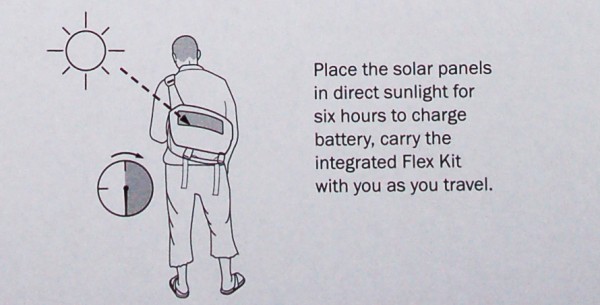
This bag will be the official Pop!Tech 2009 bag, and will also be sold by Timbuk2 sometime after that. It’s a unique bag that has the potential to change the way a lot of people (not just in Africa) do things. I don’t have detailed information on any of that, so look to the Pop!Tech team for more information on availability.
AfriGadget’s part in this
Due to my fairly extensive travels, dealing with just the right cross section of potential users for the bag, I was in the right place to distribute some test bags for feedback from end-users. My job, over the next three weeks will be to find the right types of people to give a bag to, interview them before and after, and report back on my findings.
My first stop is Ghana, then on to Kenya and Uganda. I have 10 FLAP bags, with plans to hand out 4 in Ghana, 4 in Kenya and 2 in Uganda. To do the interviews, I will have the help of Henry Addo in Ghana (also a colleague or mine at Ushahidi), and with David Ngigi in Kenya (a young videographer and friend). Pop!Tech has supplied us with small video cameras that we’ll be using for the interviews, as well as some starter questions and types of individuals that they would like to see get the bag.
My objective is to find people from many walks of life, from taxi drivers to citizen journalists, and from roadside food ladies to seamstresses. One of my questions is this: can much of this bag be created from locally available materials?
My main goal: find out if it is useful, usable and if its adaptable to everyday life in Africa.
The Challenge: asking people how they would adopt these kits, looking for inventiveness.
I won’t be sugar-coating my own reviews, nor those of the people who we interview.
Tune in for more tomorrow
My next post will be pictures of the kits, unboxing of the items that I have received and my initial opinions on them. I’ll also be doing some personal interviews (video diary) of myself throughout the weeks ahead, giving some insights into the day’s events and overall thoughts on the FLAP bag project.
[Update: Day 1 video diary]
I’ll also be using Twitter for updates, and though I manage the @AfriGadget account, when I get on the road I usually just post from my personal @WhiteAfrican account.
Additional updates from the manufacturer and from the project team will be found on the Pop!Tech blog and the Timbuk2 blog from time-to-time.