Archive for March, 2009

An Oven Made From a Blockbuster Drop Box

The following story came in from Luca Varaschini (by way of David Sasaki) who was born and raised in Robertsport, Liberia where his father was a doctor. He now lives in Milan, Italy, but was in Robertsport a couple weeks ago for the first time since he left as a child.

During my first week back in Liberia I had been invited to Hawa’s birthday party, on Sembehun Beach, not far for Robertsport, so I passed some time with the ladies while they were preparing western-style food for everyone: rice, beef stake, pasta and potato salad. Then they started stirring what would have to be two cakes for the dessert, and I started wondering how they’d be able to bake them, since the only cooking apparels in the big warehouse were these coal pits on the ground.

They showed me the oven, a big metal cabinet against the far wall; looks like a refrigerator on legs, to allow a coal pit to fit under the bottom, but when I get near it, I see it’s a Blockbuster Quick Drop Booth! The front, where the slit had been closed, faces the wall and the back door is to access the oven; inside are several fridge trays, on which they lay the pans. The door is then locked with a simple bolt and sealed all around with wet cloths.

The cake was fabulous.
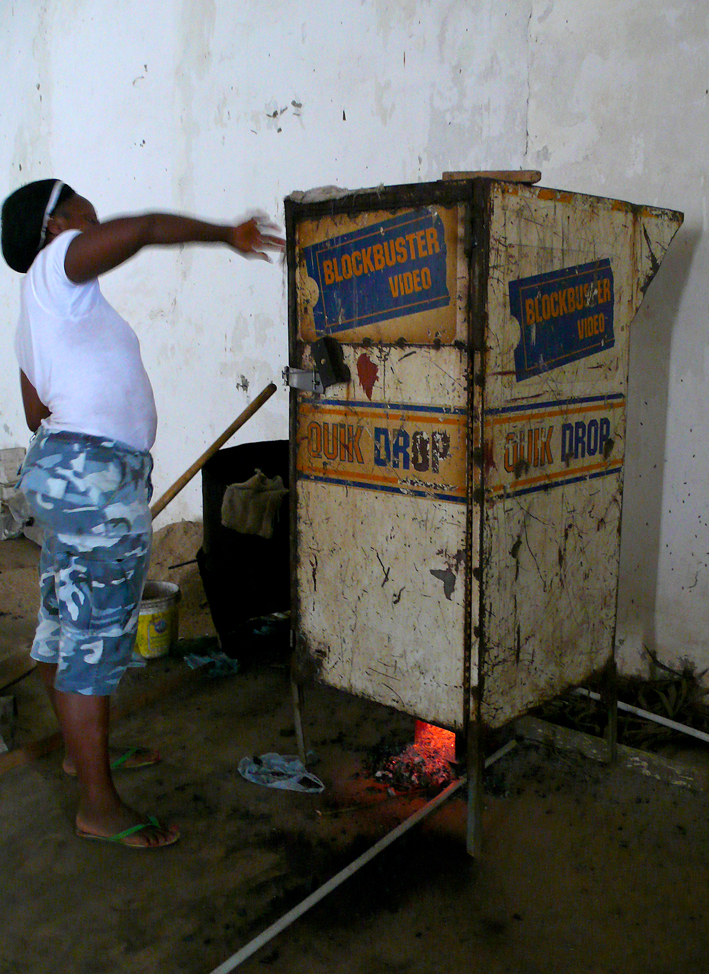
[Editor's note: I'm find myself incredibly curious trying to figure out where they found this... How did a Blockbuster drop box get to Liberia?]
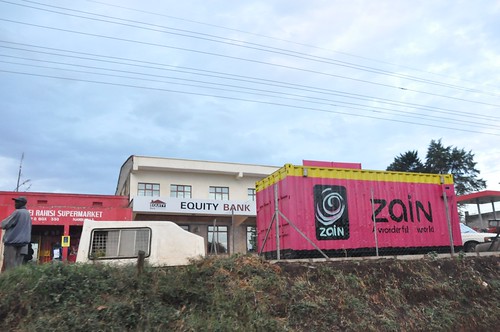
Repurpose: Converted Shipping Containers

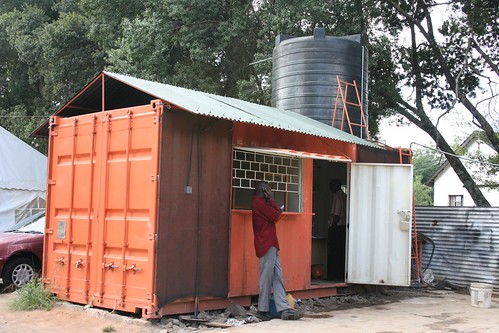
Spotted in Nandihills, Kenya January 2009.
I saw one just like this in Bungoma, but was not quick enough with the camera to get a good shot. Turns out Zain, a major mobile phone service operator is using these as pre-fab offices in rural areas.

Converted shipping container to Mobile Office

Spotted in Nairobi, January 2008
At Lagoon, a bar/nyama choma (roast meat) joint.

Shipping Container/Office

Got more in your archives? If so, please comment.

Turkana zipper head dresses

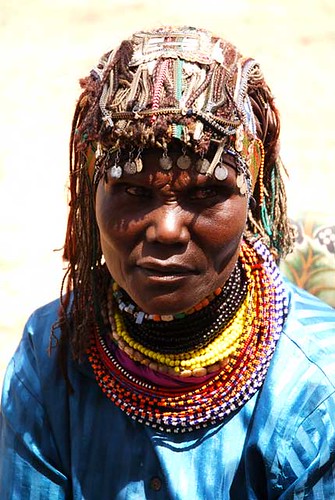
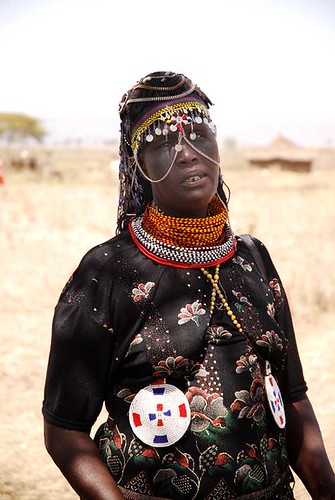
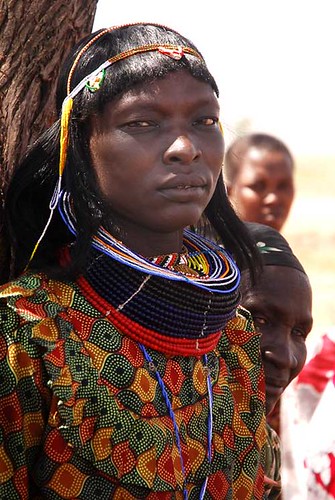
While visiting a rural community in the dry bushlands of Elementata I met some Turkana women who were absolutely captivating

Turkana mama

Turkana mama

Turkana woman

Turkana woman

Turkana girl

Turkana girl

Dancing Turkana woman

Dancing Turkana woman

Did you notice the creative head dresses? Zippers may have been invented in USA but nobody would have imagined they’d be used for head dresses.  I was so awed by the outfits that I forgot to ask where they got all those zippers from – I can’t get rid of the image of all the village men wondering about with gaping flies.

Liberia’s Blackboard Blogger

Liberias Blackboard Blogger

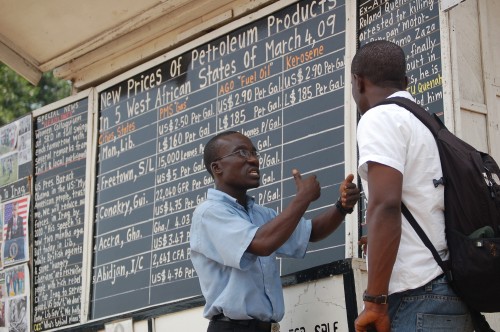
Alfred Sirleaf is an analog blogger. He take runs the “Daily News”, a news hut by the side of a major road in the middle of Monrovia. He started it a number of years ago, stating that he wanted to get news into the hands of those who couldn’t afford newspapers, in the language that they could understand.

Alfred serves as a reminder to the rest of us, that simple is often better, just because it works. The lack of electricity never throws him off. The lack of funding means he’s creative in ways that he recruits people from around the city and country to report news to him. He uses his cell phone as the major point of connection between him and the 10,000 (he says) that read his blackboard daily.


Liberia’s Blackboard Blogger from WhiteAfrican on Vimeo.

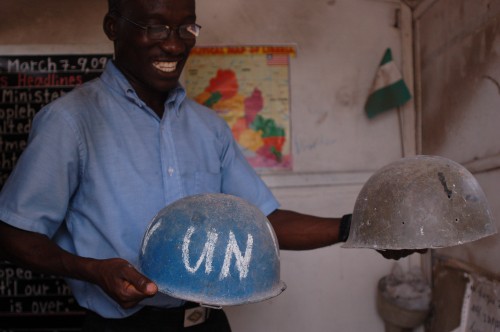
Not all Liberians who read his news are literate, so he makes use of symbols. Whether it’s a UN or military helmet, a poster of a soccer player or a bottle of colored water to denote gas prices, he is determined to get the message out in any way that he can.

Liberia - Daily News props

Advertising works here too. It’s $5 to be on the bottom level, $10 to be on the sideboard and $25 on the main section. He doesn’t get a lot of advertising, and but he manages to scrape by.

His plans for the future include decentralizing his work, this means opening up identical locations in other parts of Monrovia, and in a few of the larger cities around the country. I don’t put it past Alfred either, he’s a scrappy entrepreneur on a mission to bring information and news to ordinary Liberians. He’s succeeded thus far, and I would put my money on him growing it even further.

Alfred Sirleaf talking to a news reader

(Also, read the NYT piece on him from 3 years ago)

(note: title for this post stolen shamelessly from Rebecca’s Pocket. I also first posted this at WhiteAfrican, because I couldn’t decide if it was an AfriGadget story or not…)

Global Peace Village or a Scrap Yard?

Community members accuse him of being involved with witchcraft, the local government forbids him to showcase his work …the Zimbabwean artist, Dexter Nyamainashe has been collecting scrap to create art for six years now. Dexter collects all his created art objects together in his one masterpiece: The “global village of peace”.

This inspiring artist-activist goes against all odds to follow his passion. Dexter sees beauty in what most of us would just call ordinary ‘scrap’. Dexter, an inspiring man we can all learn something from…

Please find the original story and more information about Dexter and his work here on the Tashanda blog

The beesness of honey

Bee keeping logo

You know it’s a great jua kali project when you see the logo

Honey is one of the most valuable products of the drylands of Africa. It can be obtained by following a little bird called a honey guide to a bees nest in a tree, whereupon one raids the hive. Or bees can be farmed…in most places a bee keeper simply hollows out logs to make perfectly acceptable hives for local consumption. for commercial purposes however, Langstroth hives are universally thought to be superior to the traditional log hives found in Africa – the box shape make them easy to stack and move around,  and the movable frames guide bees to build combs in an organized manner making comb extraction easy. These hives also have a queen excluder, a mesh grid, usually made of wire or plastic, sized such that worker bees can pass through but the bigger queens cant. This keeps the queen from laying eggs in the honey combs called supers leading to cleaner honey. There are so many NGO’s, GOs and religious Orgs introducing these bright yellow langstroth hives across the Kenyan landscape.They don’t always catch on though – in rural areas people still prefer the logs…

Traditional hive

Traditional hive

Traditional log hives are hollowed out logs usually cut from specific tree species with the permission of the local chief. They are hung high in trees and the inside is rubbed with leaves of plants that attract bees – a practice that has been going on for eons. The bees enter the hives through a tiny hole and build their combs willy nilly throughout the space, it’s inefficient and the honey is of a lower quality as the larvae are all mixed up with the honey combs. Not very good for a business approach… or should I say Beesness?.

Langstroth hive in Baringo Kenya

Langstroth hive in Baringo Kenya

Logic would suggest that the Langstroth hives which produce cleaner honey and they save trees should be favoured right? Wrong! These modern hives are produced by experts in cities and cost a good $100 – far beyond the reach of anyone living in rural Kenya. It’s also rumoured that these hives are easily broken into by honey badgers, over heat in the dry climate of north Kenya driving bees away, and are expensive to maintain. On a personal note, I for one, find them extremely ugly too.

Modified traditional hive

Modified traditional hive

One bee keeping cooperative in Bogoria has figured out a cunning way of modifying traditional log hives to produce more honey. A bee excluder is made using coffee mesh.

Symon demonstrated how beeswax tracks are laid down to guide the bees where to build their combs in neat lines. Cost? One third of the Langstroth hive.

Bucket of raw honey

Bucket of raw honey

The honey is collected at night by naked men (yes totally naked …) they say that this prevents one from getting bees stuck in your clothing… I asked about the possibility of getting stung in sensitive places, they said the bees were far too civilized for that…but yes, people had fallen from the trees and been found comatose and butt naked at the tree base…

Honey extractor

Honey extractor

Raw honey with comb is sold to the local cooperative where wax is separated from honey. The machine is another jua kali item bought in a workshop in Nairobi.

Home made bee smoker

Home made bee smoker

Bees are smoked out of the hive using a home made smoker.

Production by 40 bee keepers was 8 tons last year, each Kg of raw honey was bought by the cooperative for Ksh 80 ($1), and sold on raw at Ksh 100, or processed and honey sold at Ksh 600 per kg ($8).

8 tons of raw honey were collected in 2008 – this is valued at Ksh640,000 for the 40 bee keepers in the business.

The wax is not wasted but converted into candles which sell for Ksh 10 each ($ 0.12).

Candle making gadget

Candle making gadget

Using a jua kali gadget for making candles, comprising a string, a piece of conduit pipe and two beer caps….ingenious!

Bees wax candle

Bees wax candle

Producing the sweetest smelling cheapest candles I’ve ever used. They claim they burn much longer than paraffin candles. Besides they smell delicious

Some sweet facts

· The dry lands of Kenya are the important honey producing districts in Kenya – the semi arid climate, diversity of flowering plants and easy access to fresh water makes it perfect for bees. Kenya is the fourth largest producer of honey in Africa 22,000 tons, China is the worlds largest producer at 299,000 tons (USA produces 70,000 tons) (figures for 2005).

· The group in Baringo produced 8 tons of honey last year.

Bee keeping motto

I love their motto for hard work - "never expect magic from no where".

· Kenya is a world center of bee diversity with over 3,000 species (about 10% of the worlds total number of species)

· Only 150 species or thereabouts produce honey in Kenya.

· Contrary to popular belief, most bee species are harmless… they have no stings

· The Kalenjin people immunize themselves to bees by purposely stinging babies with bees

· In many pats of Africa, honey is an important component of dowry or bride price – a kilogram being made as part payment for the bride – symbolic of the sweetness of sex – or so I’m told ;)

· Bees pollinate most of the crops that we eat

· Bee keeping is most productive in natural habitats, and is a one of the few forms of resource extraction that does not destroy the environment.

The sour facts

· Bees in USA and Europe are disappearing fast – a condition described as colony collapse disorder (ie. Nobody knows why it’s happening). Africa is unaffected so far making honey production a very sweet deal.