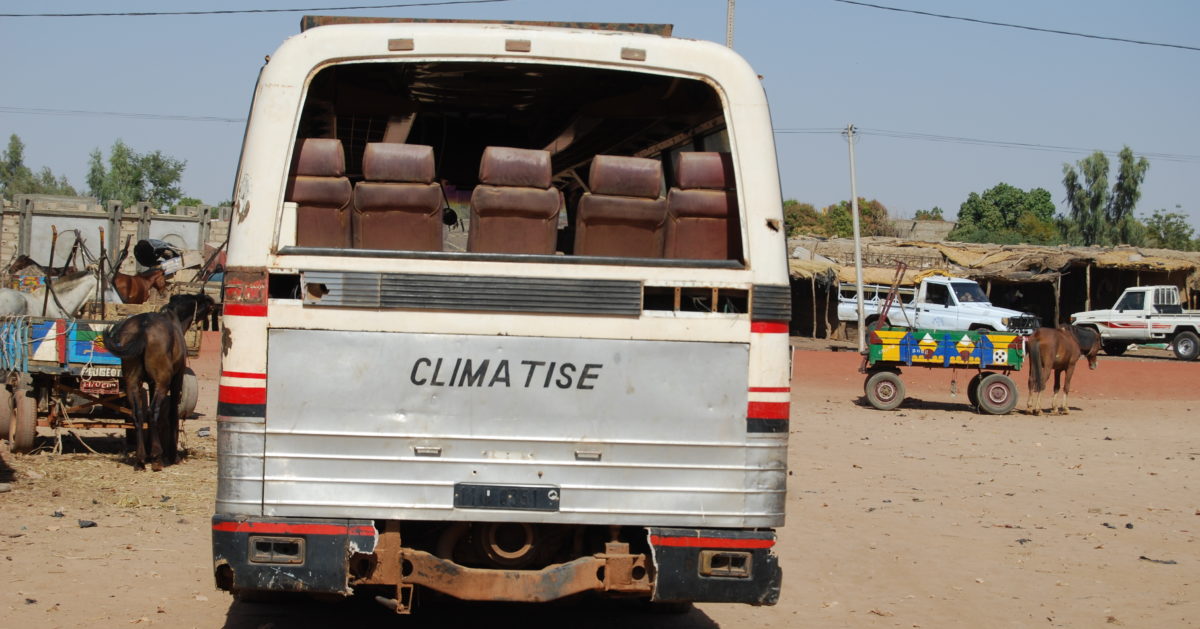
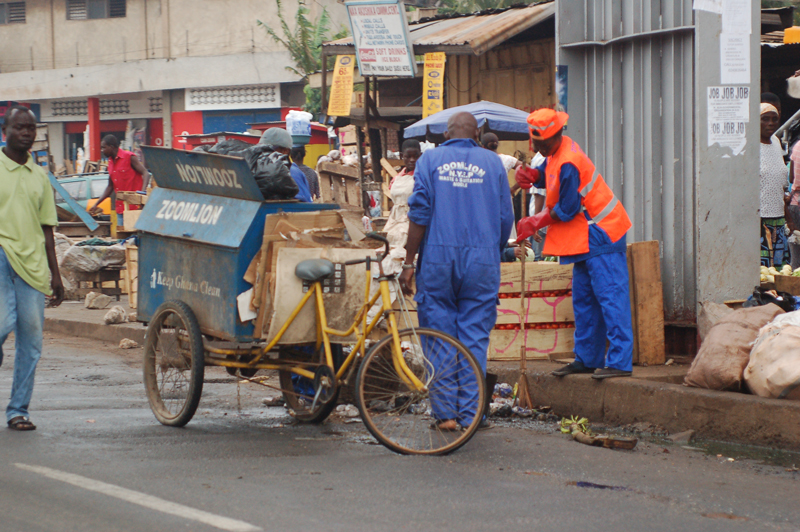
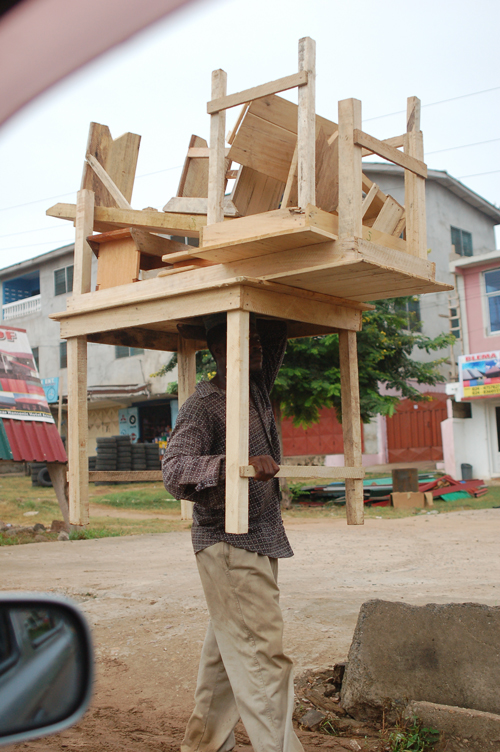
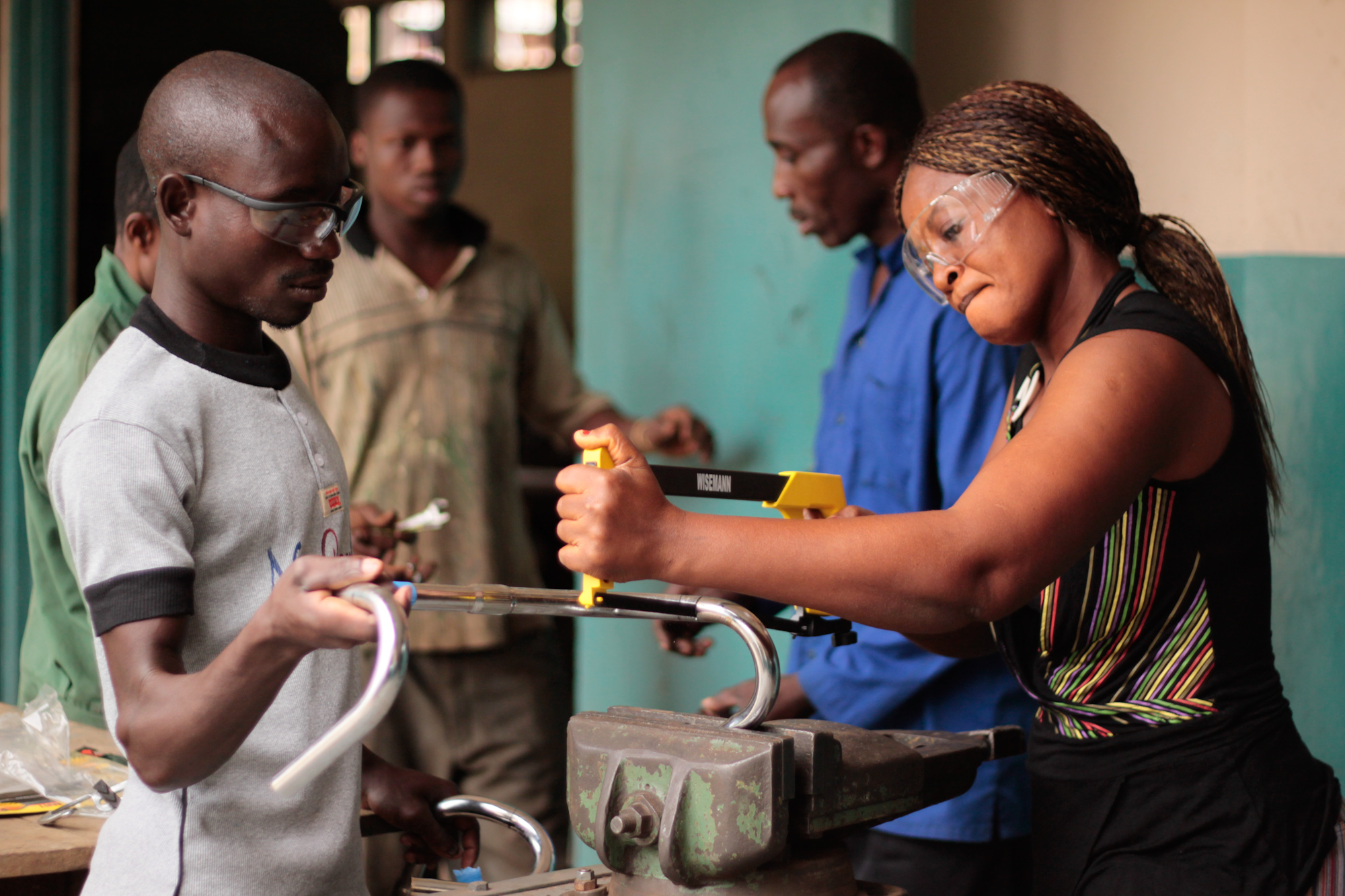
I’ve been having a great time in Accra, but not nearly enough time to spend on the details of every cool product or invention that I see. In the meantime, here are a couple pictures from around Ghana that will whet your appetite for what is coming up in the next week:
The International Development Design Summit is put on by Amy Smith and her students at MIT. This year it took place in Kumasi, Ghana – which will be followed by Maker Faire Africa this weekend in Accra, where some of their work will be shown.
Here’s a quick list of the projects they have been working on over the last five weeks:
– A press that speeds up the process of extracting oil from shea nuts
– A device for generating electricity from a playground carousel
– A machine for making recycled plastic products from used water sachets
– A set of tools for threshing groundnuts
– A mechanism for producing chlorine from salt water using readily available materials
– A simple, low cost battery made from local materials, for household lighting and other uses
– A human powered grating machine for speeding up cassava processing
– A thresher to improve the quality of rice by preventing stones from mixing with the grains
– A chlorine dispenser for disinfecting drinking water
– A family friendly latrine designed to promote use and hygiene among young children
– A device for monitoring the growth of children under five through cell phone technology
– A container that extends the shelf life of tomatoes during transport and storage
Edward tells Hazwan some of his thoughts on the rice threshing machine.
The importance of being in Ghana
Niall Walsh has written this information about how the importance of the move to Ghana for this year’s IDDS was to both MIT and the participants:
The main difference between IDDS Ghana and IDDS in MIT is the proximity to community partners and potential end users of the projects. IDDS prides itself on the spirit of co-creation and this movement from the States to Africa is a crucial one in line with this vision. The difference between participants sitting in lecture halls in MIT, learning about international development and the importance of speaking to at least fifty villagers before designing a technology, and actually living with and talking to hundreds of villagers all over the country, is immeasurable. In total IDDS this year worked with ten villages throughout the Bromg – Ahafo and Ashanti regions and teams had the chance to make three separate two night visits (spread throughout the design process to make sure they had input into every stage) to these villages. Among a huge number of other factors, the simple experience of having end users actually become extremely excited about your prototype, and seeing them test it out, is an incentive for teams to continue their project after IDDS.
Another way in which IDDS interacted with the local community, rather than simply for it, was through it’s interactions with Suame Magazine. This is an engineering cluster located in the centre of Kumasi, spanning twenty miles and with a working population of over 200,000 people. There are approximately 12,000 independent micro, small and medium enterprises located in the area and their main activities of vehicle repair and metal fabrication (welding and casting) are renowned for their ingenuity all across West Africa. During the summit, participants worked extensively with these engineers and mechanics in the ‘Magazine’ and had the chance to share ideas, techniques, and technologies with each other
The point has been stressed home at this year’s IDDS that these villagers involved in the process, as well as the workshop guys in Suame, are partners in the design process, rather than simply people we should talk to along the way. Without these partners, the technologies presented tomorrow at the Great Hall would quite simply not be possible, and I think that knowledge, in and of itself, will prove invaluable to our participants as they continue to work in international development after the conference. In light of this, five villagers from each village, as well as workshop managers from Suame, will be provided transport, accommodation and food to come to the final presentations to see all the different prototypes.
Systems have also been put in place to ensure that the projects worked on at this year’s IDDS will continue to be worked on after IDDS. There are project grants and partnership grants available for the teams and there will also be a full time country liaison for Ghana, responsible for integrating the technologies into all of our partner villages, as well as sourcing new villagers and markets to help disseminate and create business models for the technologies. On a far more practical level, villagers will also have the opportunity to decide which of the prototypes they are most interested in, and then work with our partners in Suame Magazine to have these manufactured.
This is part of an ongoing series of posts on the FLAP bag project, a collaborative effort by Timbuk2, Portable Light and Pop!Tech. We at AfriGadget are helping to field-test these bags that have solar power and lighting on them, and get interviews of the individuals using them.
Day 2: The buckets arrive
This is a continuation of yesterday’s starting video diary, where I received the flaps to the FLAP bag. Saturday morning the package from Timbuk2 was on our doorstep waiting to be opened. The bottom part of the bags had arrived, but there were a few surprises in store for me…
This is part of an ongoing series of posts on the FLAP bag project, a collaborative effort by Timbuk2, Portable Light and Pop!Tech. We at AfriGadget are helping to field-test these bags that have solar power and lighting on them, and get interviews of the individuals using them.
Day 1: The flaps arrive
The FLAP bag kits started to arrive Friday evening. The buckets (bottom part of the bag) from Timbuk2 had not yet been delivered at this point, so all I had was the flaps.
Tune in for part 2 later… in the meantime, some pictures:
The flap from the FLAP bag projectAn unassembled bag flapThe control unit and an unassembled FLAP bag's flapFLAP bag kit assembly and usage directionsThe components
I’m scrambling to put my bags together for Ghana, as I leave in just a day for Maker Faire Africa. There’s only one problem, I don’t have everything that I need, and I’m waiting on a shipment from a California bag company. The good news: I’ve just been told that I’m no longer sworn to secrecy, so I can begin telling the story. Here is the FLAP bag project story (from my perspective) and AfriGadget’s involvement in it.
A little background
Four months ago the Pop!Tech team approached me about their collaborative project with Sheila Kennedy of the Portable Light project, who showed off her solar TB blanket at Pop!Tech 2008, and Timbuk2, the well-known messenger bag company.
Their plan was to develop a bag that has the potential to bring the benefits of portable power to selected global communities around the globe, and they were hoping the I could help with distribution and testing within the African communities that I frequent, where power is crucial. Of course, I jumped right in, this was just too intriguing to not do so, plus I have great admiration for all of the players: Pop!Tech, Timbuk2 and Sheila Kennedy.
The FLAP bag project
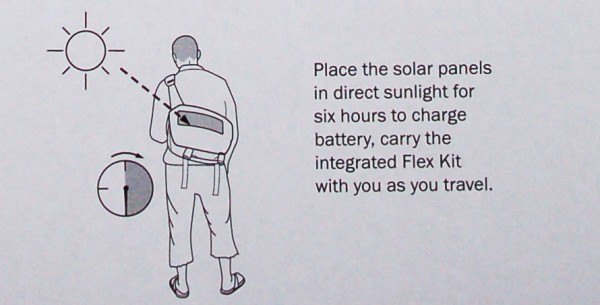
FLAP stands for Flexible Light And Power. The flap on the messenger bag has the single solar panel on it, connected to the tech tray, which has an on/off switch, an LED light and a USB connection. So, in concept, the bag can be used as a portable lighting and power supply unit for anyone. Most useful however, to those lacking consistent power for devices or an electric lighting option.
Image: How to charge the FLAP bag
This bag will be the official Pop!Tech 2009 bag, and will also be sold by Timbuk2 sometime after that. It’s a unique bag that has the potential to change the way a lot of people (not just in Africa) do things. I don’t have detailed information on any of that, so look to the Pop!Tech team for more information on availability.
AfriGadget’s part in this
Due to my fairly extensive travels, dealing with just the right cross section of potential users for the bag, I was in the right place to distribute some test bags for feedback from end-users. My job, over the next three weeks will be to find the right types of people to give a bag to, interview them before and after, and report back on my findings.
My first stop is Ghana, then on to Kenya and Uganda. I have 10 FLAP bags, with plans to hand out 4 in Ghana, 4 in Kenya and 2 in Uganda. To do the interviews, I will have the help of Henry Addo in Ghana (also a colleague or mine at Ushahidi), and with David Ngigi in Kenya (a young videographer and friend). Pop!Tech has supplied us with small video cameras that we’ll be using for the interviews, as well as some starter questions and types of individuals that they would like to see get the bag.
My objective is to find people from many walks of life, from taxi drivers to citizen journalists, and from roadside food ladies to seamstresses. One of my questions is this: can much of this bag be created from locally available materials?
My main goal: find out if it is useful, usable and if its adaptable to everyday life in Africa. The Challenge: asking people how they would adopt these kits, looking for inventiveness.
I won’t be sugar-coating my own reviews, nor those of the people who we interview.
Tune in for more tomorrow
My next post will be pictures of the kits, unboxing of the items that I have received and my initial opinions on them. I’ll also be doing some personal interviews (video diary) of myself throughout the weeks ahead, giving some insights into the day’s events and overall thoughts on the FLAP bag project.
I’ll also be using Twitter for updates, and though I manage the @AfriGadget account, when I get on the road I usually just post from my personal @WhiteAfrican account.
Additional updates from the manufacturer and from the project team will be found on the Pop!Tech blog and the Timbuk2 blog from time-to-time.
We use cookies on our website to give you the most relevant experience by remembering your preferences and repeat visits. By clicking “Accept”, you consent to the use of ALL the cookies.
This website uses cookies to improve your experience while you navigate through the website. Out of these, the cookies that are categorized as necessary are stored on your browser as they are essential for the working of basic functionalities of the website. We also use third-party cookies that help us analyze and understand how you use this website. These cookies will be stored in your browser only with your consent. You also have the option to opt-out of these cookies. But opting out of some of these cookies may affect your browsing experience.
Necessary cookies are absolutely essential for the website to function properly. This category only includes cookies that ensures basic functionalities and security features of the website. These cookies do not store any personal information.
Any cookies that may not be particularly necessary for the website to function and is used specifically to collect user personal data via analytics, ads, other embedded contents are termed as non-necessary cookies. It is mandatory to procure user consent prior to running these cookies on your website.