
HAPV – Human and Animal Powered Vehicle in South Africa

The HAPV (Advertised as HAPPY) is a twist on the ‘horse and buggy’ mode of transportation, making this a donkey, cart, solar panel on a canopy FUV (Farm Utility Vehicle) that is quite ingenious and absolutely AfriGadget. A donkey drawn carriage is commonplace in many countries in Africa, and this retrofit by the organization Water and Wheel adds more functionality and utility especially suited for rural Africa.
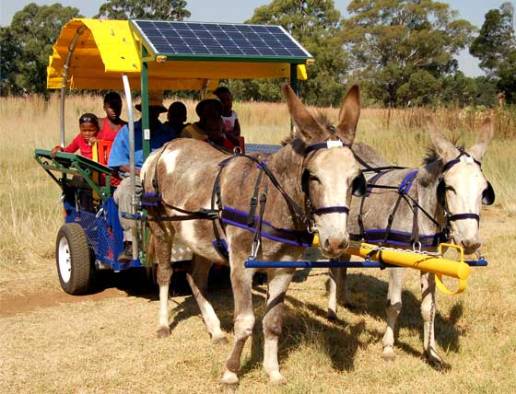
HAPV

Fitted with a solar panel that charges a 12 volt battery under the driver’s seat, the “HAPPY” becomes an independent, sustainable source of energy that powers cell phone connectivity, front and rear emergency lights and a small neon tube at night. Add a water filtration system, and the “HAPPY” doubles as a multi functional mobile business unit, that can empower an entrepreneurial owner, to generate income from it as a fresh water outlet, a mobile phone kiosk or a spaza shop – even after dark.

Read more about it here.

(Hat tip Mweshi)

Note: Erik Hersman (White African) was interviewed a few minutes ago on BBC, a podcast will be available in a day or two and we will be sure to share it here (link).

“I Try and I Make”

I found a story about a young Malawian who had built a windmill from scratch to help power the lights in his rural home. When I showed up at TED Global in Arusha in June, I had no idea that I would meet him. At that point, he hadn’t been introduced to the larger TED community, so I was this lone excited voice squawking about how thrilled I was to meet him.

2 Days later, William Kamkwamba was introduced to the TED community on stage:


Kickstart Technologies: irrigation, and cooking oil human-powered pumps

I met the managers of Kickstart technology at the recent TED Global conference in Arusha, Tanzania. Kickstart’s patented technology bridges the gap between expensive industrialize equipment used to pump, squeeze or pack and all it’s products are human powered. This is a very important feature in Africa for the Base of the Pyramid (BOP) market, because it solves the issue of energy and cost for equipment used in agriculture, and construction.

Kickstart’s most popular product is an irrigation pump that uses the stepping motion you see in a work-out gym to move water hundreds of feet to irrigate land. Kickstart also has been able to sell several thousands of these products all across Africa, and has been approach by the United Nations to sell globally.

Below is the irrigation pump

Kickstart pressing pump for building construction

Below you can see a picture of a person squeezing seeds to make oil

Here is a little more about Kickstart from the organization’s website.

About KickStart

KickStart’s mission is to help millions of people out of poverty. We promote sustainable economic growth and employment creation in Kenya and other countries by developing and promoting technologies that can be used by dynamic entrepreneurs to establish and run profitable small scale enterprises.

Go to the organization website

Wind Powered Cell Phone Base Stations

Safaricom in Laisamis uses wind powered cell phone stations.

Photo courtesy of Bergey. Oct 26 2006 Dedication of the cell phone base station site in Laisamis, Kenya Africa.

AfriGadget appears to be on a roll with wind power, so lets continue the wave shall we?

The company WinAfrique designs and builds hybrid wind and diesel turbine systems for powering cell phone base stations. Kenya’s biggest wireless companies Safaricom and Celtel have contracted with WinAfrique.

…Safaricom contracted with Winafrique Technologies in Nairobi to design and supply pilot wind/diesel hybrid systems at three very remote base stations. The systems consisted of a Bergey 7.5 kW turbine on a 24 m (80 ft) SSV tower, sealed batteries, and an inverter. These sites were installed and monitored for one year. The results showed excellent reliability and diesel fuel savings of 70-95%. Based on these positive results, Safaricom has contracted for six more sites, and has many other wind/diesel sites in the planning stage.

Hybrid systems that utilize renewable energy such as wind and solar are making it possible to extend wireless service in remote areas that are not connected to grid power. You can read more about Safaricom’s use of wind powered cell phone base stations, and more here about Celtel’s.

William’s Windmill


William’s Windmill, originally uploaded by whiteafrican.

Inspiring, innovative and representative of what Africa’s future holds.

William Kamkwamba is a 19 year old Malawian who built his first windmill at 14. Here he is, pictured just this last week doing some work on his windmill near his home.

The propellers are made of plastic pipes supported by sticks to that they should not bend when the wind is strong and placed almost vertical to the direction the winds is coming.

Unlike in most windmills where the propellers directly turn the spindle connected to the turbines directly, William added pulleys to his machine to increase speed thereby generating more energy.

There are three pulleys and the last is connected to a bicycle wheel. When this wheel turns it turns a dynamo which in turn generates electricity.

Read his blog for inspiring stories about making things work in rural Africa!

Read more on William’s Windmill blog in Malawi.