Wind Powered Cell Phone Base Stations

Safaricom in Laisamis uses wind powered cell phone stations.

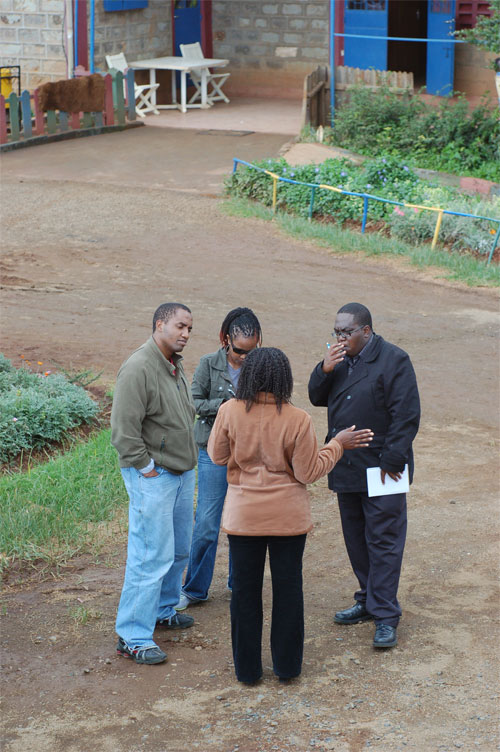
Photo courtesy of Bergey. Oct 26 2006 Dedication of the cell phone base station site in Laisamis, Kenya Africa.

AfriGadget appears to be on a roll with wind power, so lets continue the wave shall we?

The company WinAfrique designs and builds hybrid wind and diesel turbine systems for powering cell phone base stations. Kenya’s biggest wireless companies Safaricom and Celtel have contracted with WinAfrique.

…Safaricom contracted with Winafrique Technologies in Nairobi to design and supply pilot wind/diesel hybrid systems at three very remote base stations. The systems consisted of a Bergey 7.5 kW turbine on a 24 m (80 ft) SSV tower, sealed batteries, and an inverter. These sites were installed and monitored for one year. The results showed excellent reliability and diesel fuel savings of 70-95%. Based on these positive results, Safaricom has contracted for six more sites, and has many other wind/diesel sites in the planning stage.

Hybrid systems that utilize renewable energy such as wind and solar are making it possible to extend wireless service in remote areas that are not connected to grid power. You can read more about Safaricom’s use of wind powered cell phone base stations, and more here about Celtel’s.

William’s Windmill


William’s Windmill, originally uploaded by whiteafrican.

Inspiring, innovative and representative of what Africa’s future holds.

William Kamkwamba is a 19 year old Malawian who built his first windmill at 14. Here he is, pictured just this last week doing some work on his windmill near his home.

The propellers are made of plastic pipes supported by sticks to that they should not bend when the wind is strong and placed almost vertical to the direction the winds is coming.

Unlike in most windmills where the propellers directly turn the spindle connected to the turbines directly, William added pulleys to his machine to increase speed thereby generating more energy.

There are three pulleys and the last is connected to a bicycle wheel. When this wheel turns it turns a dynamo which in turn generates electricity.

Read his blog for inspiring stories about making things work in rural Africa!

Read more on William’s Windmill blog in Malawi.

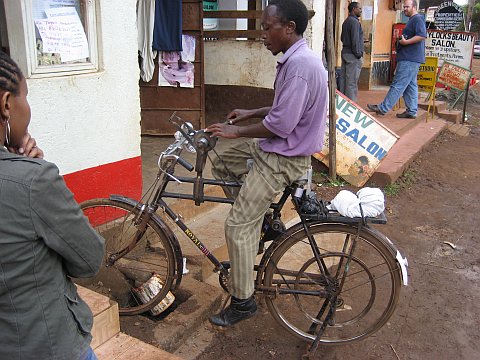
The knife-sharpening bicycle

Peter Kahugu of Banana Hill just outside Nairobi makes a living using his bicycle.

And no, he is not a professional cyclist.

AfriGadget reporter Afromusing and I had an opportunity to interview Peter who has modified his bicycle with a belt, a set of tensioning pulleys and a grinding stone to make it a knife-sharpening machine. By kicking the bike up onto its stand and engaging a gearing system, he is able to use “leg-horsepower” to drive a grinding wheel and sharpen knives while “on the move”.

Peter has been at this for 2 years now and he makes about Kshs 500 ( app. 10 US$) a day by riding his mobile workshop from client to client sharpening all their knives as he goes. The grinding stone he uses has lasted an astounding 2 years and he has had to replace his drive belt a couple of times but that is as simple as cutting up a long strip of rubber from an old car or bicycle tire inner tube.

Be sure to click though on the image for video on YouTube of the Peter and his bike in action.


The knife-sharpening bicycle

AfriGadget at TEDGlobal

The last couple weeks have found myself, and a couple other AfriGadget team bloggers (1, 2, 3), traipsing across East Africa on our way to and from TEDGlobal. We were able to source a few really good stories that you’ll see coming online in the next couple of weeks.

AfriGadget Blogges
Some of the AfriGadget bloggers

While at TEDGlobal, I had the chance to talk on stage about African ingenuity and innovation at the most micro level. Needless to say, it was exhilarating. I gave examples of the stories we’ve published here over the last year. It was a lot of fun and I think people enjoyed it.

Of course, this high-flying adventure couldn’t all go smoothly. In fact, on Thursday, the last day of TEDGlobal and the day that some pretty big sites linked to us, our web host was hacked and we went down in flames. I was off to Uganda and had a terrible connection, and it wasn’t until today that I’ve been able to fix things.

So, thanks for your patience in all of this, and thanks for reading! We’ve got some pretty exciting ideas about this next year and will keep you informed as they happen.

[update: here’s a short audio slideshow of what I think I said…]


Home Made Welding Machine

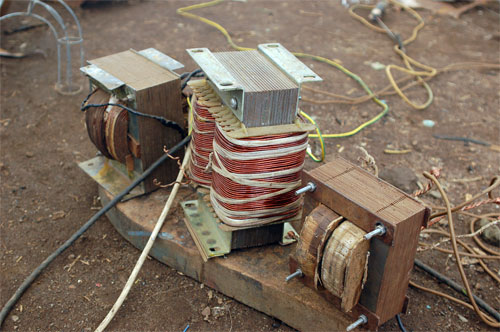
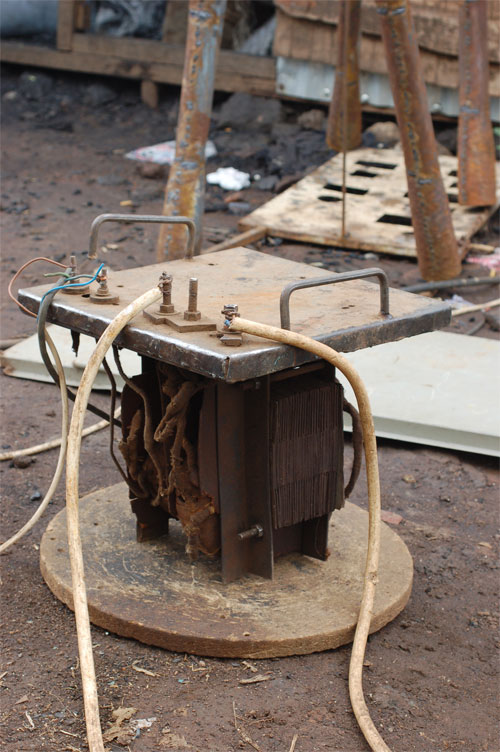
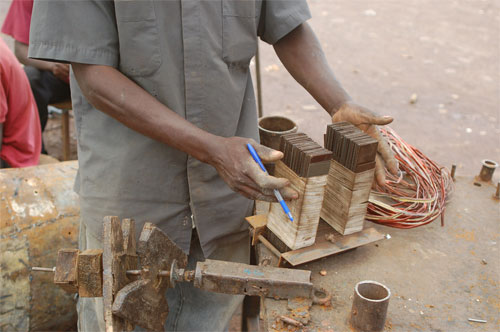
Being on the ground in Nairobi makes it a little easier to find good AfriGadget stories. I took a walk down Ngong road, an area with a lot of shadetree mechanics, wood carvers and metal fabricators. The first place I stopped at had a home made welding machine.

Simon, the shop owner, showed me a couple of the machines and gave a video tour of how it works. He’s a prime example how an entrepreneur in Africa will figure out ingenious solutions to meet local market demands. The welders sell for around 14,000 Kenya Shillings (just over $200), but fabrication costs only a small fraction of that.

Below is the video and some pictures. (Another video will be uploaded later, connection speed issues preclude me uploading another one right now).


DIY Welder

Home Made Welding Machine in Nairobi, Kenya

Home Made Welding Machine - Parts

Send in your stories of African ingenuity here.