
A Little Housekeeping at AfriGadget

AfriGadget LogoFirst off, I’d like to thank the thousands of readers who visit AfriGadget every week. It’s been great to see the amount of interest that innovation Africa-style engenders. I’d like to give a little update on what’s been happening and where we’re going with AfriGadget in the near future. If you’d like to help in some way, please contact me.

Some AfriGadget Groups

    AfriGadget Flickr Group – We have an image gallery on Flickr that you can take part in. Tag your images “AfriGadget” and add them to the AfriGadget group.

    AfriGadget Facebook Group – Just started this month, the AfriGadget Facebook group is a place that you can talk to other AfriGadget readers and find like-minded friends.

Website Redesign
This has been a long time coming. The current site has some problems that we’d like to “fix” via a redesign. We’ll still be using WordPress, but want to make it more accessible and increase the breadth of information available. Feedback indicates that people like the look and feel of the current site, so we’ll try and stay pretty true to what you see now.

There has been an ever increasing number of emails asking for more information on specific projects, as well as a great deal of interest from people who want to purchase some of the items that we’ve shown on AfriGadget. We’re going to be building in some of those features into the new site.

Helping Micro-Entrepreneurs
I’ve had a number of interviews by different media outlets over the last couple months, and one specific interview by a South African radio company really hit me. They asked, “How does AfriGadget help the Africans who are beings showcased?”. I didn’t have an answer – or, I did, but the answer was “not at all”.

In the new site, we would like to work with an organization like Kiva, and their partners, to create ways for people to invest in some of the entrepreneurs that we talk about. In the cases where it makes sense, we’ll also help the entrepreneurs sell some of their items via our website.

Growing AfriGadget
The website initiative is only one of the three that we’re planning for this year. If we can find the right partners, we’ll be announcing some projects that a couple AfriGadget editors will be leading that are, quite frankly, much more exciting and “big” than a website redesign. As we grow AfriGadget we’re looking for partners who can help us. Contact me if you’d like to know more about those initiatives!


All of us do AfriGadget on the side. The growth of the site that I have outlined above is meant to benefit the innovators in Africa, not those of us who manage and create content for this site.
“I Try and I Make”

I found a story about a young Malawian who had built a windmill from scratch to help power the lights in his rural home. When I showed up at TED Global in Arusha in June, I had no idea that I would meet him. At that point, he hadn’t been introduced to the larger TED community, so I was this lone excited voice squawking about how thrilled I was to meet him.

2 Days later, William Kamkwamba was introduced to the TED community on stage:


Water Harvesting by Roadside Plant Nursery

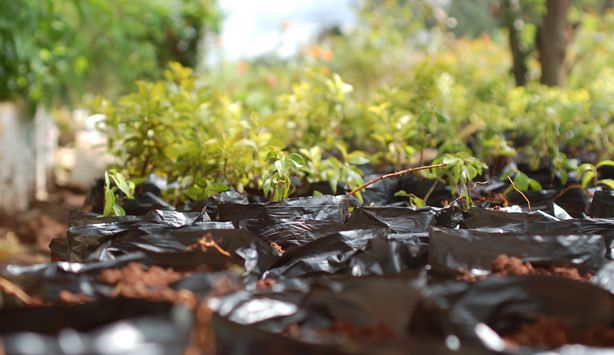
David Mwangi has run a roadside tree and plant nursery outside of Nairobi for four years. In Kenya, you have to work around the two seasons (unlike the 4 in the West). The rainy season where everything is fine, and the dry season where your plants will likely die. This gets even worse when a drought happens.


Roadside Nursery in Kenya

David had the idea to dig a ditch down the side of the road and channel that into two 2-meter deep water catchments. The water is used to support the plants during the dry season and he never runs out of water, even during a drought. He has also stocked the pulls with fish (Tilapia), that he and his workers eat. A third byproduct is that the rain water being diverted doesn’t further erode that part of the road.

It’s a lesson in simplicity married with low-tech ingenuity coming together for increased business profitability.

Here’s a short video, where one of my friends translates for David:


More pictures available at the Flickr AfriGadget group.

If you have any stories or pictures of African innovations and ingenuity, please contact us.

Kickstart Technologies: irrigation, and cooking oil human-powered pumps

I met the managers of Kickstart technology at the recent TED Global conference in Arusha, Tanzania. Kickstart’s patented technology bridges the gap between expensive industrialize equipment used to pump, squeeze or pack and all it’s products are human powered. This is a very important feature in Africa for the Base of the Pyramid (BOP) market, because it solves the issue of energy and cost for equipment used in agriculture, and construction.

Kickstart’s most popular product is an irrigation pump that uses the stepping motion you see in a work-out gym to move water hundreds of feet to irrigate land. Kickstart also has been able to sell several thousands of these products all across Africa, and has been approach by the United Nations to sell globally.

Below is the irrigation pump

Kickstart pressing pump for building construction

Below you can see a picture of a person squeezing seeds to make oil

Here is a little more about Kickstart from the organization’s website.

About KickStart

KickStart’s mission is to help millions of people out of poverty. We promote sustainable economic growth and employment creation in Kenya and other countries by developing and promoting technologies that can be used by dynamic entrepreneurs to establish and run profitable small scale enterprises.

Go to the organization website

Made From Scratch Model Airplane

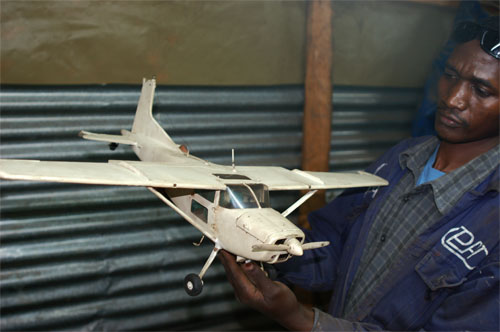
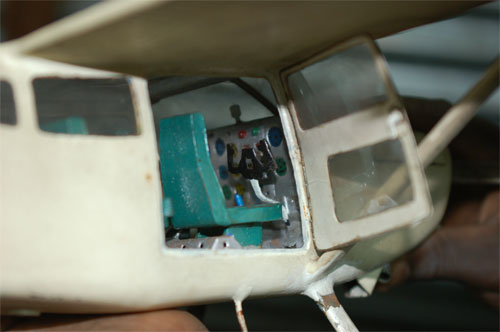
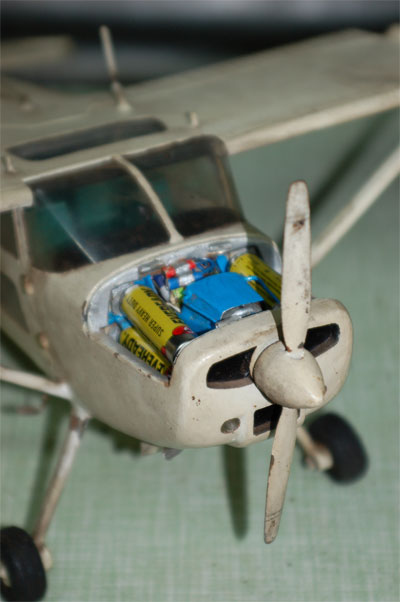
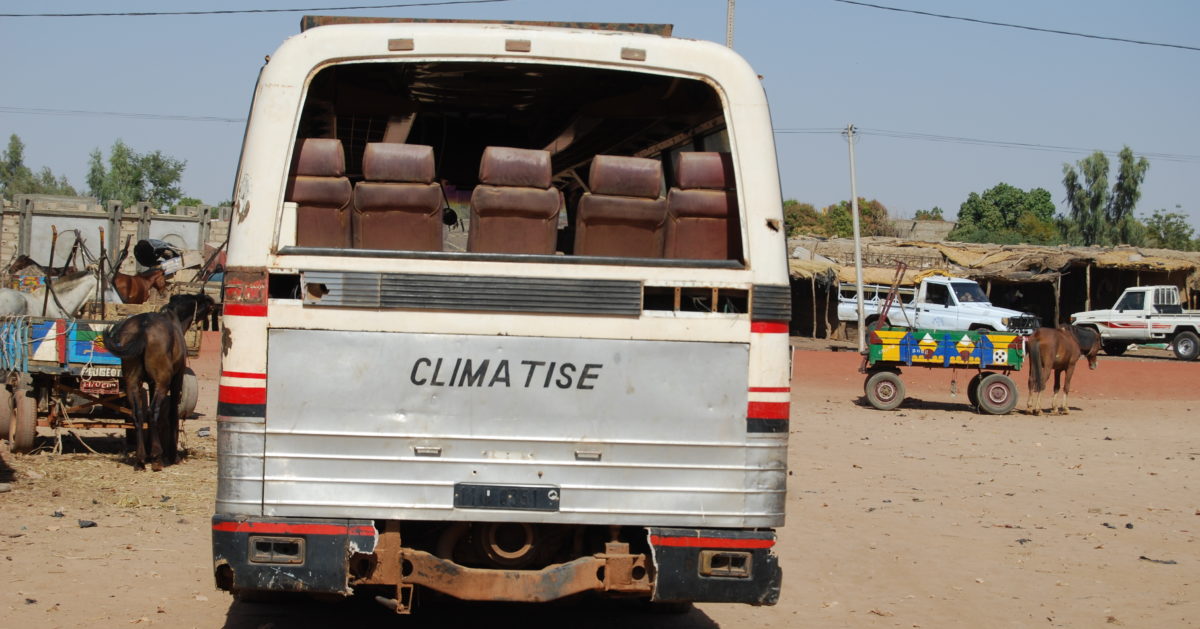
Phillip Isohe is a metal fabricator in the jua kali, non-traditional industrial sector, in Kenya. In his spare time he builds models of airplanes and buses. This seems to be an extension of what many of us did while growing up in Africa – building wire, or tin can, cars. What’s most interesting is the excruciating attention to detail that he puts into each one. In fact, they each have motors with working lights, steering, engine and interiors.


Phillips model airplane in kenya

Phillip had just sold one of his buses, so the only other one I have a picture of is only half-built (picture). However, he did have a finished and working model airplane. It was amazing to see how each piece, engine included, was built from scratch. It’s not every day that you see this kind of detail work on hobbies, no matter where you are in the world.

The models take him 30 days to make and goes for about 25,000/= ($370). That’s likely just his “starting price” though, and they probably sell for a good deal less when he really wants to move it.

Here’s a short video of the model plane:


More pictures:


Made From Scratch Model Airplane

model airplane engine

More pictures like these can be found on the AfriGadget Flickr group.