Flat parabolic mirror is not an oxymoron!

Can a parabolic mirror be flat? Dominic Wanjihias latest invention may prove that this is the most efficient way of capturing solar energy.
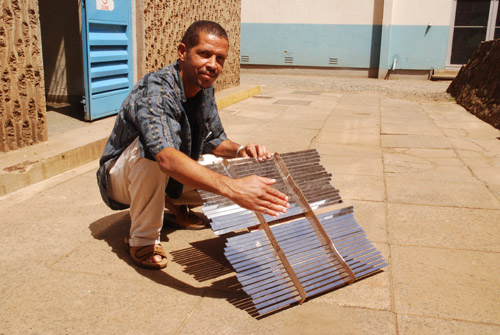
flat parabolic mirror 2

Everyone knows what a parabolic reflector is, right? It’s supposed to be a curved surface that collects energy by converging it towards a focus. Parabolic reflectors were invented a very long time ago and have been used in satellite dishes, spot lights and car headlights to name a few. They are also widely used for alternative energy projects to concentrate solar energy for heating and cooking.

Dominic (designer of the flexible solar vest, the solar dryer, and camel milk cooler for Somalia) thinks that the parabolic mirror should lose it’s shape which is an obstacle, to transportation and function.

So how does the flat parabolic mirror work? Dominic has cut inch wide 2 foot long pieces of flexible acrylic mirrors and arranged them at specifically computed angles. When angled towards the sun, this creates a perfectly focused beam of light.
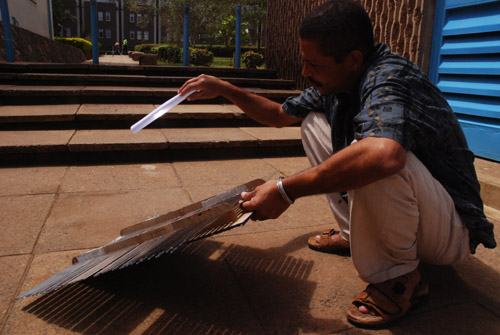
flat parabolic mirror

This concentrated energy can be used to heat water in a pipe for numerous purposes including generating electricity. The beauty of this gadget is that

  1. It is very cheap,
  2. It can be quickly dismantled or moved,
  3. It is easily transportable as it can be carried flat or in a tube,
  4. It is easily repaired if broken as the individual mirror pieces can be replaced (rather than having to fix or replace an entire parabolic mirror).

Please note that this is part of Dominic Wanjihia’s ongoing project with Nairobi University and MIT’s FabLab where he is doing a course.

Fab lab sign .

Video of home made bicycle repair tools and gadgets in Nairobi

In Africa bicycle repair men can be found everywhere, from under a tree to in the local vegetable market, one of the best places to find African innovations.

At the Karen market I met the charismatic Mohammed Makokha who proudly showed me two of his home made gadgets that are critical for his business.

I’ve obviously been wasting my money in the bicycle stores.

Recycling car batteries in Rural Kenya

Maina, Rhoda and little Winnie are  a typical Kenyan family who live on the outskirts of Nairobi in an area that has no electricity.

But they have solved the problem of getting the daily news

rhoda family2

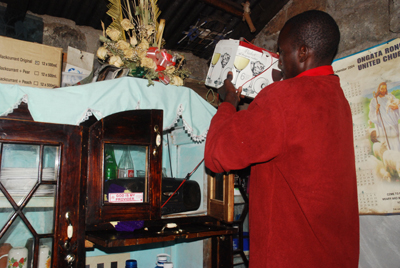
When I visited their home I was impressed that despite the lack of electricity, Maina has come up with an innovative solution and is able to keep up with whats going on and listen to his favourite Kikuyu music all day long!

taking it down

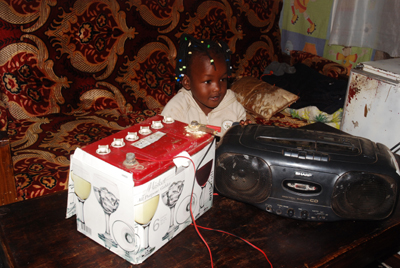
Here’s a better look at the system – a second hand car battery hooked up directly to his radio

Radio charger

The wiring is simple

maina showing

Fully charged the battery last 2 weeks. To recharge Maina has to take it to a place in town for 24 hours at a cost of Ksh 50 (about 80 cents US. If he were to  use ordinary batteries Maina would be paying several hundreds of shillings per month (15$) and creating toxic waste with their disposal (Kenya has no battery disposal system).  No wonder used batteries are in such huge demand!

bicycle ride2

And no wonder this family is smiling!

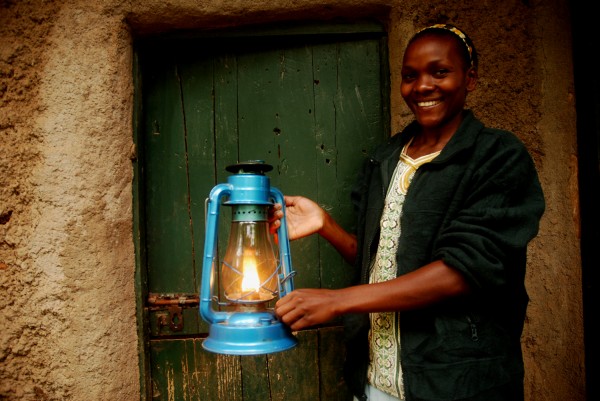
I’m wondering how much it would cost to hook up Mainas battery to a solar panel and  some lights. They currently depend on hurricane lamps.  Powered with kerosene these are not only a weak source of light but are dangerous and prone to cause fires.

rhoda lamp

Got any ideas anyone – can we charge a car battery from solar?

Post note:  This story was found while making a video slideshow about this average Kenyan families carbon footprint for WildlifeDirect.

Solution for Nairobi Blackouts

It’s no secret that Kenya’s rivers are running dry as a result of forest destruction and environmental degradation which has led to a season of blackouts in the capital city Nairobi.

Typical of the ingenious people of Nairobi one street vendor has cashed in on the crisis with this wonderful gadget which he markets as

“Perfect for Nairobi black out”

juakali lamp1

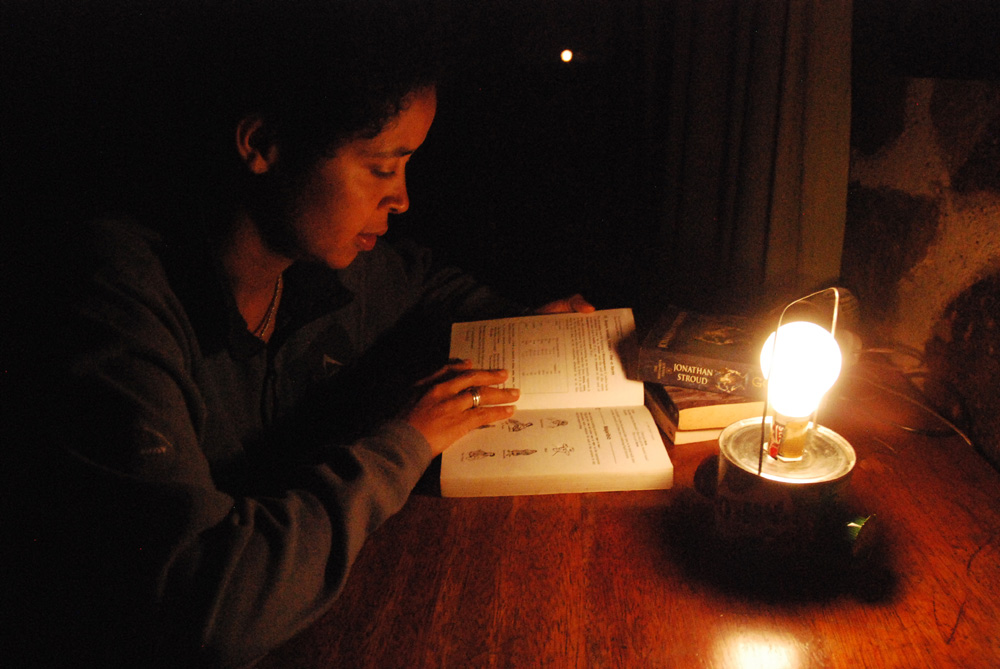
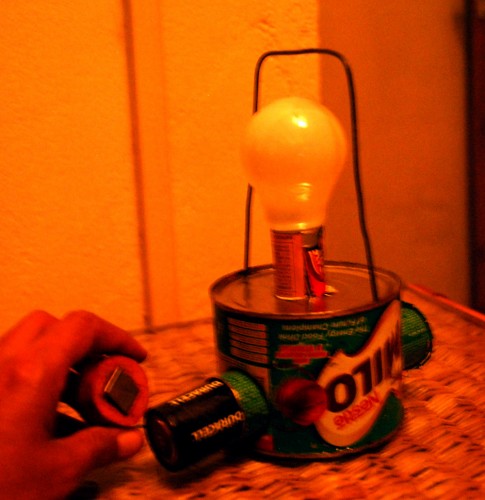
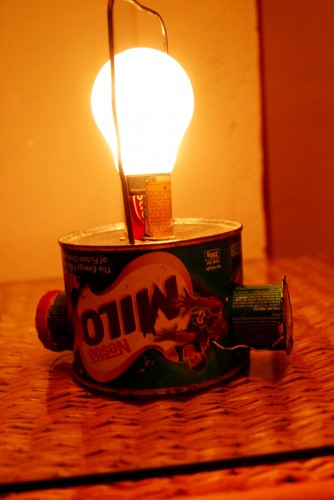
As you can see I could actually read by the light of this lamp which is made from a used tin can, some pieces of wire to make the connections

juakali lamp3

And the battery compartment is ingeniously crafted from a circle cut from a retired flip flop.

juakali lamp2

I love my juakali lamp and everyone that I know  in Nairobi needs one of these lamps. Everything about it is so true to the juakali spirit – hand crafted using colourful recycled tins, and designed for a real purpose with a handle so you can move it around from room to room or hang it up. The vendor tried to sell it to me for Ksh 350 but we settled on Ksh 200 (about $2.50) though I’m sure he would have gone cheaper but the traffic was moving and I had to go.

If you want one visit the Nyayo stadium roundabout.  They stood out amongst the chinese junk that vendors are selling you could practically kit out your house from the junk on sale there. Here’s a short list of what I saw during my 30 minute traffic hold up:

Pens, hats, footballs, blow up spiderman (who needs one of these?), peanuts wrapped in newspaper cones,

smelly car things, driveres licence holding cases, scarves, giant maps, Kenya flags, apples, kits (spiderman kites),

Nike shorts, cowboy hats, socks, oanges, backpacks, cheap watches, key chains knives, olympic medals (yes I wanted one of those!),

knee length shorts for guys who sag, hazard ttriangles, cables to cack your car, name tags for meetings, torches, window wipers (!),

car mats, pears, plumbs, tiny folding chairs for children (or Chinese people?), vehicle number plates, fire extinguishers, stickers,

Enormous framed pictures of furry cats and snow leopards (I can just see one of these this in my house), bananas and bandanas, plastic lunch boxes, pillows and cussions, a huge variety of stuffed toys,

posters with Jesus’ sayings, polo shirts, stearing wheel covers, spanners, screw drivers and of course my favourite – juakali lamps.

Nairobi never fails to impress. I love it. What else have you seen on sale in the Nairobi streets?

Killer Snares turned into artful message

I’ve been meaning to write this post for some time to recognize the amazing work being done by Dipesh Pabari at the Kenya Coast.

When he told me he was turning snares set to kill wildlife into art I didn’t imagine it would look quite like this.

Then he embarked on turning pollution in the ocean into another work of art. This whale shark is the outcome of his labor of love, it’s beautiful and meaningful. Hopefully we all get the message ‘stop killing wildlife and stop polluting the natural environment”. The project is getting a quite some attention.


Last summer as part of their Ocean Project, Camp International, a volunteering organisation running trips to Africa and Asia, coordinated 7 beach cleanups involving gap year students from the UK to cleanup the Kenyan coastline. Over 200 bags of litter were collected which included over 7000 flip-flops. The Camp Kenya School Team Expedition then worked with local artists to create a life size whale shark made out entirely of the recycled flip-flops picked up from the beach.