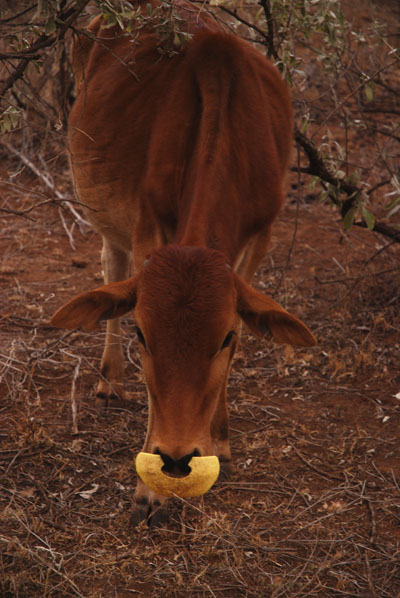
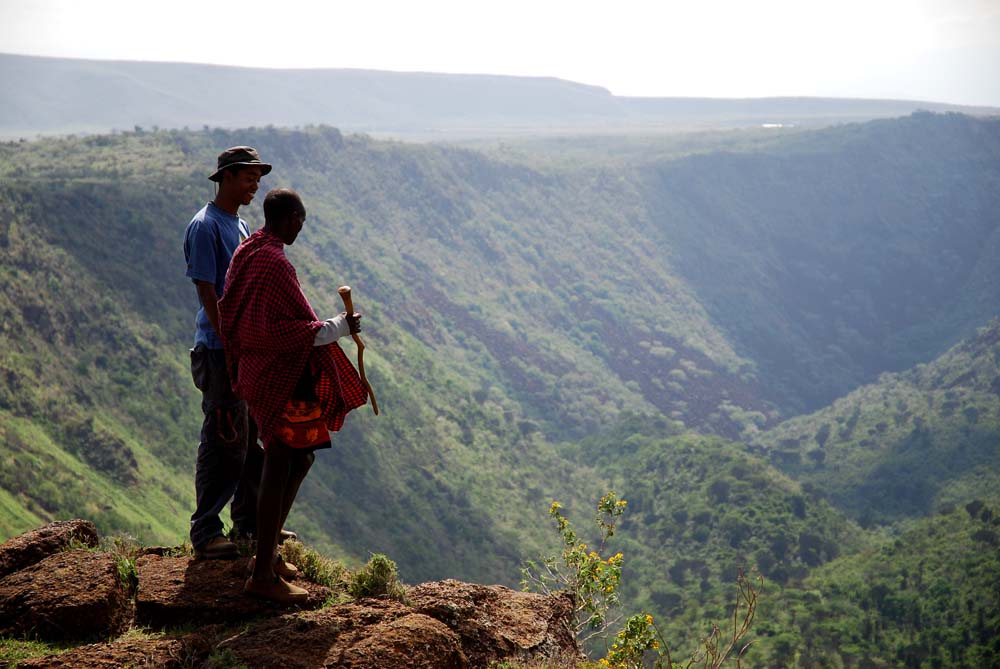
While hiking in the rift valley recently I came across a cow wearing this plastic gadget on his nose. It’s made from an old plastic container …..the local herdsmen said it was to stop him from suckling his mother – which is especially critical due to the severe drought in the region.
Simple and effective I’d say!
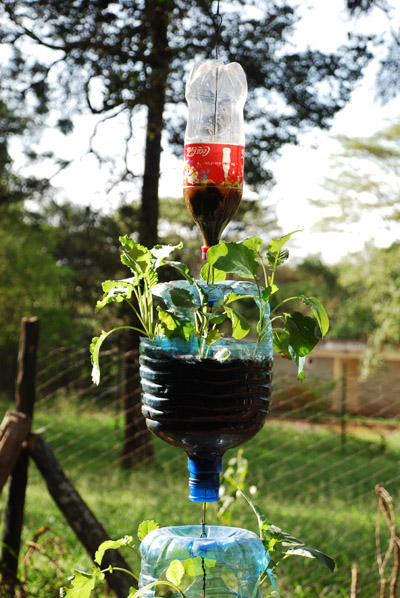
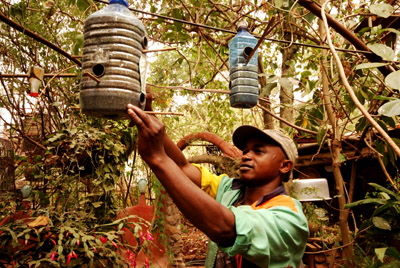
And here’s another one from Dominic Wanjihia – he calls it his vertical shamba
and it’s water efficient and space conserving… perfect for a tiny yard.
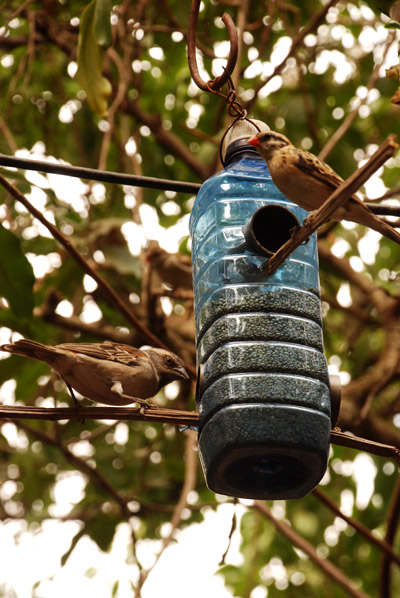
Here’s another clever use of plastic water bottles – bird feeders are impossible to find in Kenya
So Maina Maina fabricated this at Kitengela Glass where virtually nothing is thrown away
These feeders have pieces of mirrors attached and attract a huge assortment of birds at all times. He’s selling them at Ksh 200 (US $2.50 )
Just last week two African inventors won recognition for inventions that involved scrap, bicycles and mobile phones.
William Kamkwamba grew up as a farmer in Malawi, at the age of just 14, he had built his own wind generator.
During a drought his families fortunes collapsed and he spent his time in libraries reading and discovering about wind energy. He found components for his invention in a scrap yard; a tractor fan, shock absorber, PVC pipes and a bicycle frame.
When his prototype was able to run four bulbs people arrived to charge their mobile phone. William has just appeared on TED Global conference in Oxford this week to the conference to tell the audience how he did this.
Another inventor has already appeared on Afrigadjet and has just been discovered by the BBC. Pascal Katana, 22 who with Jeremiah Murimi, 24, has gone beyond fish and has invented a dynamo-powered “smart charger” to help people without electricity in rural areas to charge their cell phones. The system costs $4.50 and it takes an hour to fully charge a cell phone.
These two young men developed the idea during summer break. Wish I had so much energy in my holiday. These guys should be at Maker Faire in Ghana this August.
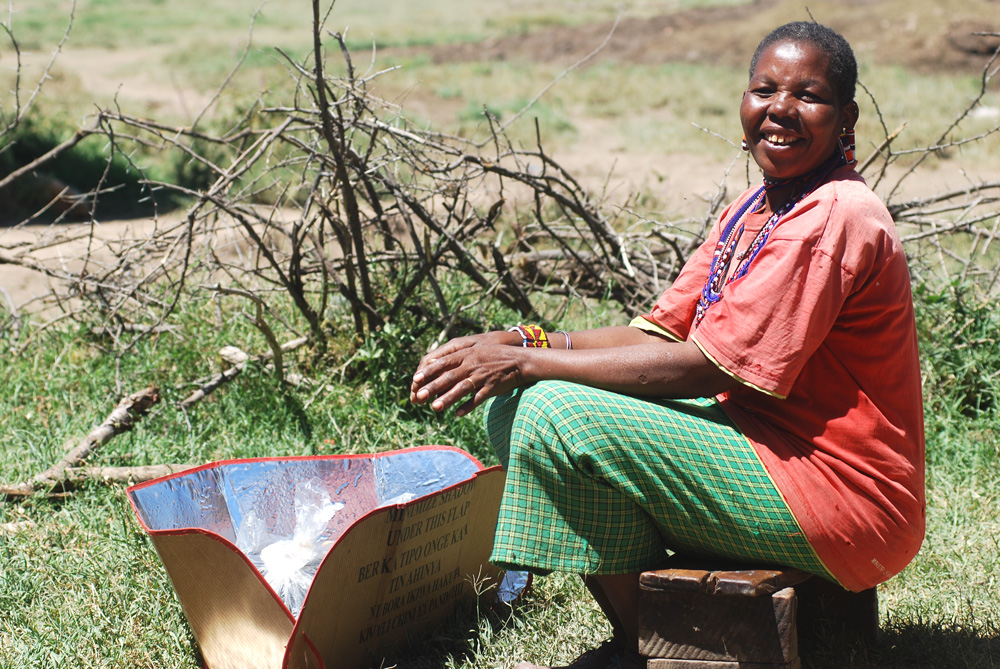
I didn’t believe it possible but I found this lady actually using a solar cooker in the Masai Mara!
Mama solar cooker
Made only of cardboard and tin foil this cooker fold up into a neat little package. It apparently cooks potatoes and cabbage in just 1 hour!
She told me that she got it as part of a study – one solar cooker was given to every manyatta. She couldn’t rememer which organization was handing them out but she has adapted hers by putting her pot into a plastic bag which she says retains the heat better. She says she’ll continue using the solar cooker after the study and will even buy one at Ksh 1,000.
She still has a 3 stone wood fire to cook meat.
I wonder what happens to this device when it rains…does the cardboard become a sodden mess?
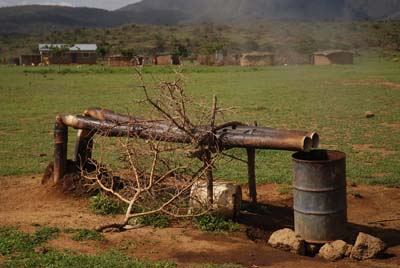
A unique water harvesting method has been devised in the drought ridden crater of Mt. Suswa, which is dotted with continuously puffing scorching steam vents.
Tapping steam for condensation
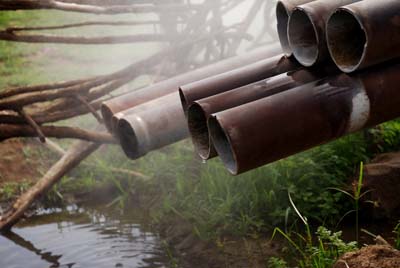
Taking advantage of the steam vents that dot this landscape, local Masai have ingeniously tapped the vents for steam that is condensed on long plastic pipes that drip continuously into drums. The local Masai claim that these vents can fill half a drum (approx 30 lt) per hour (though it seemed very unlikely to us). The water is sweet and apparently it feeds a community of several hundred people and their cattle with fresh and clean water.
We saw at tens of these contraptions in a particular zone within the outer crater of Mt Suswa. All were protected from animals by thorn bushes. There seemed to be an ownership structure amongst the users, some were better constructed, had longer pipes, were better protected and maintained. We were told that the systems were installed fifteen years earlier and it did not look like any modifications had been done since then.
The water distilling system used here is permanent and produces a continuous supply of clean water that is collected regularly by the local community. The system we observed was in the area called Kishalu – just beyond a school. The system could be more efficient at trapping condensation – much steam was wasted as pipes were quite short, and collection drums were left uncovered and open to evaporation. The beauty of the system is that it works overnight. These water distilleries were introduced to enable the community to survive the dry season when rain water catchments had dried up.
The Suswa system is infinitely better than the water distilling process on the edge of Lake Elamentaita. Here the local Masai Women daily place a piece of zinc sheeting over a steam vent to capture condensation. They produce only 2 liters per day; a days work to produce enough drinking water for a small family for one day.
If there’s an Afrigadget award out there, the Suswa water distilleries deserve it.
For more information about Mt Suswa check out Roving Rasta, and Wild about Africa for satellite images and details about hiking and caves
In a previous post we told you about the Kenya Ceramic Jiko, a fuel efficient stove, it’s such a common stove, we all have one at home. But did you know that it was invented by Maxwell Kinyanjui?
I recently I “discovered” another amazing jua kali fuel efficient stove – I was at a private party enjoying a fantastic barbeque meal with 100 other guests. I stole around to the kitchen where there was no oven, but out back a tiny aluminium stove that was producing enormous amounts of food with an impossibly small amount of charcoal.
I’ve since come across it again at a private ranch where only the cook knew how to operate the thing to bake the most amazing cakes.
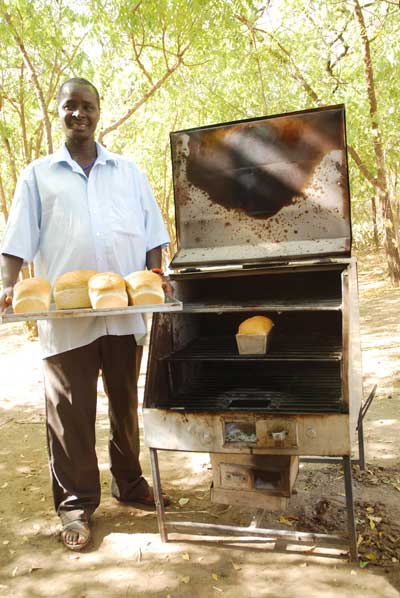
Baking Bread in Baringo
And at Roberts Camp 100 miles north on the shores of Lake Baringo where the chef told me that one only used a tiny amount of charcoal, he lets it cool down somewhat and then let the bread bake without opening the oven until done (I guess he can tell from the smell?)
Fuel efficiency stoves
In recent months I’ve noticed these wonderful stoves everywhere, on roadsides and in jua kali markets. I don’t know why I didn’t see them before. They come in a variety of sizes and openings are offered (two door or top hinged). They go for US $100 for a small oven (big enough to bake 4 loaves), and a little more for the bigger varieties. Great for baking, they provide important business opportunities for communities, and underprivileged groups like the Jacobs Oven making business for women and feeding orphans.
This is another of Maxwell Kinyanjuils inventions and it’s called the Kinyanjui Jiko. Maxwell is a household name in Kenya, founder of Woodlands 2000 Trust, he is associated with plantations, experiments with trees for fuel, furniture and new designs of fuel efficient stoves including the Kenya ceramic jiko! Because of the deplorable state of our forests, Kenya is well known for efforts in improving fuel efficiency through stove inmovations – many of which can probably be attributed to Maxwell Kinyanjui. – the man gets two gold stars from me! I went to see Maxwell at his Kitengela Arborretum near Athi River just outside of Nairobi. He laughed when he heard that I was the proud owener of a clone. Yes, his inventions are sold only in Nakumatt and Uchumi. In good spirit he was pleased that the oven has been replicated with some modifications … all good business for the jua kali sector.
I bought one and was just amazed that this stove uses such a ridiculously small amount of charcoal. It is great for baking and slow cooking of vegetables and meat but not so good for traditional nyama choma. A well known Nairobi chef told me that he uses it to perfectly finish meat that has been braised on the traditional bbq. As a food loving vegetarian, I find it is brilliant for slow cooked vegetables –mixture of onions, garlic, potatoes, pumpkin, beetroot, aubergines, chopped on a tray and sprinkled with some salt, rosemary or other herbs, and olive oil …absolutely spectacular results at a very low cost. Bread and cakes have so far eluded me.
Want one? Order it here
Musaki Enterprises Ltd.
Po Box 23058, Nairobi
Lower Kabete
000804
Phone: 0724690352 or 0713564768
Email: teddykinyanjui@hotmail.com or musakitrade@yahoo.com
We use cookies on our website to give you the most relevant experience by remembering your preferences and repeat visits. By clicking “Accept”, you consent to the use of ALL the cookies.
This website uses cookies to improve your experience while you navigate through the website. Out of these, the cookies that are categorized as necessary are stored on your browser as they are essential for the working of basic functionalities of the website. We also use third-party cookies that help us analyze and understand how you use this website. These cookies will be stored in your browser only with your consent. You also have the option to opt-out of these cookies. But opting out of some of these cookies may affect your browsing experience.
Necessary cookies are absolutely essential for the website to function properly. This category only includes cookies that ensures basic functionalities and security features of the website. These cookies do not store any personal information.
Any cookies that may not be particularly necessary for the website to function and is used specifically to collect user personal data via analytics, ads, other embedded contents are termed as non-necessary cookies. It is mandatory to procure user consent prior to running these cookies on your website.