Mubarak Abdullahi’s home-made helicopter takes Nigeria’s Kano Plains by storm

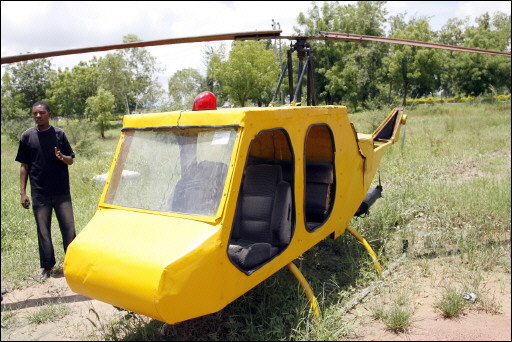
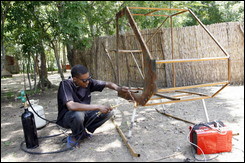
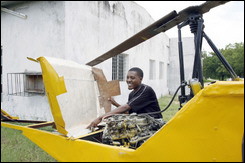
Yahoo! News (among other sources) carries a story from October 21st about Mubarak Muhammad Abdullahi of the Kano Plains of Nigeria who has built a working helicopter over the last 8 months using scrap aluminum and parts from a Honda Civic, an old Toyota and from the remains of a crashed Boeing 747.

This inventor has had no formal training in flying and his helicopter has never flown higher than 7 feet of the ground. In an interview, he talks about how the machine works:

Mubarak Abdullahi’s home-made helicopter

“You start it, allow it to run for a minute or two and you then shift the accelerator forward and the propeller on top begins to spin. The further you shift the accelerator the faster it goes and once you reach 300 rmp you press the joystick and it takes off,”

Mubarak is ambitious however and has embarked on a new project to build a better helicopter that will be able to make 3 hour flights. He hopes to get support for his project from the Nigeria Civil Aviation Authority (NCAA) and other Nigerian government bodies.

Mubarak Abdullahi’s home-made helicopter  Mubarak Abdullahi’s home-made helicopter

HAPV – Human and Animal Powered Vehicle in South Africa

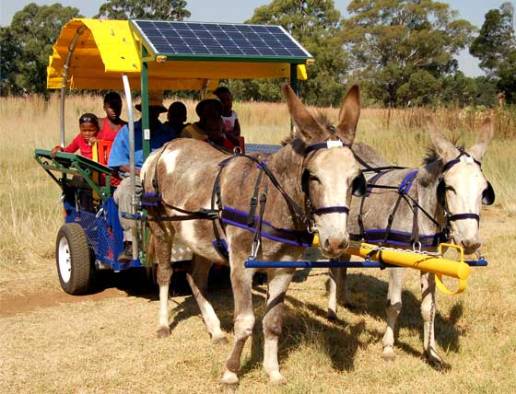
The HAPV (Advertised as HAPPY) is a twist on the ‘horse and buggy’ mode of transportation, making this a donkey, cart, solar panel on a canopy FUV (Farm Utility Vehicle) that is quite ingenious and absolutely AfriGadget. A donkey drawn carriage is commonplace in many countries in Africa, and this retrofit by the organization Water and Wheel adds more functionality and utility especially suited for rural Africa.

HAPV

Fitted with a solar panel that charges a 12 volt battery under the driver’s seat, the “HAPPY” becomes an independent, sustainable source of energy that powers cell phone connectivity, front and rear emergency lights and a small neon tube at night. Add a water filtration system, and the “HAPPY” doubles as a multi functional mobile business unit, that can empower an entrepreneurial owner, to generate income from it as a fresh water outlet, a mobile phone kiosk or a spaza shop – even after dark.

Read more about it here.

(Hat tip Mweshi)

Note: Erik Hersman (White African) was interviewed a few minutes ago on BBC, a podcast will be available in a day or two and we will be sure to share it here (link).

The VIP – an invention from Zimbabwe

Ingenuity, obviously, isn’t only limited to the African continent, as it is especially found in societies where access to resources is limited. While we’ve been able to witness lots of interesting innovations from other regions of the world that were born out of a lack of readily available solutions, we must also not forget that a few smart ideas were actually developed in Africa and have since then conquered the world.

One of such smart ideas is the Ventilated (Improved) Pit Latrine, in short: the VIP – which was developed as the “Blair Latrine” by Peter Morgan, who has been living and working in Zimbabwe for over 35 years, researching and developing water and sanitation technologies.
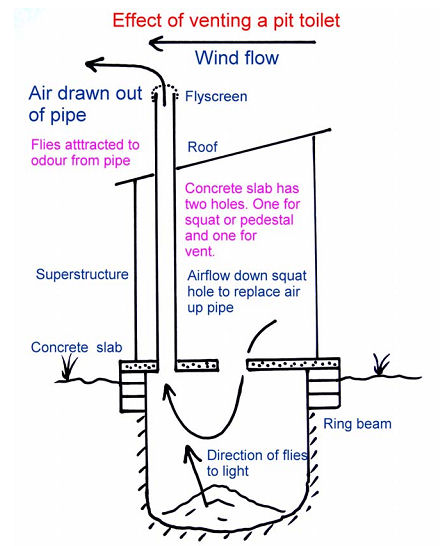
venting a pit latrine
Diagram showing effect of vent pipe on functions of pit latrine (source)

The major advantage of the VIP over a normal pit latrine is that it comes with a ventilation pipe (covered with a durable fly screen on top) which reduces flies and odour. In the absence of other alternatives, the Ventilated Pit Latrine is considered reliable, which explains the success of this technology: over 500.000+ units of this type have been built in Zimbabwe alone and it has proven to work elsewhere around the world.

The VIP clearly isn’t the solution to sustainable sanitation as it comes with a few limitations, but it does function without water and has very low investment, operation and maintenance costs.

Next to some interesting experiments with different water pump systems such as the Blair hand pump (also known as the Zimbabwe Bush Pump) or the spiral water wheel pump, Peter is also active in the field of ecological sanitation and recently published a very interesting booklet titled “Toilets That Make Compost” where he writes about his experiences with compost toilets such as the Arborloo and the Fossa Alterna.
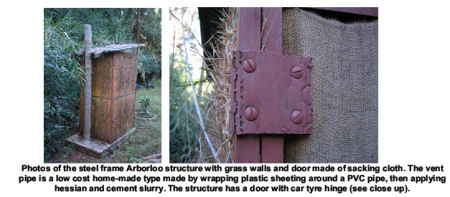
arborloo.jpg
screenshot from Peter Morgan’s manual on how to build an Arborloo (PDF,~ 3,1MB)

While there’s no single sanitation concept that will work in all places around the world, the VIP for one is a proven technology which has been accepted by its users since 30 years.

Street Meat Heater: A Simple Solution

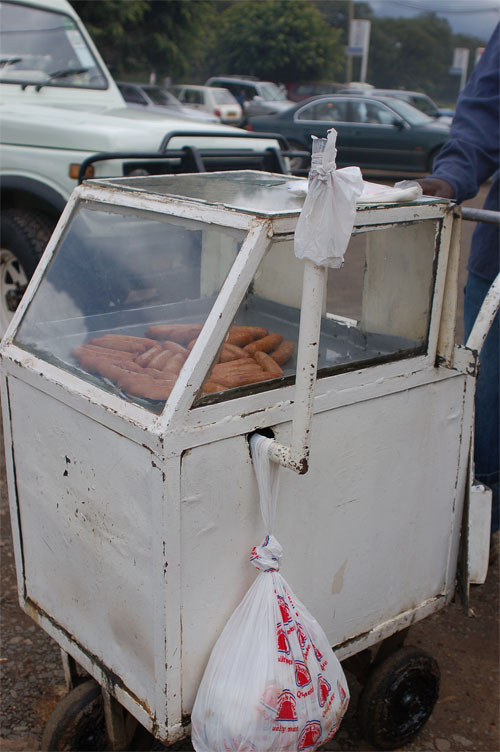
Simon Kasiraba is one of many sausage vendors found in the cities and small towns throughout East Africa. He’s the prototypical micro-entrepreneur trying to make a living by supplying a need (food – conveniently available). He’s on AfriGadget because of the simple innovative solution that he employs to keep his food ready to be eaten at all times of the day – which is very important when you’re set up beside a bus stop.


Sausage Cart - Simple Heating for Street Meat

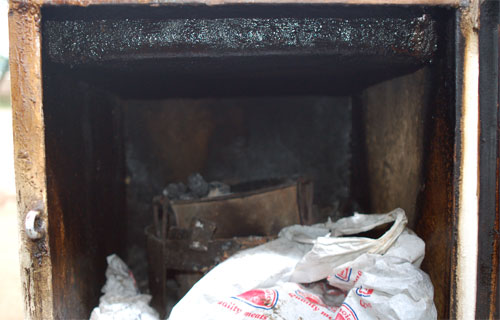
He keeps the meat warm using steam, with a simple charcoal heater placed inside the body of the sausage cart. The water goes into the pipe on the side of the cart, and floods a water panel directly underneath the meat. When it gets hot, the steam keeps the sausages warm, yet juicy. The cart cost him 14,000 shillings (about $200). He sells each sausage for 10 shillings (about 0.14 cents).

Here is a video of Simon showing me his sausage heating cart:


Images of the sausage heating carts can be found in the AfriGadget Flickr image pool.


Inside the Sausage Heating Cart

If you have any stories that would fit well on AfriGadget, contact us, we’d love to hear from you!

“I Try and I Make”

I found a story about a young Malawian who had built a windmill from scratch to help power the lights in his rural home. When I showed up at TED Global in Arusha in June, I had no idea that I would meet him. At that point, he hadn’t been introduced to the larger TED community, so I was this lone excited voice squawking about how thrilled I was to meet him.

2 Days later, William Kamkwamba was introduced to the TED community on stage: