Fighting Hunger, One Village at a Time

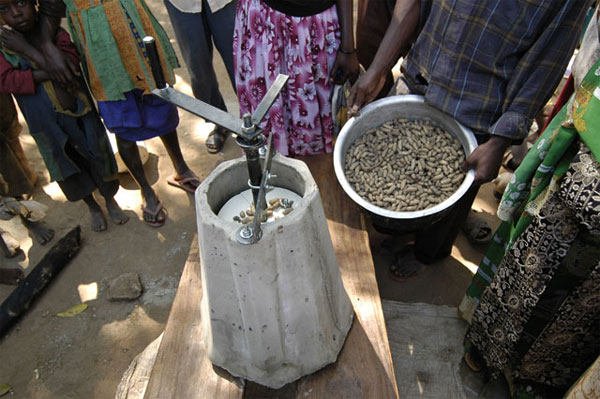
The Universal Nut Sheller (UNS) is part of the Full Belly Project. It’s really an amazing story about a device that has had a direct impact on a number of African countries. The story goes that Jock Brandis, an American inventor, was on a trip to Mali and saw some women who had been shelling peanuts leaving them with bleeding hands. This spurred him on to create a device that would help end hunger.

The Universal Nut Sheller in Africa
(Watch a video of a pedal-powered one in action)

How does it work?

The process works by centrifugal force and friction. The Universal Nut Sheller is basically a concrete cone within a cone, open at the top and bottom, with the interior cone being solid. The interior cone, or rotor, rotates on a shaft and has an attached handle (Note: only one moving part!). The user turns the handle around fast enough to spin the nuts to the outside through centrifugal force. The nuts fall between the surfaces and are rolled and squeezed, allowing the nuts and shells to fall through to the bottom. This mix of nuts and shells is then winnowed out, the old fashioned way.

Reach and Impact
According to the Full Belly Project, this machine is being used in 12 African nations, including; Mali, Uganda, Malawi, DRC, Gambia, Ghana, Kenya, Nigeria, Senegal, Sierra Leon, Sudan and Zambia.

The nut sheller is being used to shell more than just peanuts. As new villages take up the device, they turn it towards their own diverse nut shelling needs, such as jatropha, neem nuts, shea nuts or coffee.

Most importantly, he Universal Nut Sheller costs about $50-75 dollars to make, depending on the price of local materials, and will serve the needs of a village of 200 to 1000 people.

Like two past projects that we’ve highlighted on AfriGadget, this one is encouraging. Both the recently profiled see-saw power machine (possibly), and the KickStart pumps are based on the belief that sustainable economic growth comes through empowering local entrepreneurs to start, or extend, their businesses. In fact, the plans for the UNS are free and downloadable.

(Via Kaushal)

African Toys – A Pictorial

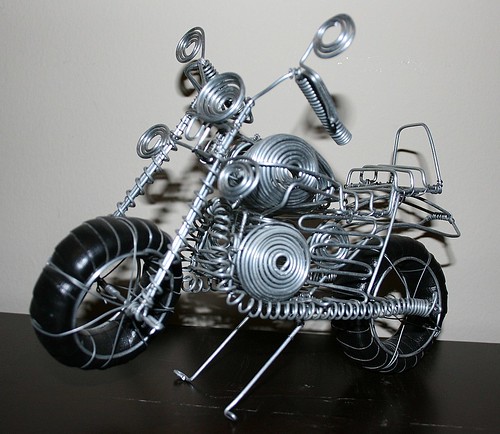
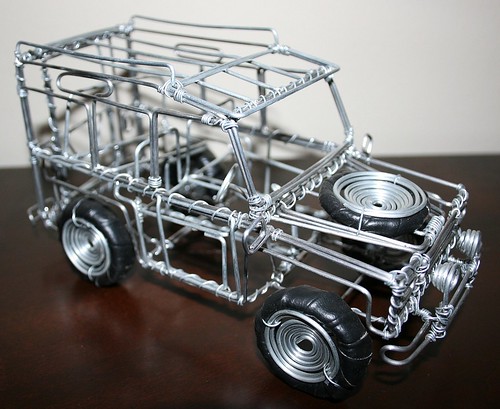
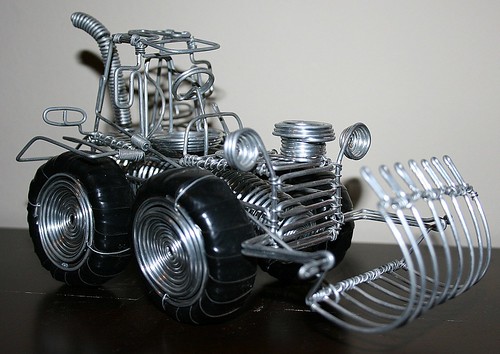
We hope you enjoy these pictures of toys from Kenya and Ghana. They are a sampling of the pictures on the AfriGadget flickr group. The materials used to make these toys are scrap metal, tins, wire, and pieces of leather.

Wire Bikes

Ghana
Colorful bikes

Toy Bikes

Spray can wheels

Bikes

Red Dynamo

Tall Bike

Wire Motor Bike from Kenya

Wire Bike

Cars and Tractor

Tin Cars from Ghana

Toy Cars

From Kenya:
Wire Landrover

Wire SUV

Wire Tractor

Wire Tractor

Affordable solar charger for Mobile Phones

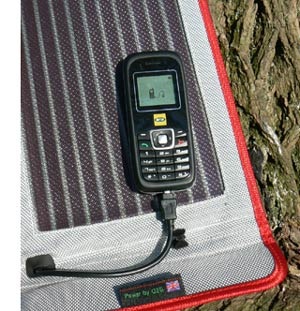
Our friend Ken Banks of Kiwanja.net and NGOMobile wrote about the challenge of mobile phone charging in off grid Africa; noting that this solar powered charger could be one of the solutions. 75802145-B69F-4065-A5DC-C40CA6D90D4B.jpg

I quite agree; two years ago i bought a similar solar powered charger that cost $99. The charger pictured above is made by G24 innovations, and costs $20. This is just the kind of technology that AfriGadget likes, because it is not only quite handy to have, but it is empowering and well suited for off-grid rural areas in Africa,  California or anywhere with sunlight for that matter. Ken explains it best…

In some rural areas, where the lack of reliable mains power might be the difference between making it worth owning a mobile or not, a small solar panel such as this could be a deal clincher. Of course, solar energy has been touted as a solution for charging mobile devices for years now, but what’s interesting about this is the cost. Suddenly, it actually seems possible. And by possible, what I really mean is affordable.

Read more about the device.

The Bamboo Bike project

The Bamboo Bike, an endeavour that aims at building bicycles in a sustainable fashion using bamboo as the primary construction material, is a joint project run by Craig Calfree of Calfree Design, a high tech bicycle design firm based in California and The Earth Institute at Columbia University.

The bicycle is the primary mode of transport in Africa and it is used for everything from personal transportation to moving medicine and the sick to hospital. Sadly, the design used in most of Africa has not changed for the last 40 years to take into account the different ways in which the bicycle is used. In fact, most bikes in use in most of Africa today are based on a colonial British design tailored to individuals travelling short distances on smooth roads.

Bamboo Bicycle Project - Bike Assembly  Bamboo Bicycle Project - The Bamboo Bike

While making bike frames based on bamboo is not a new idea, most bamboo frame designs simply use bamboo for construction material in a traditional bike frame design. Leveraging the unique properties of bamboo such as its strength and flexibility to meet the specific needs of populations local to various parts of Africa is one of the primary rationale behind the Bamboo Bike project.

The team working on the Bamboo Bike project in the US, Ghana and Kenya among other locations have a interesting blog (last updated in the summer of 2007) that chronicles the struggles of the project team while on site in Africa.

Project gear including Bamboo Bikes and clothing is available on the Bamboo Bike and Calfree Design websites.

Bamboo Bicycle Project - A Ghanian Village Elder on the Bamboo bike  Craig Calfree and the Bamboo Bicycle Project

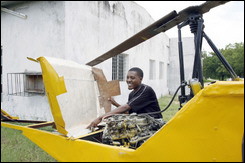
Mubarak Abdullahi’s home-made helicopter takes Nigeria’s Kano Plains by storm

Yahoo! News (among other sources) carries a story from October 21st about Mubarak Muhammad Abdullahi of the Kano Plains of Nigeria who has built a working helicopter over the last 8 months using scrap aluminum and parts from a Honda Civic, an old Toyota and from the remains of a crashed Boeing 747.

This inventor has had no formal training in flying and his helicopter has never flown higher than 7 feet of the ground. In an interview, he talks about how the machine works:

Mubarak Abdullahi’s home-made helicopter

“You start it, allow it to run for a minute or two and you then shift the accelerator forward and the propeller on top begins to spin. The further you shift the accelerator the faster it goes and once you reach 300 rmp you press the joystick and it takes off,”

Mubarak is ambitious however and has embarked on a new project to build a better helicopter that will be able to make 3 hour flights. He hopes to get support for his project from the Nigeria Civil Aviation Authority (NCAA) and other Nigerian government bodies.

Mubarak Abdullahi’s home-made helicopter  Mubarak Abdullahi’s home-made helicopter