What Do You See?

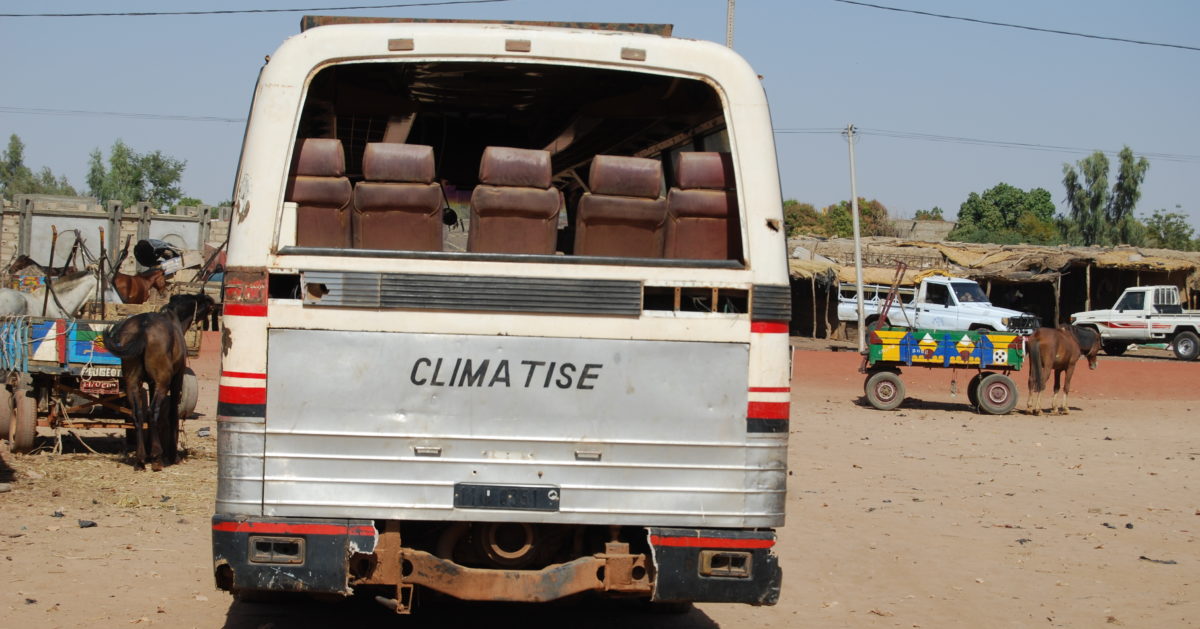
I have a talk that I give when people ask me to speak on AfriGadget at conferences that is called, “What do you see?”. It’s a visual and interactive quiz where I take the audience through different images of AfriGadget and ask them what they’re looking at. It’s a lot of fun, and it proves to everyone why it’s so hard for people in the West to come up with contextually relevant life hacks in Africa.

Below are some images from an old family friend who has spent his life working in rural Southern Sudan and Kenya. Under each image you’ll see why it’s interesting. By the way, I too missed the relevance of the flip flops at first glance…
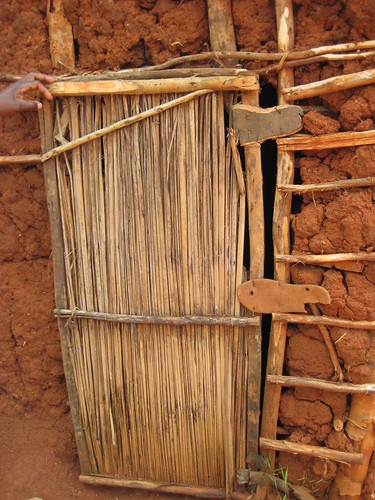

Old flip flops made into door hinges

Making use of available resources for a hinge. I really like the way that Ben has used these old slippers and shoe for the hinge of his small kiosk/shop at Butere.
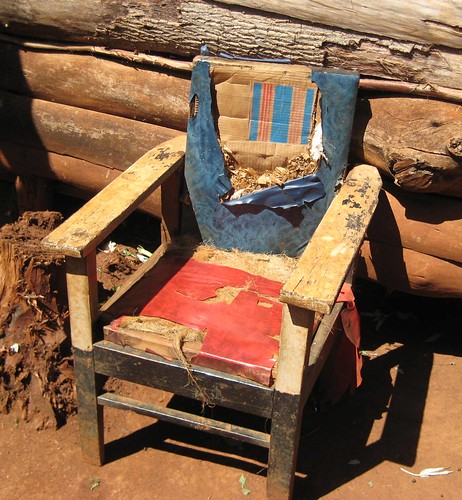

Home made African chair

This old chair at Mahanga in Western Province shows the ingenuity of the local carpenters in making use of available resources, with the carton and stuffing from sisal and wood shavings.


Bottles and plants in Kenya

Using available containers in a nursery for medicinal plants in Asembo area of Western Kenya.
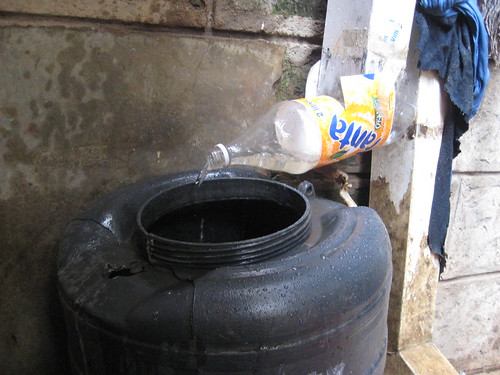

Fanta bottle pipe

Making use of a Fanta bottle to channel water from the rainwater downpipe to a storage container in Nairobi.

A special thanks to Roger Sharland of REAP East Africa for sending in the pictures.

Maker Faire Africa: Ghana, Aug 13-15

Maker Faire Africa (MFA) is a new event celebrating the innovation, ingenuity and invention within Africa – happening August 13-15 of this year in Accra, Ghana.

Maker Faire Africa in Ghana

We came at this event from a specific angle – we mixed the types of individuals who show up on AfriGadget and Timbuktu Chronicles, and the ethos of the greater MAKE community, all with the blessings of the good folks at Maker Faire. The dates were chosen to coincide with Amy Smith’s and MIT’s International Development and Design Summit (IDDS), which will run for 3 weeks before MFA, also in Ghana.

As Emeka puts it:

The aim of a Maker Faire-like event is to create a space on the continent where Afrigadget-type innovations, inventions and initiatives can be sought, identified, brought to life, supported, amplified, propagated, etc. Maker Faire Africa asks the question, “What happens when you put the drivers of ingenious concepts from Mali with those from Ghana and Kenya, and add resources to the mix?”

How You can Support MFA

get a Maker Faire Africa badge!First off, help spread the word! Let people know where and when it will be. Share the link to the site, grab a badge, blog it.

Second, help us find sponsors. If you know an organization or individual who would like to support this amazing event, put us in touch with them. It could be monetary, or it could be donating some cool gadgets, gear, tools or devices for people to hack on while there. (example idea: we’d love to get some LEGO Mindstorm kits for the local high schools).

Third, come. If you have the time and ability, we’d love to have you, your ideas and your gadgets at MFA.

The Team

In my role as founder of AfriGadget, I’m part of the organizing team to put together Maker Faire Africa, joined by my an excellent group of people including:

Want to get involved yourself? Get in touch!

An Oven Made From a Blockbuster Drop Box

The following story came in from Luca Varaschini (by way of David Sasaki) who was born and raised in Robertsport, Liberia where his father was a doctor. He now lives in Milan, Italy, but was in Robertsport a couple weeks ago for the first time since he left as a child.

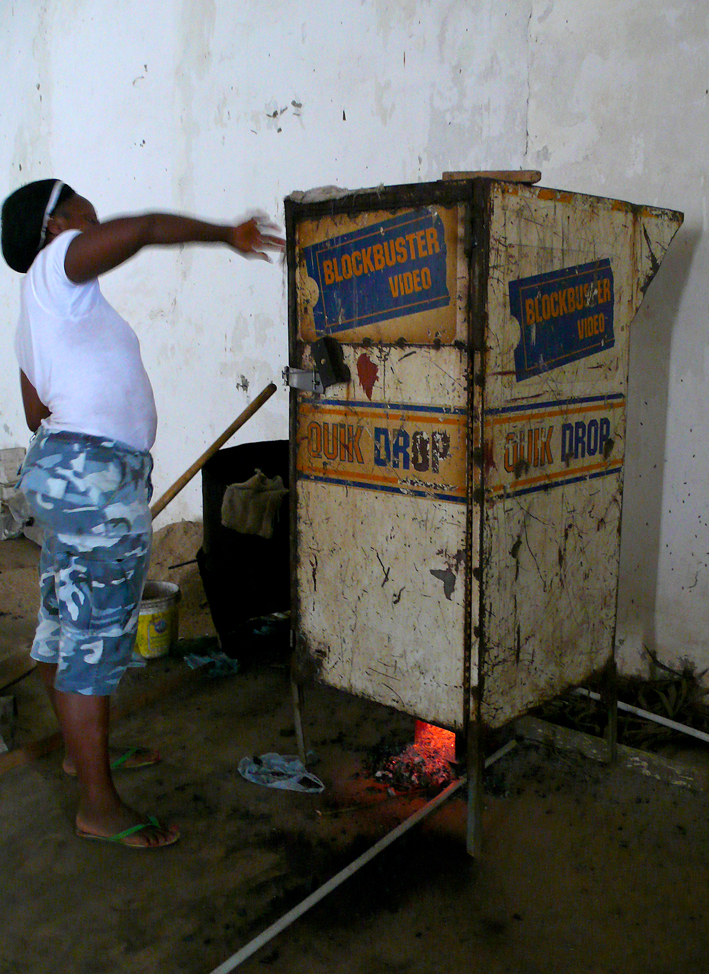
During my first week back in Liberia I had been invited to Hawa’s birthday party, on Sembehun Beach, not far for Robertsport, so I passed some time with the ladies while they were preparing western-style food for everyone: rice, beef stake, pasta and potato salad. Then they started stirring what would have to be two cakes for the dessert, and I started wondering how they’d be able to bake them, since the only cooking apparels in the big warehouse were these coal pits on the ground.

They showed me the oven, a big metal cabinet against the far wall; looks like a refrigerator on legs, to allow a coal pit to fit under the bottom, but when I get near it, I see it’s a Blockbuster Quick Drop Booth! The front, where the slit had been closed, faces the wall and the back door is to access the oven; inside are several fridge trays, on which they lay the pans. The door is then locked with a simple bolt and sealed all around with wet cloths.

The cake was fabulous.

[Editor’s note: I’m find myself incredibly curious trying to figure out where they found this… How did a Blockbuster drop box get to Liberia?]

Harnessing Personal Movement for Power in Rural Africa

Dr. Cedrick Ngalande is an inventor. He’s been working on inventing new ways for everyday rural Africans to create enough electricity to power items like mobile phones or other small electrical devices. In the past, he’s been on AfriGadget for his yeast + sugar rotary electricity generator.

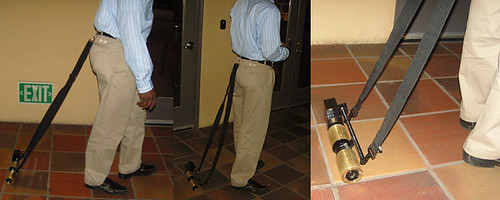
Today he has announced a new project called Green Erg, which harnesses (literally) a person’s movement energy to create electricity.

Harnessing Personal Movement for Power in Rural Africa

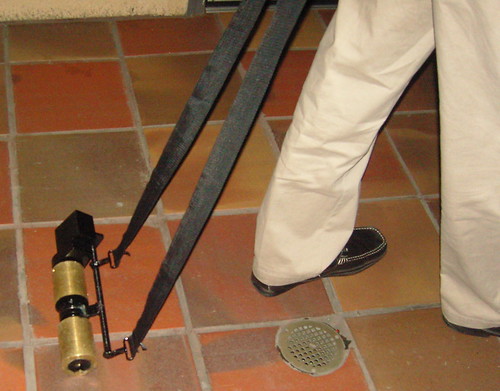
“This is basically a dynamo which is being driven as a result of friction between the ground and the blocks. The small yellowish blocks (these are covered by rubber in the real commercial product) rotate as you pull it. They are designed to rotate even on bumpy run even roads. We have tested it on moist lawn and have worked. It is very smooth so much that you basically don’t feel any disturbance as
you move along.

At normal walking speeds we have gotten more than 2 watts which is more than enough for running cell phones or radios. I envision that people will attach this to themselves and walk with it – or even attach it to an ox-cart, a skating board, bike, etc.”

africa-energy-device2

Re-using a wheeled carriage for babies to make a living

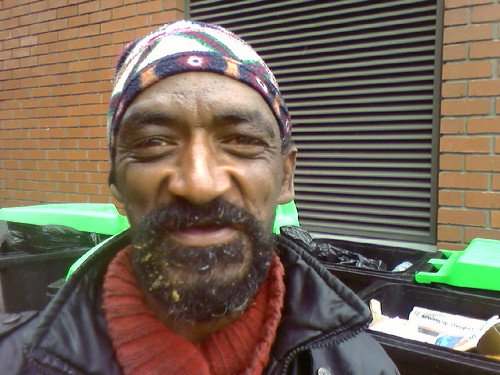
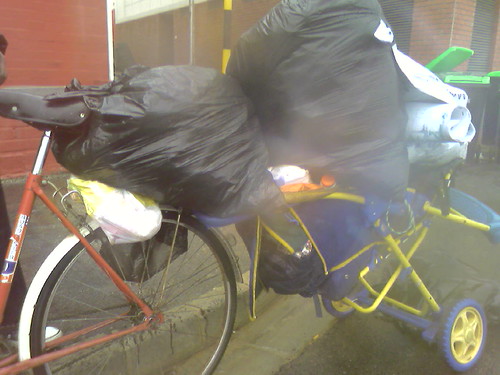
Madmoet Abrahams has been living and working on the street for more then 20 years now. He found a great way to make a living. Everyday you’ll find him in the streets of Cape Town, South Africa collecting White paper. 1 KG of White paper will pay him 23 South African Rand (approximately $2.35) at the paper scrap yard.

Madmoet Abrahams

Per day he makes more or less 50 Rand. He is a hard worker. I met him in the pouring rain, which didn’t stop him from spitting through the bins in search for more paper. He saved money and bought a bicycle for 300 Rand last year. The bicycle, in combination with his creative re-use of a wheeled carriage for babies connected to it, allows Madmoet to make twice as much money per day! His big dream is to have a paid job and a house.

This friendly, clever and hard working man can be reached under the Sunlam bridge in Cape Town or somewhere on the street…

Madmoet explains where to go with the paper
The tools to success..