After all these fascinating AfriGadgets from Maker Faire Africa, here’s another invention as seen by our friend Cedric Kalonji, a Congolese journalist in Kinshasa (D.R.C.):
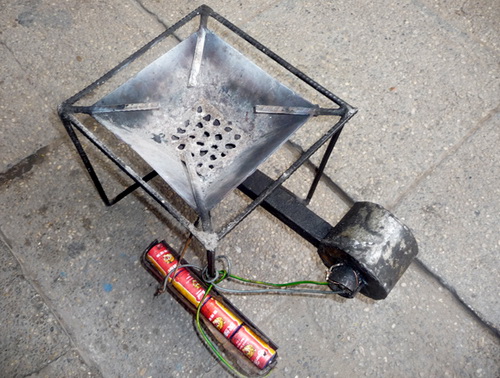
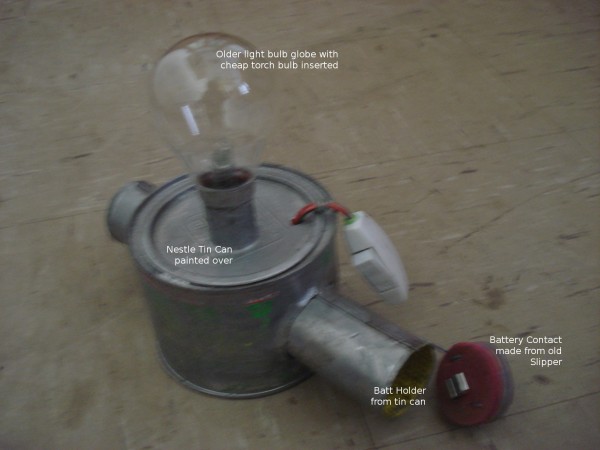
For the lack of a cheap power supply in the City of Kinshasa, smart mechanics came up with this little stove that speeds up combustion by adding a little electric fan (hidden inside this tube that looks like being part of a flat spring). The fan itself is powered by (Chinese!) batteries and with the burning of charcoal, this quick stove obviously isn’t the greenest solution. But it works and does the job for those who will otherwise have no alternative.
Cedric also mentions on his blog post that it’s difficult to identify the inventor of this device. A perfect example of how low-cost technology easily gets adopted and/or modified (and why intellectual property rights are still a major issue in many places).
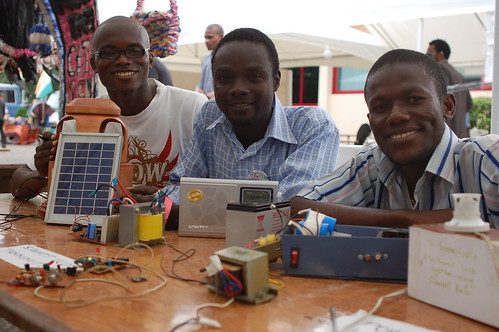
I’m a sucker for radios and antennas, and was just so excited to see the guys from Accra Polytechnic at Maker Faire Africa. Hayford Bempong, David Celestin and Michael Amankwanor are three members of the National Society of Black Engineers who have created a full radio with their own funds and brains.
They showed up at the event and setup the local Maker Faire Africa radio station, running at 101.7 FM. In conjunction with the speakers that they setup for the close proximity announcements, the radio was used to transmit up to a couple thousand meters away and spread the word about upcoming activities.
Basic electronics
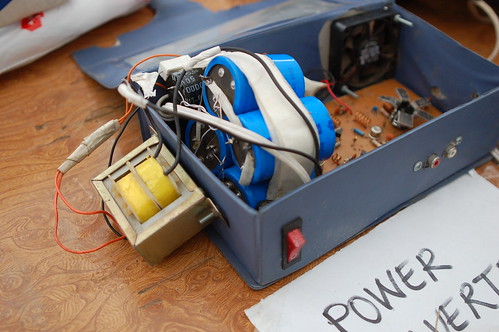
David Celestin has been building power inverters and other electronic devices from scratch since he was a teenager. Below is one of his first power inverters, that still works, and which runs out of a little box. You can tell it is all fabricated from scraps and locally available materials.
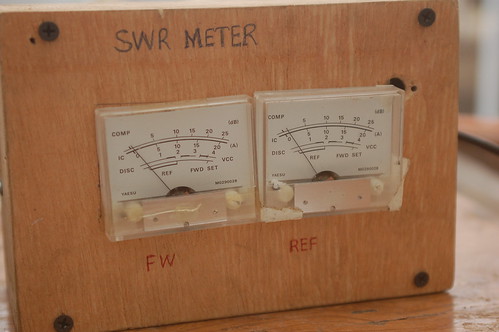
Here is their home-brew VHF SWR meter:
Antennas
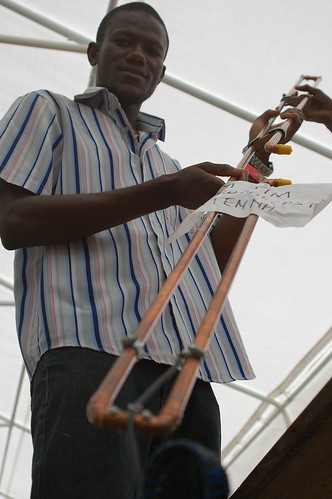
The team also creates their own antennas from scratch, including the “slim jim” below, “ground plane and a circular antenna.
I’m scrambling to put my bags together for Ghana, as I leave in just a day for Maker Faire Africa. There’s only one problem, I don’t have everything that I need, and I’m waiting on a shipment from a California bag company. The good news: I’ve just been told that I’m no longer sworn to secrecy, so I can begin telling the story. Here is the FLAP bag project story (from my perspective) and AfriGadget’s involvement in it.
A little background
Four months ago the Pop!Tech team approached me about their collaborative project with Sheila Kennedy of the Portable Light project, who showed off her solar TB blanket at Pop!Tech 2008, and Timbuk2, the well-known messenger bag company.
Their plan was to develop a bag that has the potential to bring the benefits of portable power to selected global communities around the globe, and they were hoping the I could help with distribution and testing within the African communities that I frequent, where power is crucial. Of course, I jumped right in, this was just too intriguing to not do so, plus I have great admiration for all of the players: Pop!Tech, Timbuk2 and Sheila Kennedy.
The FLAP bag project
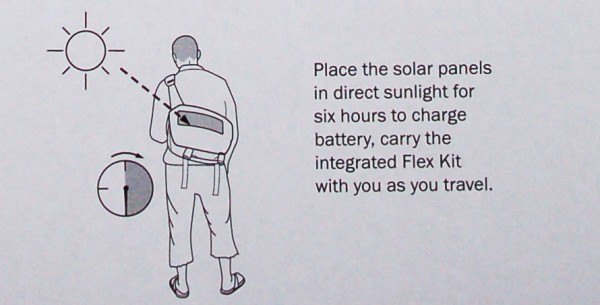
FLAP stands for Flexible Light And Power. The flap on the messenger bag has the single solar panel on it, connected to the tech tray, which has an on/off switch, an LED light and a USB connection. So, in concept, the bag can be used as a portable lighting and power supply unit for anyone. Most useful however, to those lacking consistent power for devices or an electric lighting option.
Image: How to charge the FLAP bag
This bag will be the official Pop!Tech 2009 bag, and will also be sold by Timbuk2 sometime after that. It’s a unique bag that has the potential to change the way a lot of people (not just in Africa) do things. I don’t have detailed information on any of that, so look to the Pop!Tech team for more information on availability.
AfriGadget’s part in this
Due to my fairly extensive travels, dealing with just the right cross section of potential users for the bag, I was in the right place to distribute some test bags for feedback from end-users. My job, over the next three weeks will be to find the right types of people to give a bag to, interview them before and after, and report back on my findings.
My first stop is Ghana, then on to Kenya and Uganda. I have 10 FLAP bags, with plans to hand out 4 in Ghana, 4 in Kenya and 2 in Uganda. To do the interviews, I will have the help of Henry Addo in Ghana (also a colleague or mine at Ushahidi), and with David Ngigi in Kenya (a young videographer and friend). Pop!Tech has supplied us with small video cameras that we’ll be using for the interviews, as well as some starter questions and types of individuals that they would like to see get the bag.
My objective is to find people from many walks of life, from taxi drivers to citizen journalists, and from roadside food ladies to seamstresses. One of my questions is this: can much of this bag be created from locally available materials?
My main goal: find out if it is useful, usable and if its adaptable to everyday life in Africa. The Challenge: asking people how they would adopt these kits, looking for inventiveness.
I won’t be sugar-coating my own reviews, nor those of the people who we interview.
Tune in for more tomorrow
My next post will be pictures of the kits, unboxing of the items that I have received and my initial opinions on them. I’ll also be doing some personal interviews (video diary) of myself throughout the weeks ahead, giving some insights into the day’s events and overall thoughts on the FLAP bag project.
I’ll also be using Twitter for updates, and though I manage the @AfriGadget account, when I get on the road I usually just post from my personal @WhiteAfrican account.
Additional updates from the manufacturer and from the project team will be found on the Pop!Tech blog and the Timbuk2 blog from time-to-time.
Just last week two African inventors won recognition for inventions that involved scrap, bicycles and mobile phones.
William Kamkwamba grew up as a farmer in Malawi, at the age of just 14, he had built his own wind generator.
During a drought his families fortunes collapsed and he spent his time in libraries reading and discovering about wind energy. He found components for his invention in a scrap yard; a tractor fan, shock absorber, PVC pipes and a bicycle frame.
When his prototype was able to run four bulbs people arrived to charge their mobile phone. William has just appeared on TED Global conference in Oxford this week to the conference to tell the audience how he did this.
Another inventor has already appeared on Afrigadjet and has just been discovered by the BBC. Pascal Katana, 22 who with Jeremiah Murimi, 24, has gone beyond fish and has invented a dynamo-powered “smart charger” to help people without electricity in rural areas to charge their cell phones. The system costs $4.50 and it takes an hour to fully charge a cell phone.
These two young men developed the idea during summer break. Wish I had so much energy in my holiday. These guys should be at Maker Faire in Ghana this August.
A ‘stick-up’ Light Bulb like the one shown below sells on Amazon for $3.99
Sample the version we got from Gatundu, Thika District in Kenya. It goes for KSh. 100 ($1.20)
We use cookies on our website to give you the most relevant experience by remembering your preferences and repeat visits. By clicking “Accept”, you consent to the use of ALL the cookies.
This website uses cookies to improve your experience while you navigate through the website. Out of these, the cookies that are categorized as necessary are stored on your browser as they are essential for the working of basic functionalities of the website. We also use third-party cookies that help us analyze and understand how you use this website. These cookies will be stored in your browser only with your consent. You also have the option to opt-out of these cookies. But opting out of some of these cookies may affect your browsing experience.
Necessary cookies are absolutely essential for the website to function properly. This category only includes cookies that ensures basic functionalities and security features of the website. These cookies do not store any personal information.
Any cookies that may not be particularly necessary for the website to function and is used specifically to collect user personal data via analytics, ads, other embedded contents are termed as non-necessary cookies. It is mandatory to procure user consent prior to running these cookies on your website.