A couple weeks ago one of our inspirations for AfriGadget – Emeka Okafor of Timbuktu Chronicles – put forward an idea on the Ned forums about a “Maker Faire Africa“.
The aim of a Maker Faire-like event is to create a space on the continent where Afrigadget-type innovations, inventions and initiatives can be sought, identified, brought to life, supported, amplified, propagated, etc. Maker Faire Africa asks the question, “What happens when you put the drivers of ingenious concepts from Mali with those from Ghana and Kenya, and add resources to the mix?”
The focus here is not on high-tech, but on manufacturing. Specifically, fabrication, the type of small and unorganized businesses that pop up wherever an entrepreneur is found on the African continent. It gets exciting when you think about gathering some of the real innovators from this sector into one place where they can learn from each other and spread their knowledge from one part of the continent to another.
The organizing team will collaborate with the organizers of the International Development Design Summit (IDDS), which will be held at Kwame Nkrumah University of Science and Technology (KNUST) in mid/late Summer 2009, to ensure a well-timed, visible, and celebratory event that draws upon IDDS outcomes and attracts new participants. The aim of Maker Faire Africa 2009 will be to establish partnerships and an organizing infrastructure that could lead to a series of events across the continent.
Needless to say, AfriGadget is 100% behind this initiative and will take an active role in both promotion and organizing, as needed.
When you visit Diani Beach, Kenya’s version the Florida keys, look up and you’ll see 20 rope bridges swinging over the highway – what’s that little bulge with a tail? Before you flash by, you will realise that it’s a monkey sitting up there. Yes it’s watching you! And then, a burst of action as an entire troop of black and white might start galloping across the wildly swaying bridge!
Colous on the Bridge
Colobridges were built by theColobus Trust to save the rare Angolan colobus monkeys from road traffic accidents
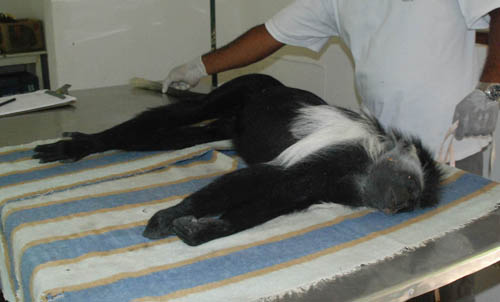
Colobus road kill.."What's black and white and red all over" ... ok I agree, it's not funny.
Faced with a crisis that could eliminate the species in Kenya, innovative solutions were tried from Lollipop stick men at major monkey crossing points, roadsigns to slow down the speed, and education for taxis, stickers in matatus (local buses).
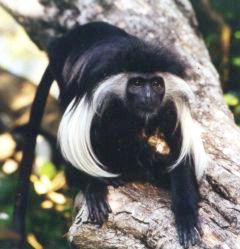
The Angolan colobus is one of Kenya's rarest and most beautiful monkeys found only in the forests of the South Coast
The bridges were the most successful. Designed locally and made of cable, rubber and PVC, each bridge takes a day to erect and costs about $500. The bridges connect two of the monkeys favourite trees on either side of the highway.
Watching the world go by
Being naturally shy, the colobus initially stared at the bridges gadgets with disdain until the more inquisitive and daring Sykes monkey began to see the logic. Once the Sykes and even vervet monkeys started using the bridges, the colobus followed suit, and are now very comfortable with their arboreal walkways.
There are now 23 ‘Colobridges’ and it’s estimated that they are used 150,000 time a year by at least three different species of monkeys! Amazing because there are only 300 of these Angolan colobus monkeys left in Diani where road kills are now rare.
Not for everyone: Bridges have also been deployed in Zanzibar to save the crazy looking Kirks red colobus but it looks like they aren’t clever enough to use them (some species are just slow)! Check out the photos of a confused monkey here
Confused monkey crossing on the road instead of using the bridge!
My plug for my favourite primate “Hug a colobus today”.
Colobridges go global or ‘Australia steals our African ideas’: Though they don’t admit it, the “colobridge” innovation inspired rope bridges to save freaky creatures in Australia too
No, not rats, but a family of ring tailed possums crossing a rope bridge (they look like a pack of terrified rodents to me)
Of course the Aussies always do things bigger and better… check this one out!
Mega rope bridge in Australia - it might help a koala, but not kangaroo's (I hear that road rage against roo's isn't uncommon over there)
Or How to get your camel milk to market in 40 degree C climate.
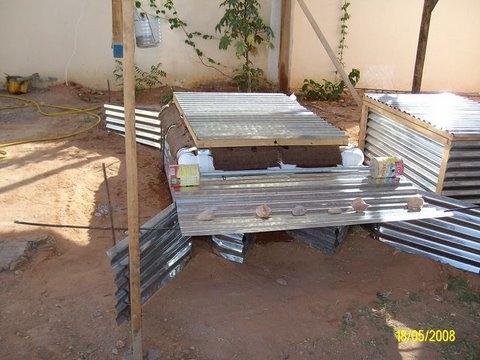
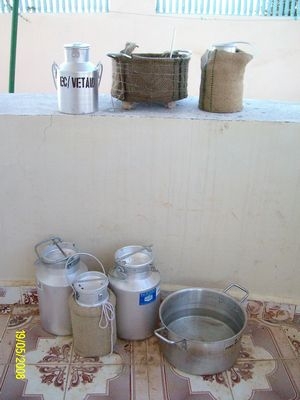
My brother Dominic Wanjihia invented this gadget which he calls Fine Lined Evaporative Cooler, for rural application in Somalia – the cooling of camels milk for transportation . He was working on a project for VETAID, Somali Pastoral Dairy Development Program – SPDDP,in Burao, Somalia June 2008. All this content belongs to Dominic who has allowed me to post it here- please seek his permission to use this content elsewhere dwanjihia@yahoo.com
Cool-box design Fine Lined Evaporative cooler
Evaporative cooling technology
The evaporative cooling concept has been used for centuries in countless applications. Cooling occurs when a fluid changes state from liquid to vapor. Put simply, evaporation. In order to evaporate, the liquid requires energy or heat. It acquires this heat energy from its immediate surrounding. As the surrounding gives up this heat, it lowers in temperature or cools.
The rate at which evaporation occurs depends largely on two main factors, the amount of heat available and the humidity in the air.
The cooler must also be shaded from direct sunlight otherwise the surfaces absorb UV heat and warms up, becoming ineffective as a cooler.
In short
Evaporative cooling devices work most efficiently in windy, dry and shaded conditions
Charcoal cooler
Everyone knows how to make charcoal fridges. After carrying out extensive tests on evaporative coolers in hot arid Burao, Somaliland, with day temperatures as high as 36OC in the shade, the charcoal would absorb ambient heat from the air and as opposed to cooling, would warm up the interior compartment.
Imagine wearing a wet thick winter jacket under the palms at a breezy beach. The jacket acts as a wetsuit and will insulate your body preventing heat from escaping.
Fine lined cooler
However, imagine wearing a wet skintight t-shirt in similar conditions. The water evaporates quite rapidly and cools your body.
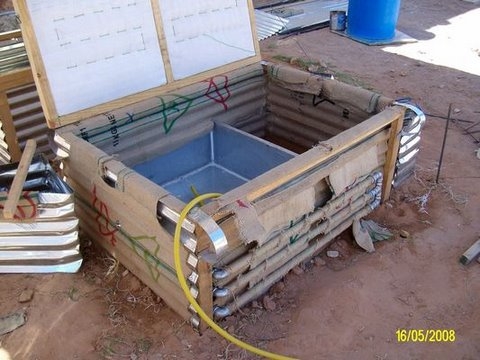
I applied this concept to the cooler prototype pictured and achieved startling results. The cooler would drop as low as 15.5OC at night when temperatures averaged 25OC and maintain under 17OC during the day at average temps of + 32OC.
Evapocooler
Construction
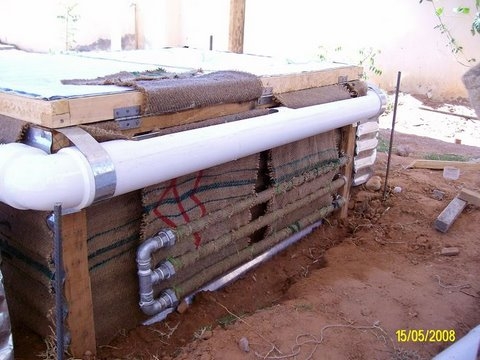
An elevated metal box is lined interior and exterior with a fabric. In this case I used locally available corrugated galvanized iron sheets for the container and sisal sacking fabric for lining. The upper ends of the fabric overhang in a water trough that rings the top of the cooler. Capillary action causes the water to slowly trickle over the inner and outer surfaces. A small vent keeps the interior air circulating and wind guides or tunnels direct air flow over the exterior surfaces. A low speed small solar powered fan can be incorporated in areas where there is not a constant breeze.
How it works
The circulating air in the interior causes evaporation on the wet surfaces. The necessary energy is acquired from the contents hence cooling them and is transfers to the iron sides.
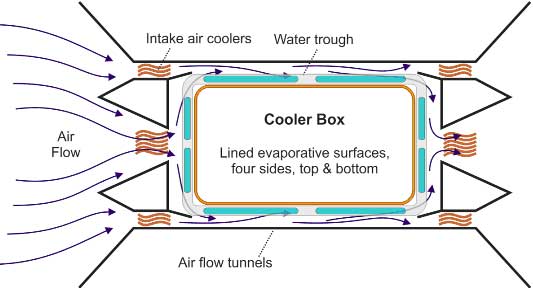
Wind guides or tunnels direct an airflow over the external sides. The evaporation that occurs acquires energy from the sides causing further cooling of the interior.
Convection current system to increase water bath cooling
Construction design
Cool-box with water-bath interior for rapid milk cooling application– Collection Point Cooler
Walk-in cold-room for vegetable storage
Vehicle mounted for long distance transporters
Features (Comparison to conventional charcoal coolers)
Very simple construction
Corrugated galvanized iron or GI sheets increase the surface area
Wind tunnels guide air flow efficiently over evaporation surfaces
Air flow coolers at tunnel entrances
Being galvanized, the sheets are long lasting
GI sheets are affordable and available in most rural areas
Secondhand sacking fabric is available in virtually every vegetable market
The simple capillary action dripping system replaces more complicated dripping apparatus
Convection current system to increase water-bath cooling efficiency
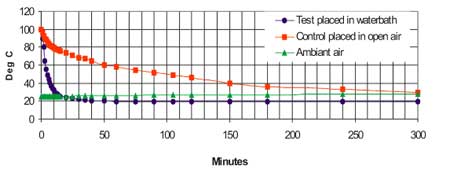
Cool box design with waterbath for rapid drop in temperature of milkThe design simplified
In hot arid regions, cooling the warm ambient air before it reaches the wet evaporation surfaces increase efficiency. Note. Setup for airflow from either direction
level coolers – achieved low’s of 16OC at ambient temp of 30OC +Rapid Temperature Drop Test 4 lts boiling water in aluminum milk churn placed in water-bath at 16OC
For further information and other rural development concepts and innovative designs, Dom can be reached on
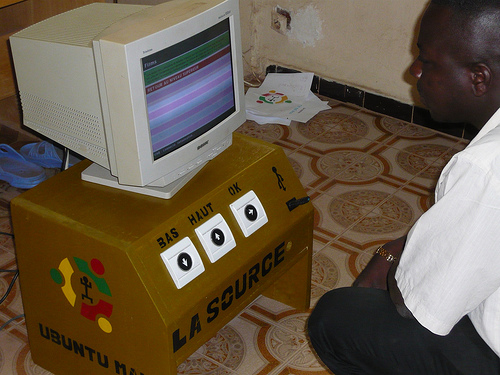
In downtown Bamako, Mali an entrepreneurial bookshop owner, Mamadou Coulibaly, has been attracting an ever-increasing number of clients and curious onlookers since the owner set up an odd-looking computer. “The Source” is a handmade computer box that acts as an offline distributor of online multimedia material. Anyone can step up to the kiosk and pick up anything from Wikipedia pages to local music. Their most popular requests: the Koran and Malian music.
“Our goal is to give people a wider access to educational and cultural material, so this can help to trigger their desire to learn and expand their knowledge.”
This type of innovation really brings home the slow, or expensive, capacity of local internet connections. Bypassing internet cafes (slow) for local, or more static content, can be done through local-only internet hosting too. However, what’s ingenious here is the idea that most people in Bamako don’t need the internet connection at all. That by acting as a simple distribution node for dynamic information and media (the web) they are successfully filling the needs of the local population.
It’s always good to see local-level entrepreneurs benefiting from taking outside ideas and making them work for their needs in Africa. Many times a completely new solution isn’t needed, just a culturally relevant one.
Morris Mbetsa, an 18 year old self-taught inventor with no formal electronics training from the coastal tourist town of Mombasa on the Indian Ocean in Kenya, has invented the “Block & Track”, a mobile phone-based anti-theft device and vehicle tracking system.
The system, that Mbetsa created by combining technology from projects that he has completed in the past, uses a combination of voice, DTMF and SMS text messages over cell-based phone service to carry codes and messages that allow control of some of a vehicles’ electrical systems including the ignition to manage vehicle activation and disabling remotely in real time.
Another feature of the system is the capacity to poll the vehicle owner by mobile phone for permission to start when the ignition is turned in real time as well as eavesdrop on conversation in the vehicle.
Mbetsa is now looking for funding to commercially develop his proof of concept and bring it to the market as reported on this video carried on the Kenya Television Network earlier this year.
We use cookies on our website to give you the most relevant experience by remembering your preferences and repeat visits. By clicking “Accept”, you consent to the use of ALL the cookies.
This website uses cookies to improve your experience while you navigate through the website. Out of these, the cookies that are categorized as necessary are stored on your browser as they are essential for the working of basic functionalities of the website. We also use third-party cookies that help us analyze and understand how you use this website. These cookies will be stored in your browser only with your consent. You also have the option to opt-out of these cookies. But opting out of some of these cookies may affect your browsing experience.
Necessary cookies are absolutely essential for the website to function properly. This category only includes cookies that ensures basic functionalities and security features of the website. These cookies do not store any personal information.
Any cookies that may not be particularly necessary for the website to function and is used specifically to collect user personal data via analytics, ads, other embedded contents are termed as non-necessary cookies. It is mandatory to procure user consent prior to running these cookies on your website.