Fuel saving Sufuria

Here’s another interesting idea from Dominic Wanjihia (see links to his other gadgets below) – the fuel efficient Sufuria. A sufuria is the aluminium pan that is used by virtually everyone in Kenya to make tea, ugali and for cooking vegetables. Like all pots that we use, energy is wasted around the sides of the pot. In Africa this is expensive as fuel be it gas, kerosene or charcoal  is expensive. sufuria 1

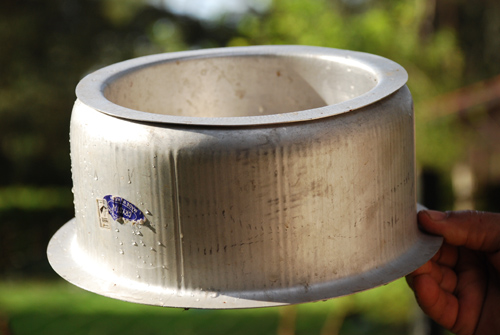
This is what it looks like when assembled

Sufuria Kenya afrigadget

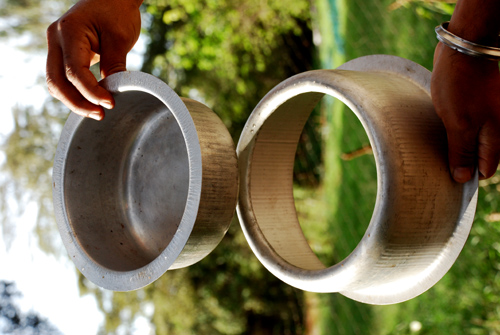
This is what it is comprised of – two sufurias to make one efficient one. Basically a hole is cut out of the bigger sufuria – and the piece cut out becomes the lid so nothing is wasted. To wash the sufuria you just dismantle the pieces by just slipping it out. The heat that otherwise escapes around the edge of the pan, is trapped between the cooking pot and  it’s sleeve.

Though it’s not in production, Dominic is using this sufuria at home and swears that it saves at least 50-75% energy on a kerosene stove (his estimate is based on how long it’ takes to boil water).

So if you put a fuel efficient sufuria on a Kinyanjui fuel efficient stove I wonder how much energy saving you could achieve?

Dominic Wanjihia has been previously on Afrigadget showcasing his flat parabolic mirror, container garden, wearable Solar Panel vest, Food dryer, and camel milk cooler.

Rim Stoves: Cooking MamaPut Goodness

I love street food. Everywhere I go, from street markets in Russia, to back alleys of Beijing to side streets in Skopje, to the boulevards of Bamako, I make it a point to eat as many meals from roadside stands as possible. Ghana and Nigeria are no exception. In fact, I love me a MamaPut.

Its only where Mama herself is there to put more of her good eats on your plate, that I really feel I’m getting a good meal. Why? Because I can see ever step of its preparation, talk with the chief personally, and share the transcending bond of food with my fellow man and woman.

Now I wouldn’t call myself a street food expert – I’m not discerning enough for that title, but I am observant in the different styles of edibles vendors. In West Africa, I’m particularly impressed by the stock street food cooking apparatus. Simple, cheap, and recycled, I present to you the “Rim Stove”.

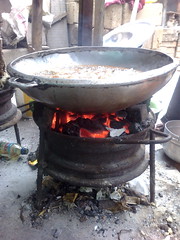
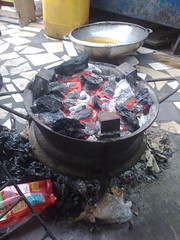
.rim stove in action rim stove charcoal.

Using the steel rim off a car wheel as the basic starting point, three metal legs are wielded to the outside of the rim. Inside, a metal grate is added to the bottom to hold in the coals, and some form of pan or kettle stand is wielded to the top.

I’ve seen several variations on this theme, but the basics are always the same – the Rim Stove burns charcoal that’s been ignited in the middle of the rim, fed by air from the bottom and heating a cooking container sitting either on the pot stand or the coals themselves.

During on extending brainstorming session, I even tried to think of improvements to the Rim Stove – how it might burn hotter with less customization. My only solution? Make sure a Rim Stove is cooking chips for your fresh grilled fish.

Recycling: From diving wetsuit to laptop bag

When Dipesh Pabari of Camps International sent me pictures of these laptop bags and bottle can holders, I just knew it would be something you AfriGadget fans would appreciate.
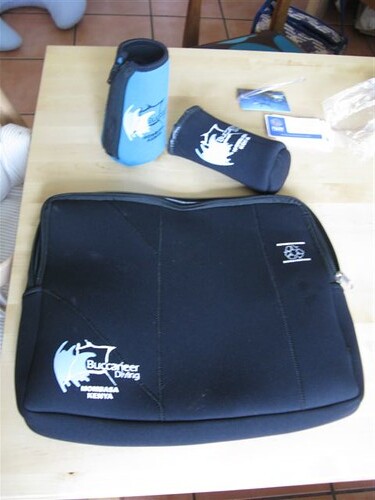
Recycling wetsuits

The fact that discarded waste is converted to something very useful… Its definitely AfriGadget. I asked Sander Den Haring a few questions about these cool products.
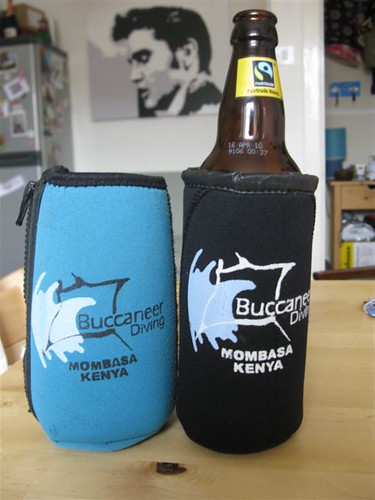
Recycling wetsuits

How did you begin your company?

I was born in a small town called Hellevoetsluis in the Netherlands but only lived there till i was 5. At that point my family moved to Yanbu, Saudi Arabia where i grew up and ended up spending 16 years. Yanbu is an industrial town situated on the Red Sea and i believe that a lot of the what, who, why and where i am is as a result of this. From the very beginning of our time in Yanbu my parents began a weekly outing to the beach which my brother and i eagerly anticipated every Friday (weekend is Thursday and Friday in Saudi Arabia). Once at the beach we would go out and snorkel virgin reefs in the Red Sea and be stunned by the serenity and tranquility each and every time. My love for the aquatic realm and the conservation of said realm has derived from these expeditions. It led me to complete a Masters in Marine Biology from the University of Groningen in the Netherlands in 2000 so that i could work in the field of marine conservation.

In 2004 i moved to Kenya where i have lived ever since. I began work for Buccaneer Diving as a base manager and soon added on the role of resident marine biologist. Under this capacity i was able to instigate a snorkeling program for some of the underprivileged local government schools in Mombasa (Schools to the Sea program) and an artificial reef program in the Mombasa Marine Park. Both these projects had local partners involved as well. I eventually finished full time work with Buccaneer Diving in June 2009 as the Operations Manager of Buccaneer Diving Kenya and currently fulfill only a part-time quality control position within all of Buccaneer Diving (Kenya and Zanzibar).

I really enjoy thinking of ways to create environmental attitudes and the recycled wetsuit product line has been great in achieving this thus far! We are still coming up with new products and refining the existing products. There are no limits barring our creativity.

What was the inspiration for re-using the diving wetsuits?

In the dive industry wetsuits have a finite lifetime after which they become ineffective (have lost their insulating capability), or they become too hole-ridden to use in a professional business. In the past, these wetsuits were discarded. This seemed an obvious waste of material (as for the sake of a few holes, large patches of usable neoprene were being thrown out), so Buccaneer Diving began looking at what could these patches of neoprene be used for. Traditionally we have used smaller bits of neoprene for various “odd jobs” (eg. snorkel holders, buffering/padding material, informal packaging, patch material for other wetsuits), but these “odd jobs” required small amounts that did not need frequent replacement. So we started thinking if there was anything else that could be made and the obvious item was laptop bags. The bottle/can holders soon followed suit as the sleeves and legs of wetsuits already had the obvious shape (they just needed a bottom added). We are currently making the products more of an “item” and also looking into how we can incorporate the production of these products to benefit other charities. these exciting developments will be happening within the next few weeks we hope so definitely watch this space (it’ll be worth it!).

When did you start selling the bags/bottle covers etc?

This is a new venture and its been active for the last seven months, so still very young. We are looking at various other items we can make from the recycled neoprene (placemats and coasters might be possibilities).

How much do the items cost?

Currently the laptop bags sell for Ksh 2500 (about 32 usd) and the bottle/can holders ksh 350 (about 5 usd)

Are they made in Kenya/Mombasa?

They are indeed produced in Mombasa. Again, the story behind the production will unfold in the next few weeks and its worth the wait.

Where can people order? Can they pay by MPESA (Mobile Money)? (Just kidding, but hey!)

These products can be purchased at the Buccaneer Diving base at the Voyager Beach resort, Mombasa. We have not yet explored the use of MPESA in the purchase of these products as they are still young, but who knows what the future will bring. We can also arrange for products to be sent via courier if people are unable to visit the Buccaneer Diving base. Sander can be reached via email sander at green-water [dot] org.

Motorized Bicycles in Nairobi

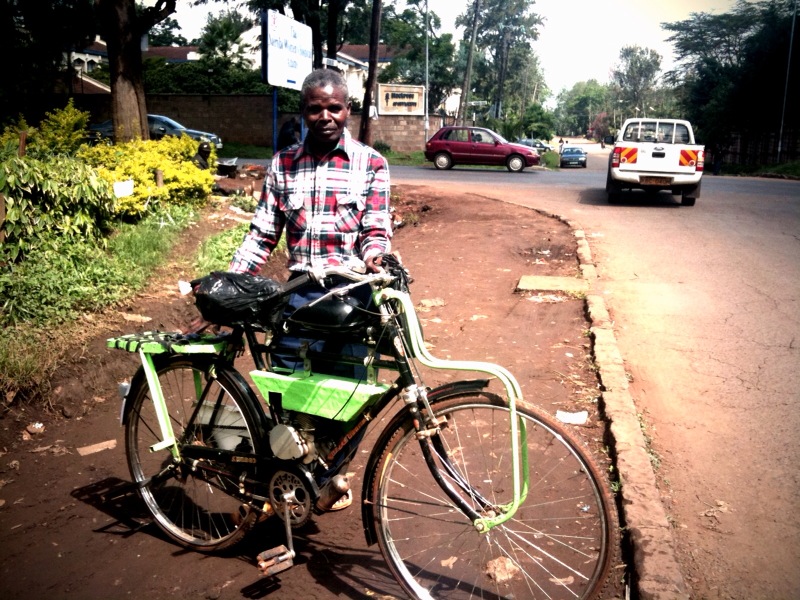
Motorized bicycle in Nairobi

I was driving down a street in Nairobi today and did a double-take when I saw a man standing by a motorized bicycle. One u-turn (of questionable legality) later and I was chatting with Samuel Magethe, a local carpenter who does house calls. Apparently, he usually carries his toolbox and wood supplies on the back of the bicycle, though he didn’t have them with him today. He has used the bike for 2 years and says that it’s a great help to him as he gets older and has problems with the hills.

Motorized Bicycles in Kenya from WhiteAfrican on Vimeo.

I talked with Samuel for a while and found out that he had bought the engine and bicycle in downtown Nairobi. Since I had to go downtown anyway, I decide to hunt out the seller and see if I could get the background story on where the motors come from and the specs on them.

Julius - manager of the downtown branch for Adtec motorcycles

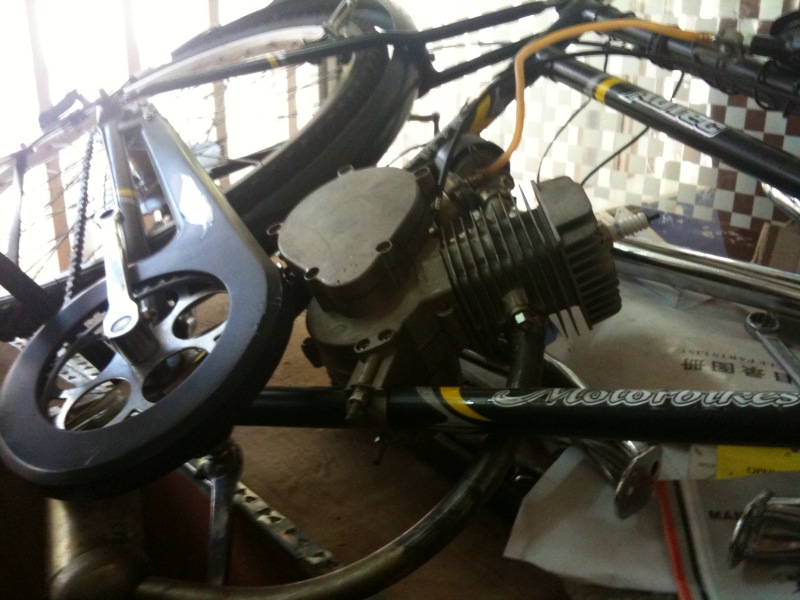
It turns out that the engines, and bicycles, are imported from the ADTEC Corporation in Japan. (As an aside, it appears that Adtec motorcycles are part of the big influx of Asian motorcycles being used as taxis in E. Africa.) It’s a 48cc 2-stroke engine that has a top speed of 40Kph (25mph). The tank can hold 2 litres of fuel and they claim that it gets 70 kilometres per litre.

You can buy the bicycle plus engine for 15,000 Ksh ($200) or just the motor for 10,000 Ksh ($135).

The company that sells them in Kenya, Adventure Technology Company Ltd, has their main office in downtown Nairobi, where they had their last two bikes that weren’t sold. In 2009 they imported 500 bicycles and sold them in their 13 branches across the country. The branch manager, Julius Lumumba, tells me it’s a good business, and they sell very quickly – especially up country in places like Kakamega, Bunguma and Kisumu.

Julius holding up an Adtec motorized bicycle in his shop in downtown Nairobi

Adtec Bicycle Engine

[Note: I forgot my cameras today, so I just had my iPhone to do the pictures/video with, thus the lower-res, sorry.]

Flat parabolic mirror is not an oxymoron!

Can a parabolic mirror be flat? Dominic Wanjihias latest invention may prove that this is the most efficient way of capturing solar energy.
flat parabolic mirror 2

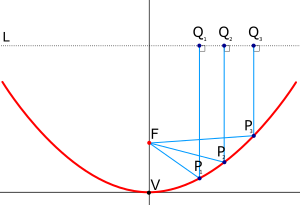
Everyone knows what a parabolic reflector is, right? It’s supposed to be a curved surface that collects energy by converging it towards a focus. Parabolic reflectors were invented a very long time ago and have been used in satellite dishes, spot lights and car headlights to name a few. They are also widely used for alternative energy projects to concentrate solar energy for heating and cooking.

Dominic (designer of the flexible solar vest, the solar dryer, and camel milk cooler for Somalia) thinks that the parabolic mirror should lose it’s shape which is an obstacle, to transportation and function.

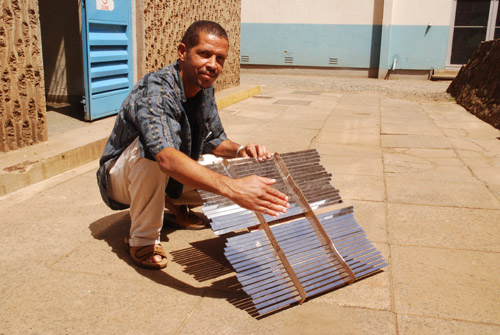
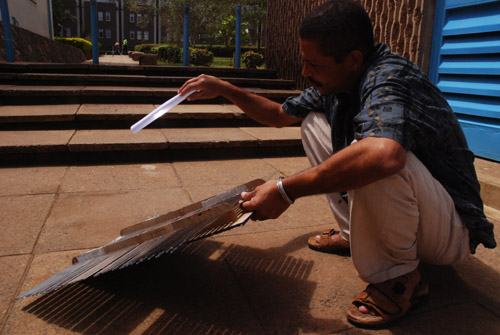
So how does the flat parabolic mirror work? Dominic has cut inch wide 2 foot long pieces of flexible acrylic mirrors and arranged them at specifically computed angles. When angled towards the sun, this creates a perfectly focused beam of light.

flat parabolic mirror

This concentrated energy can be used to heat water in a pipe for numerous purposes including generating electricity. The beauty of this gadget is that

  1. It is very cheap,
  2. It can be quickly dismantled or moved,
  3. It is easily transportable as it can be carried flat or in a tube,
  4. It is easily repaired if broken as the individual mirror pieces can be replaced (rather than having to fix or replace an entire parabolic mirror).

Please note that this is part of Dominic Wanjihia’s ongoing project with Nairobi University and MIT’s FabLab where he is doing a course.

Fab lab sign .