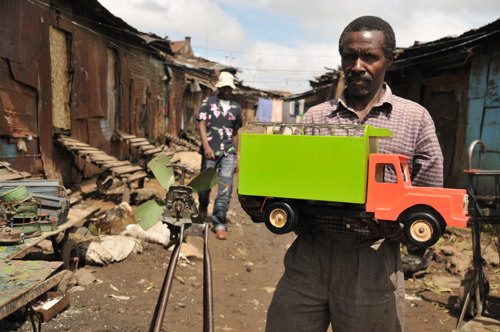
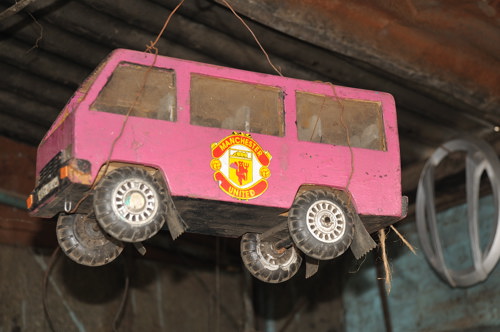
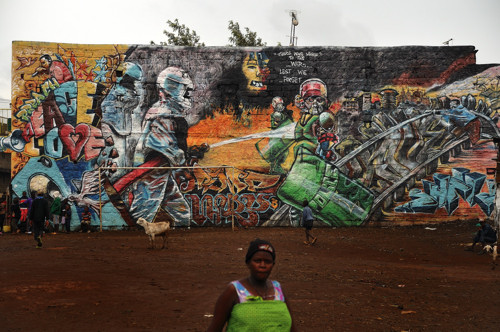
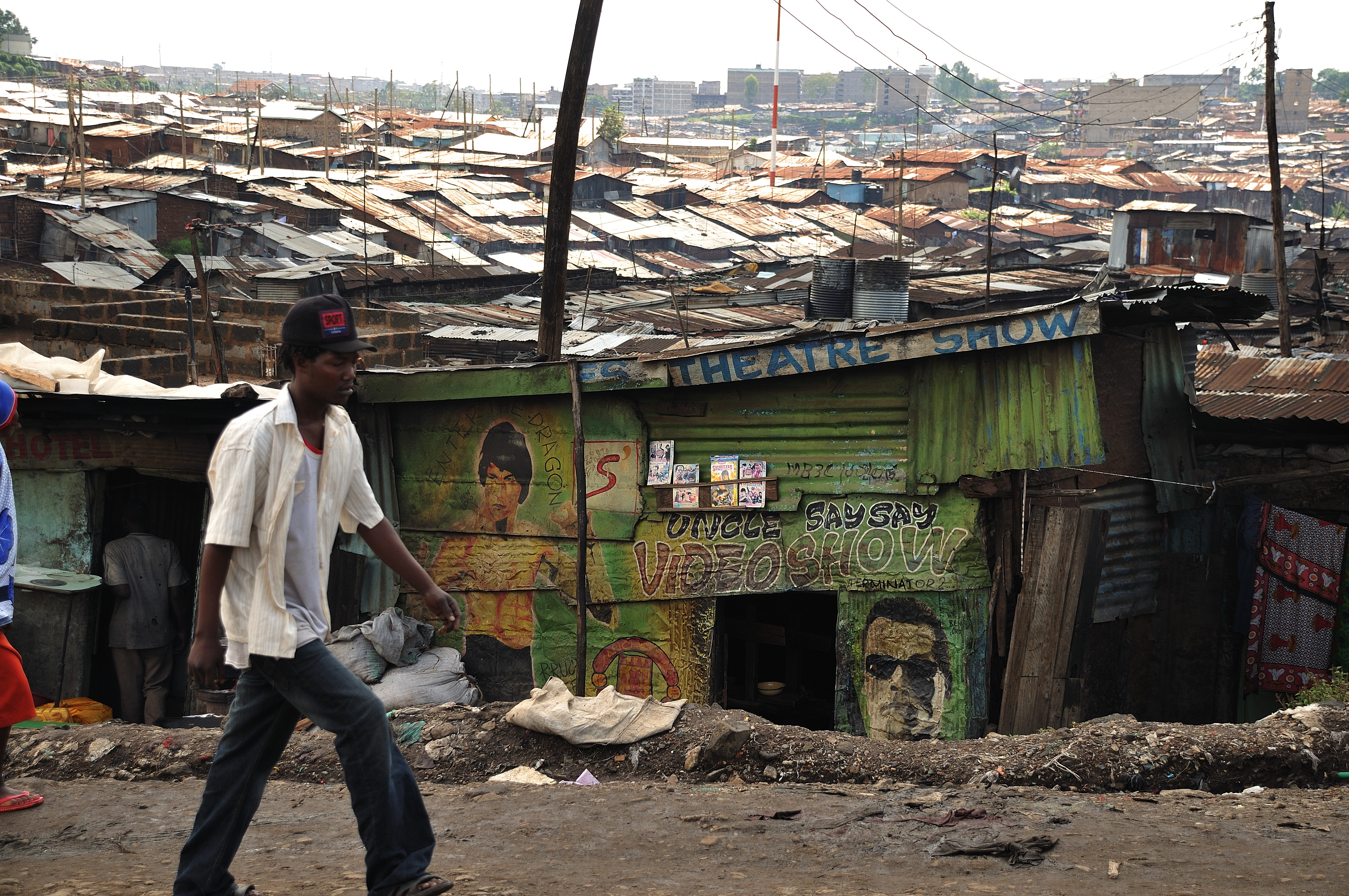
Amid the squalor in one of Kenya’s most depressing slums, there is a surprising amount of flashy colour and fun
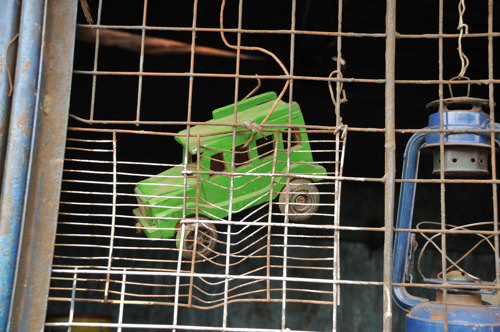
Njuguna makes these toys because he like to! His clients are local people in the slum but he does sell well outside of that market too.
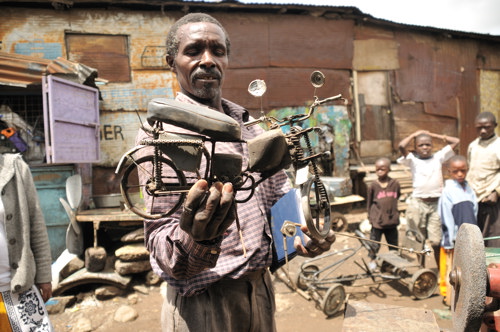
I was especially enthralled by this scrap metal motorbike but the price was Ksh 2,500 (US$ 30) which may have been a special price for visitors like me – I couldn’t afford it!
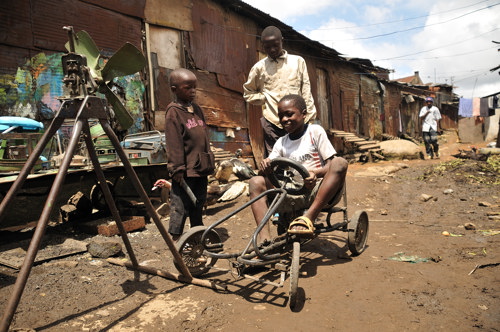
Scrap metal gocart – boys in heaven!
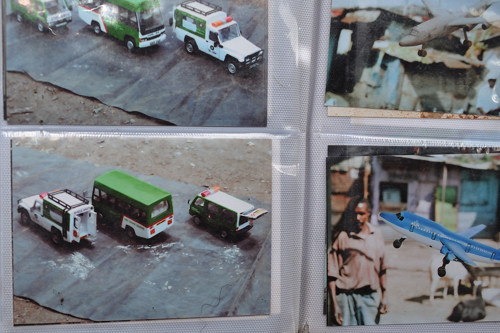
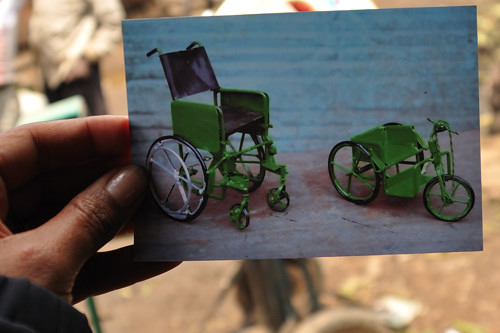
Njuguna also makes beautiful micro toys for a specialist corporate market – they had been sold but he had photos
You guessed it – client was Safaricom!
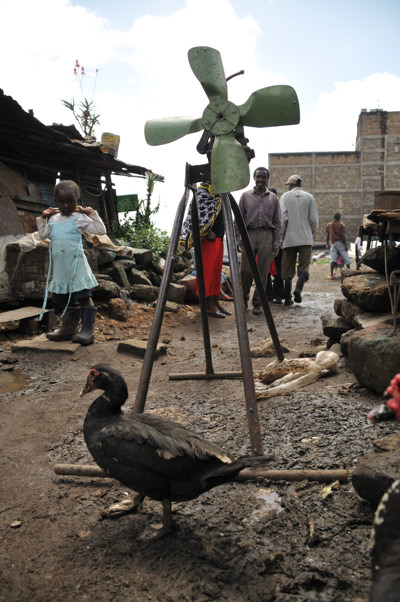
Amongst all the toys were some other serious gadgets that Njuguna had put together for no specific reason -a couple of free standing windmills rotate rapidly in the narrow streets that channel the wind. They stand there like artistic monuments, but Njuguna told me that he made these constructions made from parts taken from broken cars and had put them out and was waiting for an idea to strike him regarding what to apply them to. He called it his research experiment. … somewhere else lay another of his inventions, a waterpump …..(should I have suggested something?)
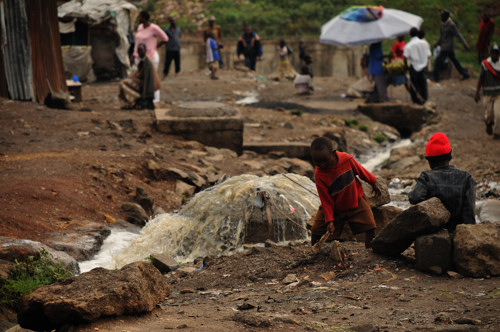
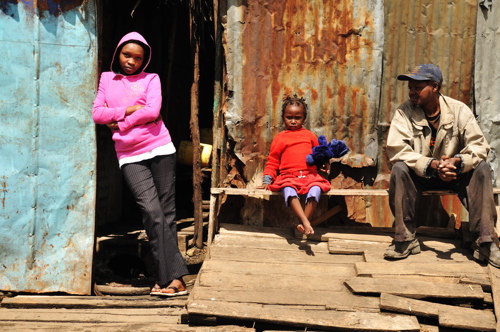
Kids play by open sewer in Mathare Valley
Visiting Kibera was disturbing in so many ways
,
….and yet it was thoroughly invigorating and inspiring – a pleasant surprise . If you ever get a chance, do visit and seek out the Njuguna’s tucked away in narrow streets. These brilliant artists and innovators might live in what seems like the worst hell on earth, yet somehow it feels like they choose to.
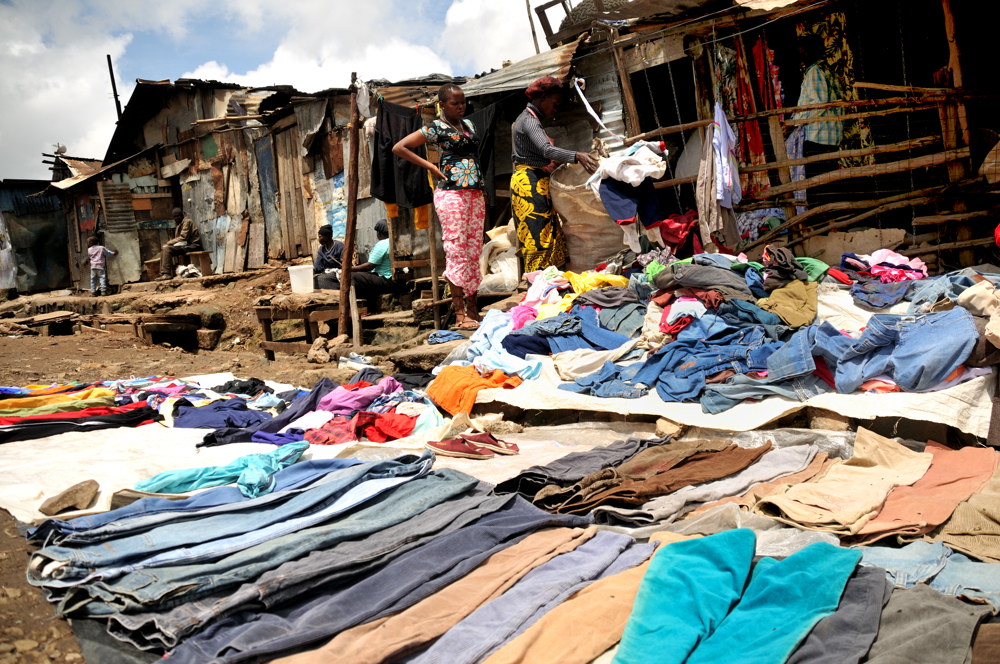
If your dream was to become a doctor and you ended up uneducated and living in a slum, would you just give up on life? Some of us might have, but not Jane Ngoiri. Jane dreamed of being a surgeon, but she was too poor to finish school or go to college. However, today Jane is a Mitumba queen from Nairobi’s Mathare Valley slum. Mitumba is the business of selling second hand clothing that arrives in Kenya from European and American regions in massive bales.
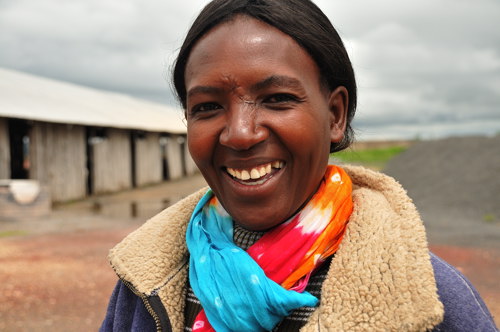
Mitumba trader in Mathare Valley
Mitumba originally referred to used clothing but today it includes everything from clothes to shoes, bags and even kitchen utensils. Huge markets have sprouted in Nairobi where the traders buy selected items when bales are first opened, and sell them in nicely arranged stalls elsewhere. It’s easy to see how mitumba provides hundreds of jobs for the juakali but everyone is doing it and the competition is intense so prices and profits are low. Jane came up with a clever way of getting past this by finding a unique niche. Unlike most Mitumba operators who simply sell second hand clothing, Jane adds value by taking the clothes apart and re-making clothing that Kenyans want for their children, especially daughters.
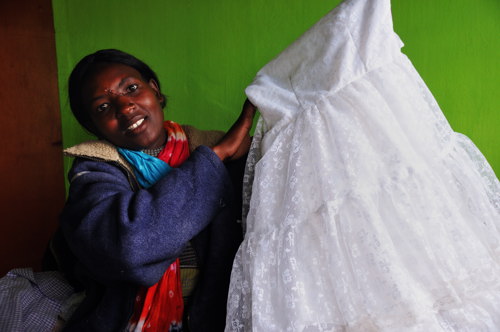
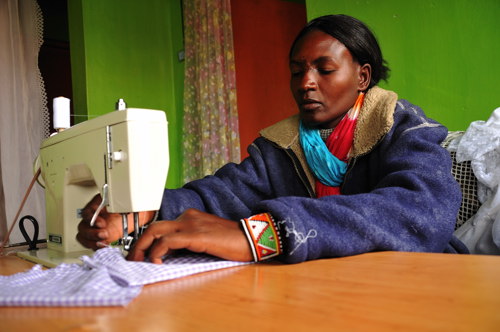
Her specialty is girls dresses, frilly, lacy dresses for special occasions, and Sunday bests. You would never find this kind of thing in Mitumba – western kids don’t wear this kind of thing. Jane buys used wedding dresses for Ksh 500 (USD 7) and from each one she can create three girls dresses and sell each for Ksh 1,500 (USD 21).
It takes her only 45 minutes to sew each one and she can make and sell up to 40 per month making a tidy profit which has literally allowed her to climb out of poverty.
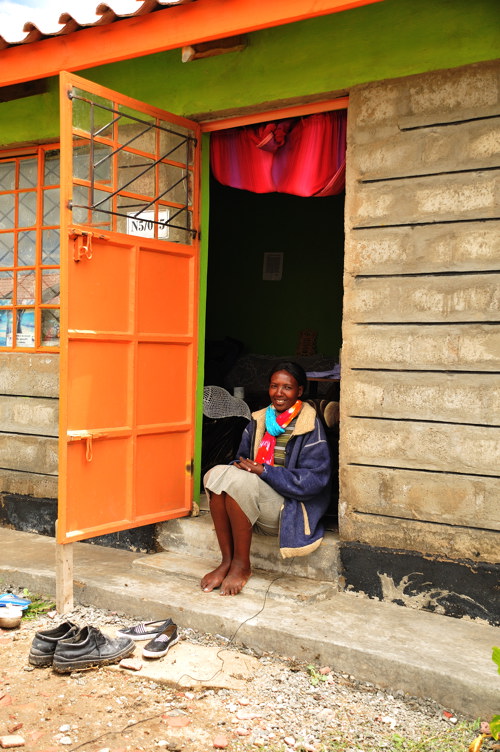
Janes may not be the slumb dog millionaire but her story of escaping a slum life is humbling. I went to see Jane at home – she now owns her very own two bedroom orange and green house in a new housing development just outside of the city. She has running water, sitting room, a huge kitchen with gas stove, an inside flush toilet and solar lighting.
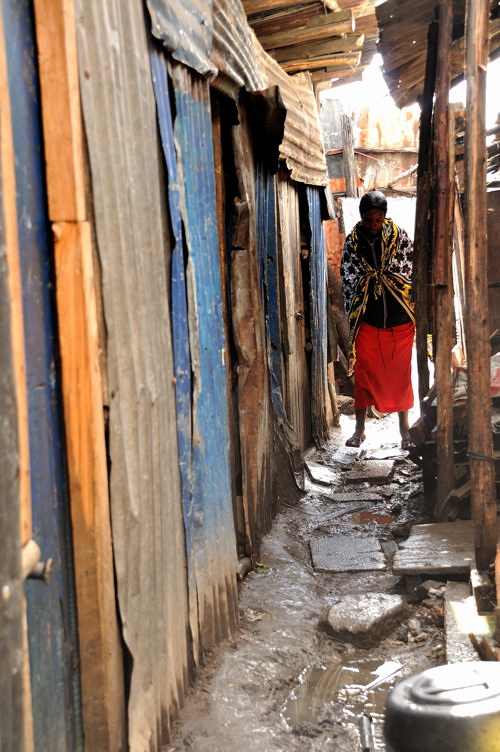
I visited her former home I n the slum, It’s hard to imagine how anyone could live in a room six foot by five, with just one bed. The mud floor was covered with a plastic mat but the water in the saturated ground seeped through.
Outside might have been disgusting, but inside the the corrugated iron room was but super neat and carefully arranged. On the bed sat the new tenant, 34 year old Catherine with her two daughters Cynthia (17) and Samantha (3). Her 12 year old son was out. To her right was someone else’s room , and to the left a changaa den (changaa is an illegal distilled alcoholic brew). Behind her were three other rooms.
The room measured about 6 x 6 feet – a prison cell! It was slimy and muddy everywhere, the evil sewage and rotting vegetable smells and the ugly structures were not nearly as invasive as the, noise. It seemed like everyone in Mathare was competing to make the loudest noise, – every room had a radio on full blast as well as the changaa brewing and drinking dens which nearly outnumber homes. Drunkards (all men) filled the street, and pestered us every few minutes, the community just ignored them as they stumbled down the hill. Children, some without shoes ran around and played in the mud, open sewers and picked through rubbish. After seeing where Jane has come from I can totally understand why she can’t stop smiling.
Her three children are no longer surrounded by filth and noise, changaa dens and drunkards. They play out doors safely, are clean and neat, and they go to school near home. This family eats well as they grow their own vegetables in a garden kitchen. And Jane is no longer just one of the million slum dwellers in Mathare, here in Kaputei, she is a respected member of a budding community.
Janes life story is nothing short of miraculous. Like everyone else in Mathare, she lived in the slum because she had no other option. When her husband took a second wife so many years ago, she walked out on him and headed for the city, four children in tow, including a baby. She thought she’d be able to get a job, but like many uneducated women her only means of survival in one of Nairobi’s toughest slums, was to use her body. That’s how she survived for many years, doing what she called “dirty business” living from hand to mouth in the filthy, noisy, congested squalor of Mathare Valley, with all her children crammed in one room.
Jane is the poster child of microcredit success, it got her out of poverty and she says it saves her life. She got training and a loan from Jamibora, one of the largest micro credit banks in Kenya. Once she’d paid that back she got another loan, and then a third. This made her eligible for membership in a housing scheme, but first she had to rise 10% of the value of the house, Ksh35,000 ($450). With her earlier loans she had bought a manual sewing machine, using that she made dresses and beaded jewelry for an international market. It sounds easy but she says it was very hard to raise the money. There were hurdles along the way and at times she almost gave up her dream. Perhaps the toughest was the election crisis struck in early 2008 when looters raided the slums and took everything she owned. Without a sewing machine she had lost her means of making a living.
So Jamibora gave her an emergency loan which enabled her to get back on her feet straight away. Sitting in her proud two bedroomed house in Kaputei Jane glows, it’s hard to disbelieve her story. But there’s more. She wouldn’t let me go until I’d heard the whole story. After getting back her life the first time, Jane decided to find out what her HIV status was. Not surprising, it was positive. Despite this she was in good health, but again she asked God to help – she needs to live long enough to pay off the 20 year loan. She promised to help other slum women by giving free lessons in sewing, after all she never paid for her own classes. So far Jane has taught three others including Catherine.
Are you inspired? Here’s a question, can you guess why Jane painted her house orange and green?
My good friend Jagi Gakunju who runs the Kenyan environmental cyclists club Uvumbuzi club told me about this project which immediately caught my attention. It’s a collaboration with Africans and a Dutch organization.
You can read all about Cycling Blue in Kisumu on their Cycling Blue blog
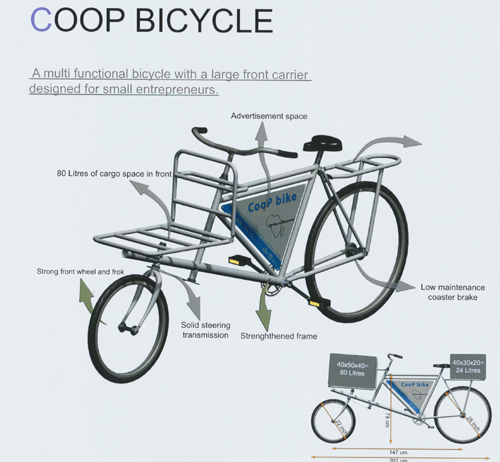
The Cycling Blue Kenya workshop is providing courses, micro credit for (modified) bicycles and creating of employment, it is aimed to reduce poverty. In the workshop bicycles will be modified to create bicycle carts (for instance bicycle ambulances) for sale. Who buys them? Garbage collectors, local entrepreneurs who want a (modified) bicycle to generate income such as the Cool coolbox, bicycles with extended carriers for transport of cabbages.
Here’s what they are cooking at the moment in Kisumu
The idea that bicycles in Africa get modified and adapted for local uses is definitely 100% afrigadget.
Our friend Bill Zimmerman, a technologist who runs a startup un-incubator called LimbeLabs in Cameroon, posted this interesting story on his blog about a teacher who makes an extra income by fabricating gadgets out of Bamboo.
Avid readers may remember the Bamboo Bike project, so the idea of using Bamboo as an alternative and sustainable material isn’t that far fetched. In fact, we’re glad that someone took the initiative and ventured into this field with so many different products at the same time. Bamboo Magic, really. Make sure not to miss out the video!
“I had an opportunity to stop by the 2009 South West Regional Agro-Pastoral Show, an annual exhibition for local farmers and craftsmen, here in Limbe this afternoon. The event was held on a community field ringed by exhibition booths overflowing with every imaginable vegetable, fruit and live animal cultivated and raised in the southwest region of Cameroon. In addition, there were a number of innovators with homemade products and gadgets crafted from local materials.
Amid all the displays, one guy stood apart with some creations that can only be described as a near perfect marriage of form, function, green design and a borderline obsession with bamboo. Lekuama Ketuafor is the proprietor of Bamboo Magic, a one-man cottage industry he’s started to supplement his work as a teacher.
Using a set of simple hand tools, glue, varnish, skill and loads of patience, Lekuama finds ways of using bamboo—a ubiquitous, low-cost, renewable material—in ways many people have never imagined. Judging from the size of the crowd gathered around his booth, I suspect few Cameroonians had seen anything quite like Lekuama’s creations before.
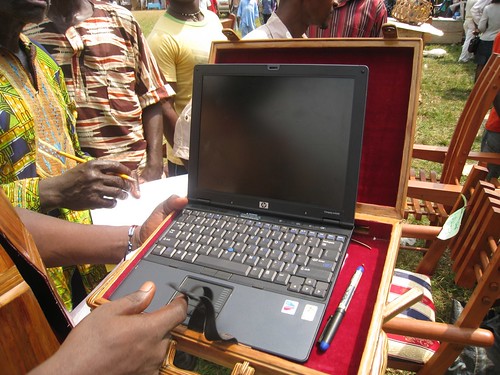
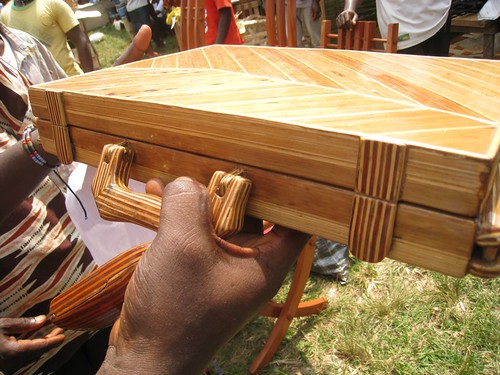
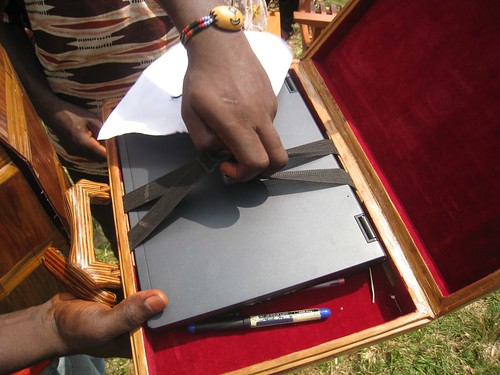
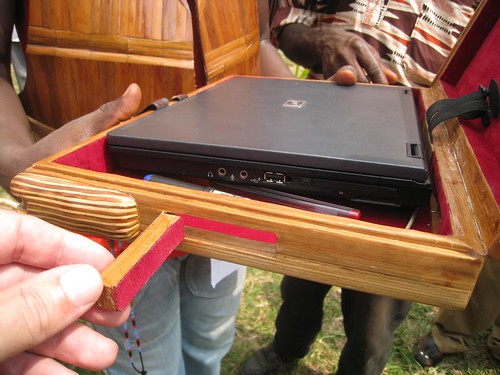
Among the intricately decorated bamboo shoes [2], vest, palm wine calabash, cowboy hat, clocks and so on, I was immediately attracted to two incredibly cool electronics-related pieces: a bamboo covered Nokia phone and an attractive and functional laptop case. Here’s a video of Lekuama, dressed appropriately in head-to-toe bamboo wear, demonstrating these items:
The attention to detail on the laptop case is impressive, right down to the external USB port access, shoulder strap attachments, carry handle, magnetic clasps, internal elastic keeper strap and red felt lining. And how about that chic mobile phone?
Due to the time intensive nature of his craft, Lekuama makes these items for sale in very small quantities. However, his dream is to establish a training center where he can transfer his skills to young Cameroonians and build a community of artisan microentrepreneurs.”
Obviously, agricultural shows in Africa are a great resource for AfriGadgets.
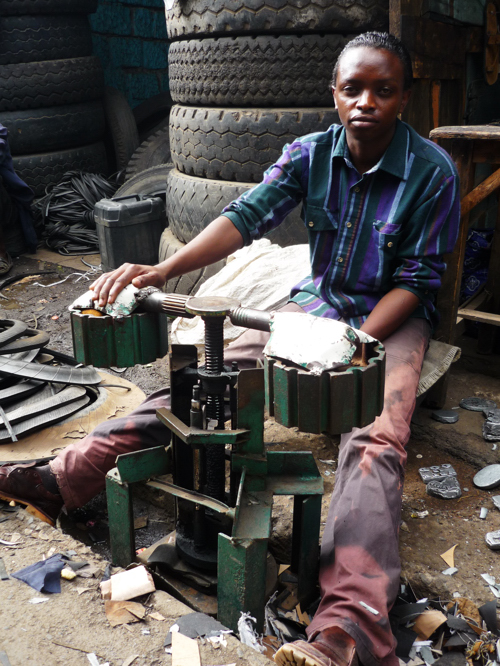
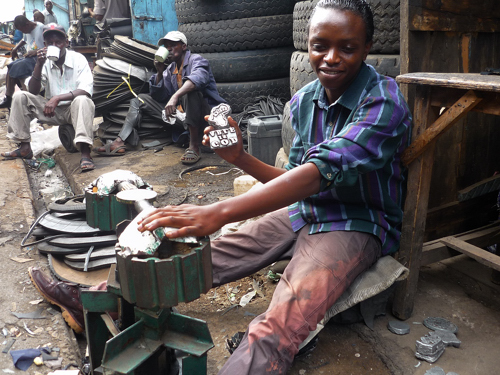
Deep in Kariokor, a slum and a hub of Nairobi’s juakali leather industry, you can’t miss spotting Drogba hard at work at his home made leather press.
Drogba at work
Drogba’s leather press is an assembly of diverse components.
The fly wheels are made up of two used conveyor pulleys full of concrete. These are joined together by two used second hand vehicle half shafts.
The half shafts are connected to an old bench vice screw (hope you are singing along here)
The screw is connected to a press foot
(all together now) “Oh hear the world of the lord” (tune of the kids song Dry Bones)
The print plates are placed on the base of the press frame.
God is able - so is Drogba!
When Drogba spins the fly wheels, he sandwiches the leather between the press plate and press foot producing perfect permanent imprints in the leather
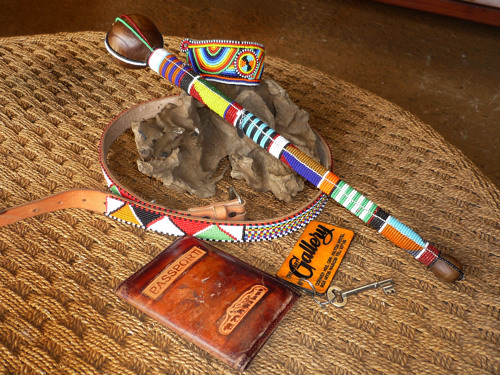
This method is used for most of Kenya’s printed leather products, a huge industry that includes Maasai beaded belts, menu covers, wallets, passport holders, belts, key holders, coasters, handbags, purses, and many fashion accessories and leather souvenir products.
Drogba is 18 years old and works a good 12 hours per day on a casual wage. He has just completed high school and is looking for a college placement. As you can imagine, he’s a huge fan of his soccer celebrity lookalike and namesake.
(special thanks to Dominic Wanjihia for this contribution)
We use cookies on our website to give you the most relevant experience by remembering your preferences and repeat visits. By clicking “Accept”, you consent to the use of ALL the cookies.
This website uses cookies to improve your experience while you navigate through the website. Out of these, the cookies that are categorized as necessary are stored on your browser as they are essential for the working of basic functionalities of the website. We also use third-party cookies that help us analyze and understand how you use this website. These cookies will be stored in your browser only with your consent. You also have the option to opt-out of these cookies. But opting out of some of these cookies may affect your browsing experience.
Necessary cookies are absolutely essential for the website to function properly. This category only includes cookies that ensures basic functionalities and security features of the website. These cookies do not store any personal information.
Any cookies that may not be particularly necessary for the website to function and is used specifically to collect user personal data via analytics, ads, other embedded contents are termed as non-necessary cookies. It is mandatory to procure user consent prior to running these cookies on your website.